
Chef Klaus
Apfelmus
The apple-harvest preserve of the German kitchen, cooked low until the fruit collapses, then kept smooth, tart, and ready for potato pancakes or warm Mehlspeisen.
A cooking platform built around craft, culture, and the stories behind what we eat.
Created by
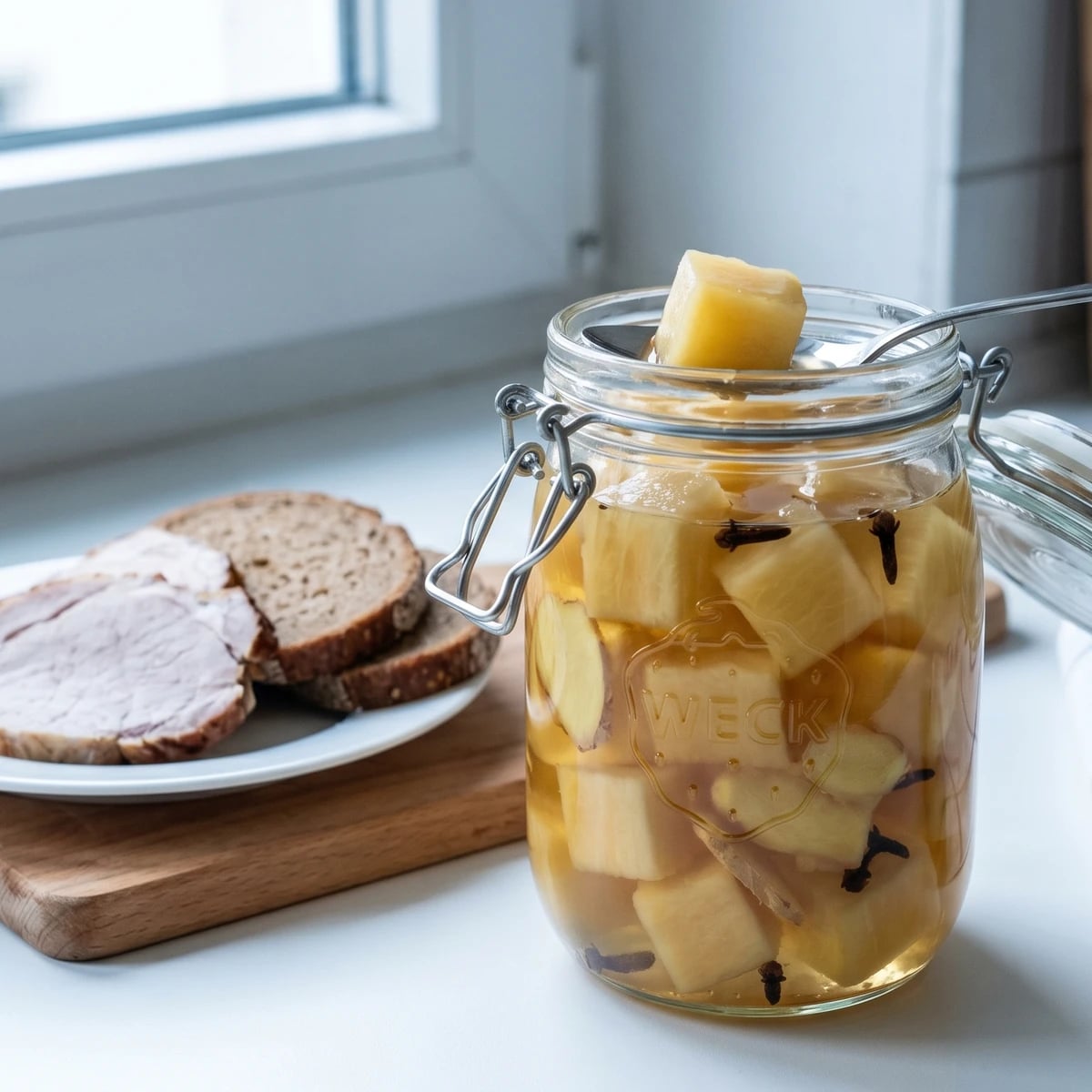
The Franconian autumn pickle that belongs beside cold roast, rye bread, and sausage: pumpkin cubes kept firm in sharp-sweet vinegar syrup, not boiled into mush.
Eingelegter Kürbis süß-sauer is autumn in the preserving pot, strongest in Franconia, where the pumpkin is cubed, steeped, and put up for the winter board. You eat it beside cold pork, sausages, rye bread, or a simple supper of potatoes and quark. It isn't dessert, though the syrup is sweet. It is the bright thing on the plate when the season has shut.
Every region pulls it a little differently. In Franconia you often meet ginger, clove, and sometimes cinnamon, warm but not loud. Further north the pickle can run sharper, closer to the vinegar larder; in the south some cooks lean sweeter and serve it almost like fruit with game or roast pork. Im Norden anders, im Süden anders. German food has no single national jar.
The technique that decides the dish is the overnight salt and vinegar steep before the syrup boil. The acid firms the pumpkin flesh and seasons it to the middle, so the cubes hold their edges when they meet the hot syrup. Skip that and you don't get pickle. You get sweet pumpkin compote with opinions.
Use a firm pumpkin, keep the cubes even, and cook them only until glassy at the edges with a pale gold center. The jars do the rest while they sit. Das braucht seine Zeit. Nicht aus dem Glas, unless it is your glass.
Sweet-sour pumpkin pickles became common in German household preserving in the nineteenth and early twentieth centuries, when American garden pumpkins had settled into central European kitchen gardens and sugar became affordable enough for winter preserves beyond the wealthy table. Franconia kept a strong version with ginger, clove, and vinegar, often served with cold meats or roast leftovers, which ties it to the same thrift table as cucumbers, beets, and mixed pickles. The surprising fact is that pumpkin was not an old medieval German staple; it arrived after the Columbian exchange, then found its real place in the larder jar.
Quantity
1.5kg
peeled, seeded, and cut into 2cm cubes
Quantity
25g
Quantity
500ml
Quantity
300ml
Quantity
500g
Quantity
40g
peeled and sliced
Quantity
8
Quantity
1 small
Quantity
2 strips
from an unwaxed lemon
Quantity
2 tablespoons
| Ingredient | Quantity |
|---|---|
| firm pumpkin or winter squashpeeled, seeded, and cut into 2cm cubes | 1.5kg |
| fine sea salt | 25g |
| white wine vinegar, 5% acidity | 500ml |
| water | 300ml |
| sugar | 500g |
| fresh gingerpeeled and sliced | 40g |
| whole cloves | 8 |
| cinnamon stick | 1 small |
| lemon zestfrom an unwaxed lemon | 2 strips |
| lemon juice | 2 tablespoons |
Use a firm pumpkin or winter squash, not a watery carving pumpkin. Hokkaido works if the skin is tender, but butternut or Muskatkürbis gives cleaner cubes. Cut everything to about 2cm so the pieces take the vinegar at the same speed; mixed sizes mean half the jar is firm and half has collapsed.
Toss the pumpkin cubes with the salt in a glass or ceramic bowl, cover, and leave 2 hours. The salt pulls out surface water, so the vinegar can move in instead of skidding off a wet cube. Add 250ml of the vinegar, toss again, cover, and refrigerate overnight.
Drain the pumpkin and discard the salty vinegar. Put the remaining 250ml vinegar, the water, sugar, ginger, cloves, cinnamon, lemon zest, and lemon juice in a preserving pan. Bring it to a boil and simmer 5 minutes so the sugar dissolves fully and the spices open into the syrup. Keep the boil modest; a hard boil throws off vinegar, and the acid is what keeps the jar honest.
Add the pumpkin cubes to the syrup and simmer gently for 8 to 12 minutes, turning them once or twice, until the edges look glassy and the center is still pale gold. Do not chase softness. The cubes keep cooking a little in the jar, and soft now means mush later. Runter mit der Temperatur, down with the temperature.
Lift the pumpkin into hot sterilised jars, packing it without crushing it. Bring the syrup back to a full boil, then pour it over the cubes to cover them by at least 1cm. Divide the ginger and spices between the jars if you like a stronger spice note, or leave some behind for a cleaner pickle. Wipe the rims, seal with clean lids, and work neatly; sticky rims are where seals fail.
For shelf storage, process the closed jars in a boiling-water bath for 10 minutes, with the jars covered by at least 2cm of water. Lift them out and leave them still until cold, because moving hot jars can break a seal before it sets. Any jar that does not seal goes into the refrigerator. Let sealed jars stand at least one week before eating, better two, so the vinegar, sugar, and spice move all the way through the pumpkin.
1 serving (about 520g)
Culinary guides, cultural storytelling, and the editorial depth that makes cooking meaningful.
Discover Culinary Explorer
Chef Klaus
The apple-harvest preserve of the German kitchen, cooked low until the fruit collapses, then kept smooth, tart, and ready for potato pancakes or warm Mehlspeisen.

Chef Klaus
The northern marinated herring that belongs to the cold larder: salt fish, vinegar, onion, and time doing the work before bread or potatoes ever reach the table.

Chef Klaus
The ruby pickle of the German winter larder: boiled beetroot sliced into spiced vinegar, sharp enough for herring, mild enough for a Sunday Brotzeit.

Chef Klaus
The thrift spread of the Schlachtfest table: pork fat rendered slowly until the cracklings turn crisp, then folded with onion and apple for dark bread.