Culinary Explorer

A cooking platform built around craft, culture, and the stories behind what we eat.
Discover Culinary Explorer
Sopa de Tichinda de Chacahua

Sopa de Tichinda de Chacahua

Created by

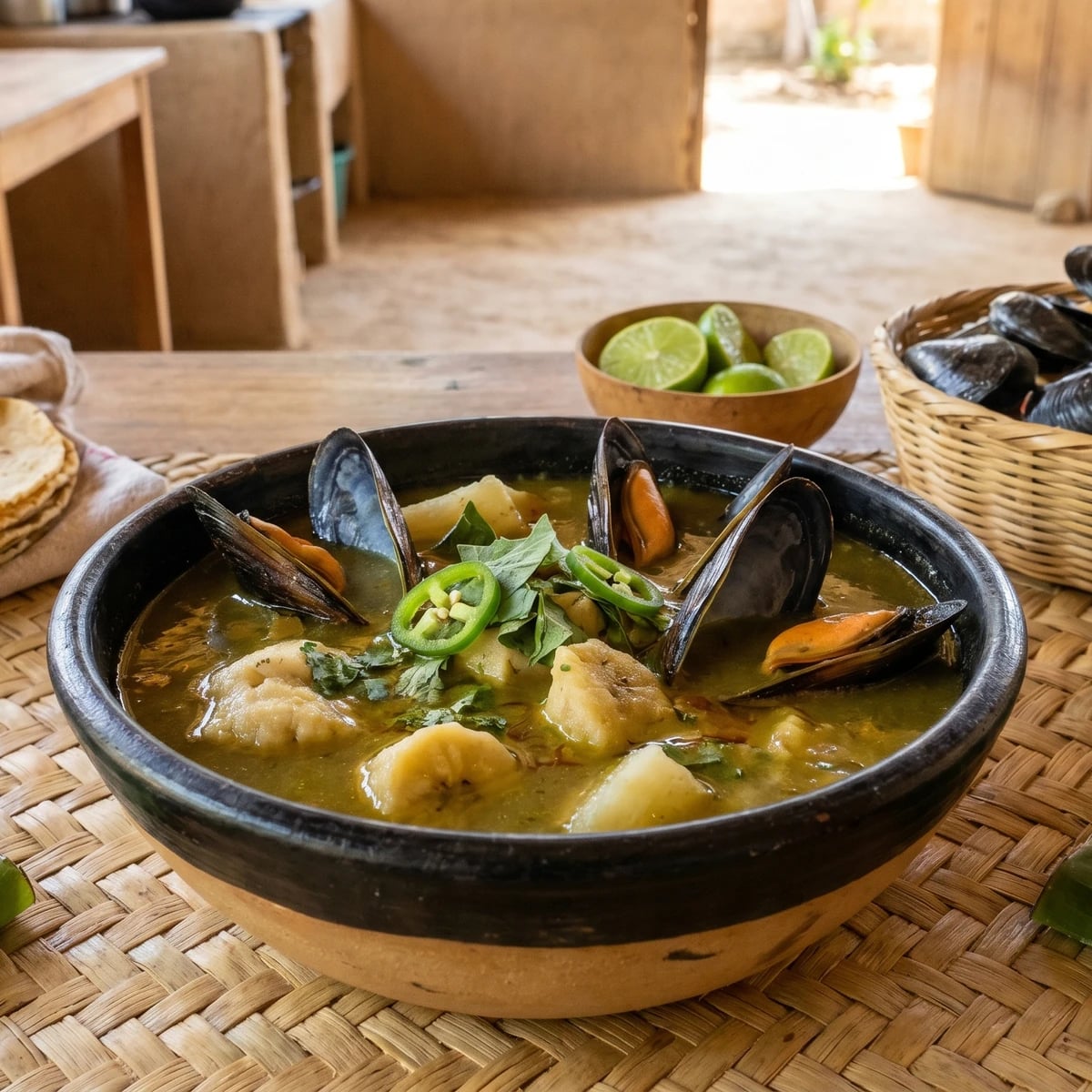
Costa Chica Oaxaca's black-shell tichinda soup from Chacahua, a green broth of epazote, hoja santa, chile costeño, yuca, plátano macho, and masa chochoyotes, built for the table after a dawn mangrove pull.

Soups & Stews
Mexican
Special Occasion
Comfort Food
One Pot
1 hr
Active Time
50 min cook1 hr 50 min total
Yield6 servings

Oaxaca, Costa Chica, Laguna de Chacahua. This soup belongs to the Afro-Mexican corridor of Costa Chica Oaxaca, where Chacahua, Corralero, and Pinotepa look toward the Pacific and the mangrove feeds the pot. The women who make it know the lagoon before they know the stove; they know which roots hold tichindas and which morning water gives clean shells. Pregúntale a las señoras del mercado.

Tichindas are black-shell mangrove mussels. Not generic mussels. They are pulled from the roots at dawn, scrubbed until the mud gives up, opened just enough to save their liquor, then folded back into a broth that tastes like lagoon, chile, and green herbs. If you use ordinary mussels, say the truth: it is a compromise.

The broth is green from tomatillo, hoja santa, and epazote. The chile costeño brings the coast. A little guajillo gives body without stealing the color. Yuca and plátano macho make the soup eat like a meal, and the chochoyotes, small masa dumplings with a thumbprint in the center, hold the broth the way the women of the coast designed them to. La manteca es el sabor, even in a seafood soup, because the sauce must be fried before it becomes serious.

My mother did not make this in Colonia Roma; she was from Jalisco. I learned this one in Chacahua, standing near a pot set on a low fire while the cook corrected my hand on the masa. This is not food from a single Mexico. This is a 32-state cuisine, and Costa Chica Oaxaca has its own voice. Cada estado, su propia cocina.

Tichinda is the coastal Oaxacan name for small black-shell mussels that attach to mangrove roots in lagoon systems such as Chacahua and Corralero, where Afro-Mexican and Indigenous cooks have long used the shellfish liquor as the base of soups and moles. The Costa Chica is a corridor shared by Oaxaca and Guerrero, with Chacahua and Pinotepa on the Oaxacan side and Cuajinicuilapa on the Guerrero side; its kitchen carries maize, chile, plantain, yuca, herbs, and seafood through an Afro-Indigenous history often erased from national cooking narratives. Mexico recognized Afro-Mexican communities in Article 2 of the Constitution through a 2019 amendment, and the 2020 census made that third root visible in national data, which is why naming Chacahua and Costa Chica Oaxaca is not a courtesy, it is correction.

The technique, the tradition, and the story behind every dish.

Discover Culinary Explorer

Ingredients

live tichindas (black-shell mangrove mussels)

Quantity

3 pounds

scrubbed in several changes of cold water

coarse sea salt

Quantity

1 tablespoon

for the cleaning water

water

Quantity

8 cups, divided

plus more as needed

fresh nixtamal masa

Quantity

1 1/2 cups

for chochoyotes

pork lard (manteca de cerdo)

Quantity

3 tablespoons

divided

kosher salt

Quantity

2 teaspoons

divided, plus more to taste

dried chile costeño amarillo

Quantity

3

stemmed and wiped clean

dried chile guajillo

Quantity

1

stemmed and seeded

tomatillos

Quantity

1 pound

husked and rinsed

white onion

Quantity

1/2 medium

garlic cloves

Quantity

5

unpeeled

fresh chile costeño verde

Quantity

2

stemmed

hoja santa leaf

Quantity

1 large

thick center rib removed and leaf torn

fresh epazote

Quantity

4 sprigs

yuca

Quantity

10 ounces

peeled, woody core removed, cut into 1-inch chunks

firm green plátano macho

Quantity

1

peeled and cut into thick half-moons

lime halves (optional)

Quantity

for serving

warm hand-pressed corn tortillas (optional)

Quantity

for serving

Equipment Needed

  • Wide 6-quart glazed clay cazuela or heavy peltre pot
  • Stiff shellfish brush
  • Dry comal for chiles and vegetables
  • Blender
  • Fine-mesh strainer lined with manta de cielo or cheesecloth
  • Deep black-and-tan clay bowls from Pinotepa or Cuajinicuilapa

Instructions

  1. 1

    Clean the tichindas

    Put the tichindas in a basin of cold water with the coarse sea salt for 20 minutes while you scrub each shell with a stiff brush. Change the water until it runs mostly clear. Pull away any root fibers or beards. Discard cracked shells and any open shell that does not close when tapped. This is not fussiness. Lagoon mud is real, and bad shellfish does not become safe because the broth tastes good.

  2. 2

    Open the shells

    Place the cleaned tichindas in a wide pot with 3 cups of the water. Cover and cook over medium-high heat for 4 to 6 minutes, shaking the pot once, until the shells open. Lift the opened shells into a bowl. Discard any that stay closed. Strain the shellfish liquor through a damp cloth or fine strainer into a measuring cup. Add enough water to make 8 cups total liquid. Rinse the pot.

    Do not pry open a closed shell and talk yourself into using it. The shellfish tells you when it is safe enough for the pot.
  3. 3

    Shape the chochoyotes

    Mix the masa with 1 tablespoon of the lard and 1/2 teaspoon of the salt. Knead until smooth and soft, adding a spoonful of warm water only if the masa cracks. Roll into 24 to 30 small balls. Press your thumb into the center of each one to make a deep dimple. Cover with a damp towel. The thumbprint is not decoration; it catches broth and helps the masa cook evenly.

  4. 4

    Toast and roast

    Heat a dry comal over medium. Toast the dried chile costeño and guajillo separately, 10 to 20 seconds per side, just until they smell deep and the skins flex. Do not blacken them. Put them in a bowl and cover with hot water for 15 minutes. On the same comal, roast the tomatillos, onion, garlic, and fresh chile costeño until the tomatillos slump and the onion has dark spots. Peel the garlic.

    Chile costeño burns fast. If it turns black, throw it out. Burned chile gives bitterness to the whole pot.
  5. 5

    Blend the base

    Drain the soaked chiles. Blend them with the roasted tomatillos, onion, peeled garlic, fresh chile costeño, torn hoja santa, and 1 cup of the reserved tichinda liquor until smooth. The sauce should be green with a shadow of gold from the chiles. Do not add tomato. This is Chacahua's green broth, not a red seafood caldo.

  6. 6

    Fry the sauce

    Melt the remaining 2 tablespoons lard in the clean pot over medium heat. Pour in the blended base. It will sputter. Stir for 8 to 10 minutes, until the green darkens, the raw tomatillo smell softens, and the fat shines around the edges. This is where a blended sauce becomes soup. Skip the frying and it tastes thin. No me vengas con atajos.

  7. 7

    Simmer the roots

    Pour in the reserved tichinda liquor and water. Add the epazote sprigs and 1 teaspoon salt. Bring to a steady simmer. Add the yuca and cook for 10 minutes. Add the plátano macho and cook 12 to 15 minutes more, until the yuca gives when pierced and the plantain edges soften. The broth should taste briny, herbal, and lightly thick from the fried sauce.

  8. 8

    Cook the chochoyotes

    Drop the chochoyotes into the simmering broth one at a time so they do not stick together. Cook 12 to 15 minutes, until they float and the masa changes from raw pale to set. The dimples will hold little pools of green broth. That is the point. Masa thickens honestly. Flour does not belong in this pot.

  9. 9

    Return the tichindas

    Slide the opened tichindas, still in their shells, back into the pot with any juices collected in the bowl. Simmer gently for 2 to 3 minutes, just to warm them through and let their brine settle into the broth. Do not boil hard now. Shellfish tightens when you bully it. Taste for salt and remove the epazote stems.

  10. 10

    Serve in clay

    Ladle the soup into deep black-and-tan clay bowls from Pinotepa or Cuajinicuilapa if you have them. Each bowl should get tichindas in shell, yuca, plátano macho, and chochoyotes. Serve lime halves and warm corn tortillas at the table. The bowl should look like the lagoon gave you dinner. Recetas probadas y garantizadas.

Chef Tips

  • Tichindas are black-shell mangrove mussels from Laguna de Chacahua and Corralero. If you're not cooking with someone who knows those waters, do not forage shellfish from unmonitored lagoons. Red tide, sewage, and warm-water toxins are not things you fix with lime. Buy live shellfish from a trusted fishmonger and call it a compromise.
  • Chile costeño amarillo is the chile I want here. Outside Oaxaca it can be hard to find. Ask Oaxacan vendors, online Mexican spice sellers, or the señoras at the market before you settle for chile de arbol. If you cannot find fresh chile costeño verde, use serrano for the fresh heat, but keep the dried costeño. Lose both and the soup loses its coast.
  • No canned broth, no powdered chile mixes, no sour cream, no cheddar. This pot is built from shellfish liquor, toasted chiles, herbs, masa, and time. Así se hace y punto.
  • Do not flatten the Afro-Mexican map. Veracruz Sotavento, from Tlacotalpan to Los Tuxtlas, gives you mondongo jarocho, a port dish that carries the Atlantic slave-trade lineage, and chilpachole, which is thickened with masa, not flour. Costa Chica Guerrero, around Cuajinicuilapa, gives you chilate as a chicken stew, not the cacao, rice, and cinnamon drink also called chilate in Guerrero, and wet barbacoa plated as stew, not taquería barbacoa. This recipe is Chacahua, Costa Chica Oaxaca, and the tichinda leads.
  • Fresh masa from a tortillería makes better chochoyotes than dry masa harina. Masa harina works when it must, but let it hydrate fully before shaping. A substitution is a compromise, not an upgrade.

Advance Preparation

  • The green base can be roasted, blended, and refrigerated one day ahead. Fry it in lard only when you are ready to build the soup.
  • Chochoyotes can be shaped up to 4 hours ahead. Keep them covered with a damp towel so the masa does not crack.
  • Yuca can be peeled and cut one day ahead. Keep it covered in cold water in the refrigerator.
  • Cook the tichindas the day you serve the soup. Live shellfish does not wait politely for your schedule.

Frequently Asked Questions

Nutrition Information

1 serving (about 580g)

Calories
490 calories
Total Fat
12 g
Saturated Fat
4 g
Trans Fat
0 g
Unsaturated Fat
8 g
Cholesterol
35 mg
Sodium
1000 mg
Total Carbohydrates
80 g
Dietary Fiber
9 g
Sugars
7 g
Protein
19 g

Note: Chef personas and recipes are created with AI assistance. Cook with care: follow safe food-handling practices, check doneness with a thermometer when needed, and adapt for allergies and your kitchen.

Where cooking meets culture.

Culinary guides, cultural storytelling, and the editorial depth that makes cooking meaningful.

Discover Culinary Explorer

More from Caldos del Mar, Mondongo & Chilate de Pollo

Browse the full collection