
Chef Lupita
Aguascalientes Beef Tongue Pozole (Pozole de Lengua)
Aguascalientes' Bajio pozole de lengua, built with cacahuazintle hominy, tender beef tongue, chile ancho and guajillo, with xoconostle brightness and table garnishes.
A cooking platform built around craft, culture, and the stories behind what we eat.
Created by
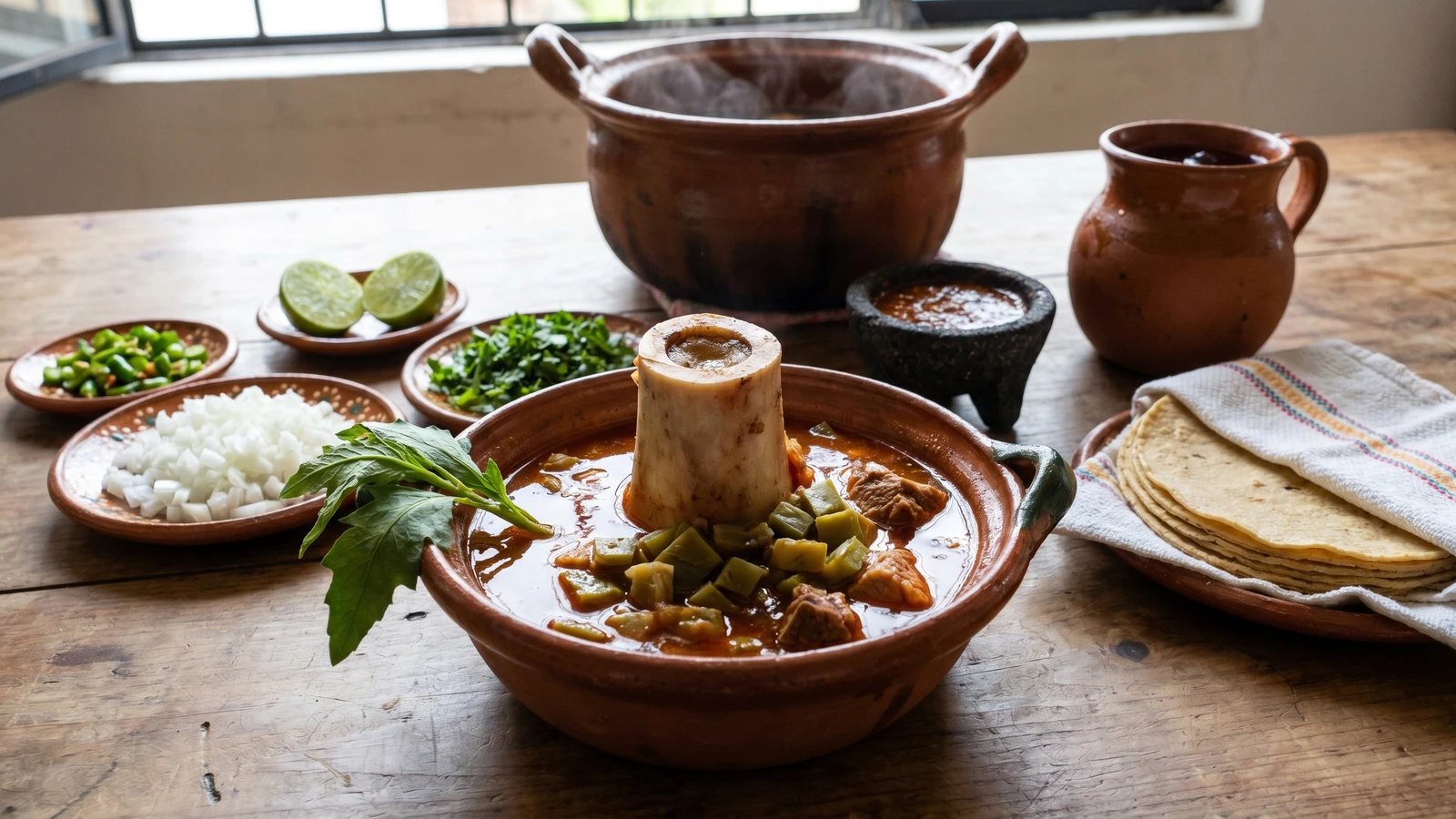
A Mexico City cantina classic from Magdalena Atlitic, beef marrow bones simmered in a smoky chipotle-tomato broth with nopales and epazote. The chilanga levanta-muertos.
This soup belongs to Ciudad de México. Specifically to Magdalena Atlitic, the old neighborhood tucked into the foothills of Magdalena Contreras in the south of the city, where small cantinas and fondas have been ladling sopa de médula into clay cazuelitas for generations. It is a chilango dish through and through, and it carries the weight of a city that drinks too much, works too hard, and needs something serious on a Sunday afternoon.
This is a levanta-muertos. A raise-the-dead. The kind of soup you eat after a long night at a cantina in Roma or Coyoacán, when nothing else will reach where the trouble lives. The bone marrow, tuétano, is the point. You scoop it out of the bone with a small spoon, spread it on a warm corn tortilla with a pinch of salt and a squeeze of lime, and eat it next to spoons of the broth. The chipotle morita gives the caldo its smoke. The guajillo gives it color. The epazote, that strange herb that smells like petroleum and lemon and something older than both, gives it the green CDMX note that no other herb can replace. No epazote, no sopa de médula. Find it at La Merced or Mercado Jamaica, or grow it on your windowsill.
My mother did not make this. It is not Jalisciense. I learned it from a señora named Doña Refugio who ran a comedor on Calle Camino Real in Magdalena Atlitic in the late 1990s. She had no menu. She made one soup a day. On Sundays it was sopa de médula and the line went out the door at noon. She told me the secret was to never let the bones boil hard, to roast the tomatoes black in patches, and to always, always finish with epazote tossed in the last 15 minutes. She is gone now. Her recipe is not. Saber cocinar es saber vivir.
Sopa de médula is part of a broader Central Mexican tradition of bone-broth soups that includes caldo de res, mole de olla, and birria, all rooted in the post-conquest fusion of indigenous corn-and-chile cookery with Iberian braising traditions. Bone marrow itself, tuétano, has been prized in central highland kitchens since the 16th century, when Spanish cattle introduced a steady supply of large marrow bones that pre-Columbian cooks had never had access to in the same quantity. The Magdalena Contreras region, where Magdalena Atlitic sits, was historically a producer of dairy and beef for the capital, and its small fondas codified the dish in the 19th and 20th centuries as a hangover cure and Sunday family meal, distinct from the more famous caldo tlalpeño that dominates the central highlands' soup repertoire.
Quantity
3 pounds
cut crosswise into 2-inch sections by your butcher
Quantity
1 pound
cut into 1-inch cubes
Quantity
1 large
halved
Quantity
1
halved crosswise
Quantity
2
Quantity
1 tablespoon, plus more to taste
Quantity
4 medium
Quantity
3
Quantity
2
stemmed and seeded
Quantity
2
Quantity
2 tablespoons
Quantity
3
despinados and diced into 1/2-inch squares
Quantity
1 large sprig (about 8 leaves)
Quantity
2
finely chopped
Quantity
1/2 medium
Quantity
for serving
warmed on a comal
Quantity
for serving
Quantity
for serving
Quantity
for serving
| Ingredient | Quantity |
|---|---|
| beef shank bones with marrow insidecut crosswise into 2-inch sections by your butcher | 3 pounds |
| beef shank meatcut into 1-inch cubes | 1 pound |
| white onionhalved | 1 large |
| head of garlichalved crosswise | 1 |
| bay leaves | 2 |
| kosher salt | 1 tablespoon, plus more to taste |
| ripe Roma tomatoes | 4 medium |
| dried chile chipotle morita | 3 |
| dried chile guajillostemmed and seeded | 2 |
| garlic cloves (for the salsa) | 2 |
| manteca de cerdo (pork lard) | 2 tablespoons |
| fresh nopal paddlesdespinados and diced into 1/2-inch squares | 3 |
| fresh epazote | 1 large sprig (about 8 leaves) |
| fresh chile serranofinely chopped | 2 |
| finely diced white onion (for serving) (optional) | 1/2 medium |
| hand-pressed corn tortillas (optional)warmed on a comal | for serving |
| lime halves (optional) | for serving |
| chopped cilantro (optional) | for serving |
| salsa de chile de árbol (optional) | for serving |
Place the marrow bones in a large bowl, cover with cold water, and add a heavy pinch of salt. Let them sit for 30 minutes while you prep the rest. This pulls the blood out so your broth runs clean, not muddy. The marrow itself stays inside the bone. Drain and rinse the bones under cold running water before they go into the pot.
Place the rinsed bones and the cubed shank meat in a heavy 8-quart stockpot. Cover with cold water by three inches. Add the halved onion, the halved garlic head, the bay leaves, and the tablespoon of salt. Bring to a slow simmer over medium heat. As the gray foam rises in the first 20 minutes, skim it off with a spoon. Cold water and a slow start are how you get a clean broth. A hard boil clouds everything and toughens the meat.
Once the foam stops rising, lower the heat until the broth shows lazy bubbles every few seconds. Partially cover and cook for 90 minutes. The meat should be tender enough to bite through cleanly, and the marrow should be soft inside the bone, no longer pink. Do not rush this. The bones release their gelatin slowly, and that body is what makes the broth feel like medicine in your hands.
While the caldo simmers, heat a dry comal over medium. Toast the chipotle morita and the guajillo separately, about 20 seconds per side. The morita burns fast, watch it. The guajillo should puff and turn fragrant. Set the chiles aside in a heatproof bowl and cover with hot tap water for 15 minutes. On the same comal, roast the Roma tomatoes whole, turning them until the skins blister black in patches and the flesh softens. Roast the 2 garlic cloves for the salsa alongside them until the skins darken. No me vengas con atajos. Skip the toasting and the broth tastes flat.
Drain the soaked chiles. Combine them in a blender with the roasted tomatoes, the 2 roasted garlic cloves, and one cup of the simmering broth lifted from the pot. Blend until completely smooth, about a minute. Melt the manteca in a small skillet over medium heat. Strain the puree through a fine-mesh sieve directly into the hot lard. It will sputter. Cook the strained puree for 6 to 8 minutes, stirring, until it darkens, the fat separates at the edges, and it stops smelling raw. La manteca es el sabor. Without this step, the broth tastes like tomato water with chile floating in it.
Bring a separate pot of salted water to a boil. Drop the diced nopales in along with a quarter onion if you have one. Cook for 8 to 10 minutes, until they turn from bright green to a duller olive. Drain in a colander, rinse under cold water until the slime is gone, and shake them dry. This step is non-negotiable. Skip the purging and the babita, that slippery liquid, ends up in your soup.
Lift the spent onion halves, garlic head, and bay leaves out of the caldo and discard. Stir the fried chile-tomato base into the broth. Add the purged nopales and the whole sprig of epazote, stems and all. Simmer for 15 more minutes, partially covered. Taste for salt now. The broth should be assertive: smoky from the morita, deep from the bones, herbaceous from the epazote. If it tastes shy, more salt. If it tastes flat, more morita next time. Así se hace y punto.
Ladle the broth into deep clay cazuelitas. Make sure each bowl gets at least one marrow bone, a generous portion of meat, and a heap of nopales. Set the finely diced raw onion, chopped serrano, cilantro, lime halves, salsa de chile de árbol, and a stack of warm tortillas in small platitos around the table. Each diner scoops the marrow out of the bone with a small spoon, spreads it on a warm tortilla with a pinch of salt and a squeeze of lime, and alternates bites of taco and spoons of broth. That is the chilanga ritual. Recetas probadas y garantizadas.
1 serving (about 350g)
Culinary guides, cultural storytelling, and the editorial depth that makes cooking meaningful.
Discover Culinary ExplorerChef Lupita
Aguascalientes' Bajio pozole de lengua, built with cacahuazintle hominy, tender beef tongue, chile ancho and guajillo, with xoconostle brightness and table garnishes.

Chef Lupita
Veracruz's Gulf coast rice from Alvarado, built with seafood stock, tomato, chile chipotle, epazote, shrimp, fish, jaiba, and pulpo, served loose and brothy in a clay cazuela.

Chef Lupita
Costa Chica's wet salt-beef stew, built from chile costeño, guajillo, tomato, manteca, yuca, plantain, and masa dumplings, the ranching pot of Cuajinicuilapa and Pinotepa.

Chef Lupita
Michoacán's P'urhépecha atápakua is a masa-thickened sauce and stew at once, built with pork, chile guajillo, and hierbabuena added only at the end.