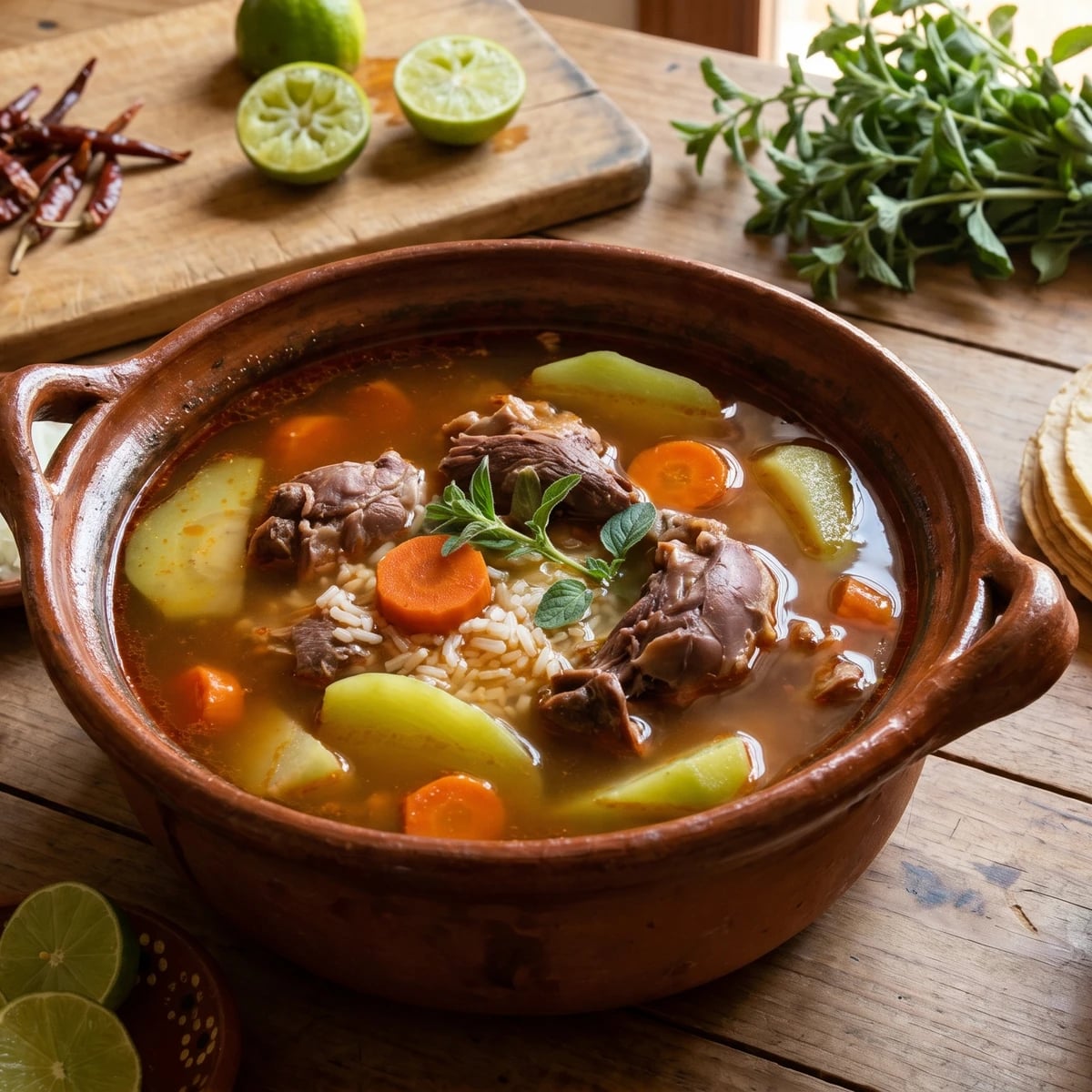
Hidalgo's ceremonial wedding broth from the Altiplano: turkey necks slow-simmered with fresh poleo, finished with rice and a fried base of toasted guajillo and ancho. The caldo that anchors a Hidalguense celebration.
Soups & Stews
Mexican
Special Occasion
Celebration
Holiday
30 min
Active Time
2 hr 30 min cook•3 hr total
Yield8 servings
This caldo is from Hidalgo. From the Altiplano specifically, the high cold plains that stretch from Pachuca up toward Real del Monte and east toward Actopan, where the guajolote, the native Mexican turkey, has been raised in courtyards since long before the Spanish arrived. When a family in this region marries off a daughter, the morning after the wedding is announced with the smell of this pot.
The defining ingredient is not the turkey. It is the poleo. Poleo is a highland pennyroyal that grows wild on the slopes around the old silver-mining towns of the Sierra de Pachuca, and the women of the Tianguis de Actopan carry it down in damp bundles to sell on market days. It has the cool sharpness of mint and the persistence of oregano, and it perfumes the broth in a way that no other herb does. Hierbabuena will not work. Spearmint will not work. If your mercado does not have poleo, find a Hidalguense vendor and ask. No me vengas con atajos.
The turkey neck is the cut for this caldo because it carries flavor that breast meat cannot match, with enough collagen to give the broth real body and enough bone to make it worth gnawing at the table. The chile guajillo base, fried in manteca until the fat separates, gives the caldo its color and its weight. The rice goes in toward the end to thicken the broth without turning it into stew. Cada estado, su propia cocina, and this one belongs to Hidalgo.
My mother did not know this dish. It was not Jalisciense and it never crossed her notebook. I learned it in Actopan in my fifth year of the 32-state project, sitting in the patio of a woman named Dona Eustolia who was preparing for her granddaughter's wedding. She let me stir the pot. She corrected my chile-toasting. She told me the poleo had to be tied in a bundle so it could be lifted out cleanly before serving. Recetas probadas y garantizadas. Now I am writing it for you the way she taught it to me.
The guajolote, Meleagris gallopavo, is native to Mesoamerica and was domesticated in the central Mexican highlands at least 2,000 years before the Spanish arrival, making it one of only two animals (along with the Muscovy duck) that pre-Columbian Mexico raised for food. In Hidalgo's Otomi and Nahua communities, turkey caldos were ceremonial dishes reserved for weddings, baptisms, and the festivals of the patron saints, with the bird often raised specifically for the occasion. Poleo, Mentha pulegium and the related native species Hedeoma piperita, was used by the Otomi for both culinary and medicinal purposes long before colonization, and its inclusion in this caldo reflects a continuity of highland herbal tradition that survived the Spanish substitution of European mints in most of the rest of Mexican cooking.
The technique, the tradition, and the story behind every dish.
halved crosswise, plus 3 cloves reserved for the chile base
bay leaves
Quantity
2
kosher salt
Quantity
1 tablespoon, plus more to taste
fresh poleo (Mexican pennyroyal)
Quantity
10 sprigs
tied with kitchen twine
dried chile guajillo
Quantity
6
stemmed and seeded
dried chile ancho
Quantity
2
stemmed and seeded
roma tomatoes
Quantity
2 medium
manteca de cerdo (pork lard)
Quantity
1 tablespoon
long-grain white rice
Quantity
1/2 cup
rinsed until the water runs clear
carrots
Quantity
2 medium
peeled and cut into thick coins
chayotes
Quantity
2 small
peeled and cut into wedges
fresh epazote
Quantity
1 sprig
dried Mexican oregano (preferably oregano de monte)
Quantity
1 teaspoon
chopped fresh cilantro (optional)
Quantity
for serving
lime halves (optional)
Quantity
for serving
dried chile de arbol (optional)
Quantity
for serving
toasted on the comal
hand-pressed corn tortillas (optional)
Quantity
for serving
warmed
Ingredient
Quantity
turkey necks (pescuezos de guajolote)cut into 2-inch sections
3 pounds
turkey wings or backsfor added body
1 pound
white onionhalved, plus 1/2 cup finely diced for serving
1 medium
head of garlichalved crosswise, plus 3 cloves reserved for the chile base
1
bay leaves
2
kosher salt
1 tablespoon, plus more to taste
fresh poleo (Mexican pennyroyal)tied with kitchen twine
10 sprigs
dried chile guajillostemmed and seeded
6
dried chile anchostemmed and seeded
2
roma tomatoes
2 medium
manteca de cerdo (pork lard)
1 tablespoon
long-grain white ricerinsed until the water runs clear
1/2 cup
carrotspeeled and cut into thick coins
2 medium
chayotespeeled and cut into wedges
2 small
fresh epazote
1 sprig
dried Mexican oregano (preferably oregano de monte)
1 teaspoon
chopped fresh cilantro (optional)
for serving
lime halves (optional)
for serving
dried chile de arbol (optional)toasted on the comal
for serving
hand-pressed corn tortillas (optional)warmed
for serving
Equipment Needed
•8-quart olla de barro or heavy stockpot
•Cast iron comal or heavy skillet for toasting chiles
•High-powered blender
•Fine-mesh strainer
•Kitchen twine for the poleo bundle
•Deep barro cazuelas for serving
Instructions
1
Sear the turkey necks
Heat a heavy 8-quart olla de barro or stockpot over medium-high. Working in batches so you do not crowd the pot, brown the turkey neck sections on every side, about 8 minutes per batch. The skin should turn deep golden and stick a little before releasing. Those browned bits at the bottom of the pot are the foundation of the broth. Do not skip this. A pale turkey neck makes a pale caldo, and a pale caldo dishonors the bird.
Turkey neck has a particular flavor that pork or chicken cannot replicate. If your butcher does not carry pescuezos, call ahead. In the Altiplano, families raise their own guajolotes for this caldo. You are looking for that taste.
2
Build the broth
Add the turkey wings or backs to the pot. Cover everything with cold water by three inches, about 4 quarts. Add the halved onion, the halved head of garlic, the bay leaves, and the salt. Bring to a gentle simmer over medium heat. Skim the gray foam that rises in the first 20 minutes. Cold water draws the flavor out slowly and keeps the broth clear. A rolling boil gives you a cloudy pot and tough meat.
3
Add the poleo
Once the foam stops rising, lower the heat until you see lazy bubbles every few seconds. Drop in the tied bundle of poleo. Cover partially and cook for 1 hour and 30 minutes. The poleo is what makes this Hidalguense. It is a wild pennyroyal that grows on the highland slopes around Real del Monte and Pachuca, and the women who carry it down to the Tianguis de Actopan will tell you it cannot be replaced with regular mint or with hierbabuena. If you cannot find poleo fresh, find it dried. If you cannot find it dried, you are making a different soup.
4
Toast and soak the chiles
While the broth simmers, heat a dry comal or heavy skillet over medium. Toast the guajillo and ancho chiles separately, about 20 seconds per side. They should puff and smell sweet, never blacken. On the same comal, char the tomatoes and the 3 reserved garlic cloves until the tomato skins blister and split, about 6 minutes total. Place the toasted chiles in a heatproof bowl and cover with hot tap water, not boiling. Soak for 20 minutes.
5
Blend and fry the chile base
Drain the chiles. Transfer them to a blender with the charred tomatoes, the charred garlic, and 1 cup of the turkey broth. Blend until completely smooth. Strain through a fine-mesh sieve into a bowl, pressing on the solids. In a small skillet, melt the manteca over medium heat. Pour in the strained chile puree. It will sputter. Cook for 5 minutes, stirring constantly, until the puree darkens and the fat separates at the edges. La manteca es el sabor. This step deepens the chile and is the difference between a thin caldo and a serious one.
6
Combine and add the rice
Remove and discard the spent onion, garlic head, bay leaves, and the bundle of poleo from the broth. Stir the fried chile base into the broth. Add the rinsed rice, the carrots, the chayote wedges, and the sprig of epazote. Simmer uncovered for 20 to 25 minutes, until the rice is tender and the chayote yields to a knife. Taste for salt now. The rice absorbs flavor as it cooks, so the broth needs to be assertive before it goes in.
7
Finish and serve at the table
Crumble the dried oregano between your palms over the pot and stir once. Ladle the caldo into deep barro cazuelas, making sure each bowl gets a section of turkey neck, a piece of carrot, and a wedge of chayote. The eater is expected to gnaw the meat off the neck bones at the table. That is part of the dish. Set the cilantro, diced onion, lime, toasted chile de arbol, and warm tortillas in small platitos around the table. Saber cocinar es saber vivir.
At Hidalguense weddings the caldo is served as the morning-after dish, the consuelo de boda, to fortify the families before the long day of celebrations. If you are serving it that way, double the recipe. Nobody eats one bowl.
Chef Tips
•Find a butcher who carries turkey necks, not just turkey breasts. In the United States, Latin and halal butchers often have them, and they will sell them by the kilo at a fraction of the price of any other turkey cut. If your butcher does not stock them, ask them to order. The neck is the recipe.
•Poleo is the heart of this caldo. Fresh is best, but dried poleo from a Mexican mercado or a serious herb supplier will work. Do not substitute hierbabuena, spearmint, or peppermint. Those are different plants with different oils and they will give you a caldo that does not taste Hidalguense.
•The chayote is traditional in the Altiplano version. If you cannot find it, calabacita criolla works as a compromise. Zucchini from the supermarket is a poor third option but will not ruin the pot.
•The caldo is better the next day. The poleo deepens, the chile settles, and the broth gels from the collagen in the necks. Reheat gently. Boiling will break the rice.
Advance Preparation
•The turkey broth and the fried chile base can be made one day ahead and refrigerated separately. Combine, add the rice and vegetables, and finish on serving day.
•The whole caldo keeps refrigerated for three days and the flavor only improves overnight. Add a splash of broth or water when reheating to loosen what the rice has absorbed.
•Do not freeze. The rice turns to paste and the poleo loses its character.
Frequently Asked Questions
Nutrition Information
1 serving (about 550g)
Calories
415 calories
Total Fat
21 g
Saturated Fat
6 g
Trans Fat
0 g
Unsaturated Fat
13 g
Cholesterol
85 mg
Sodium
340 mg
Total Carbohydrates
28 g
Dietary Fiber
3 g
Sugars
3 g
Protein
26 g
Where cooking meets culture.
Culinary guides, cultural storytelling, and the editorial depth that makes cooking meaningful.