
Chef Lupita
Aguascalientes Beef Tongue Pozole (Pozole de Lengua)
Aguascalientes' Bajio pozole de lengua, built with cacahuazintle hominy, tender beef tongue, chile ancho and guajillo, with xoconostle brightness and table garnishes.
A cooking platform built around craft, culture, and the stories behind what we eat.
Created by
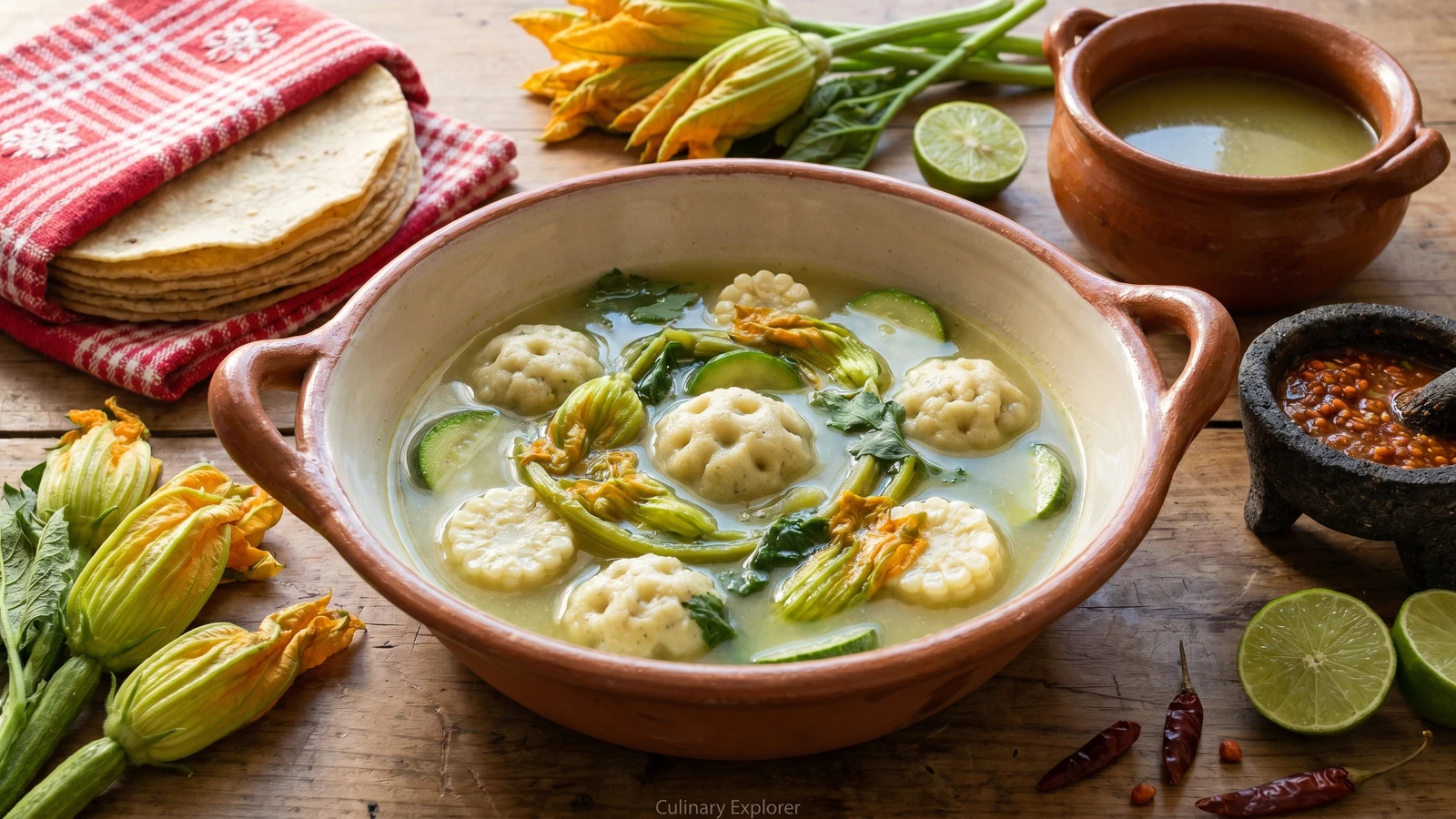
Morelos in a bowl. Squash vines, young corn, and calabacitas simmered with chochoyotes, the dimpled masa dumplings that milpa cooks have been slipping into a caldo since long before the soup had a name.
This is a Morelos soup. It belongs to the central highlands, to the small valleys around Cuautla and Tepoztlán where the milpa, that ancient companionship of corn, beans, and squash, still feeds families the way it has for thousands of years. The same dish travels under different names through Puebla, Tlaxcala, and parts of Oaxaca, but the version with chochoyotes is unmistakably central, and Morelos cooks claim it without apology.
The guías are the tender young vines of the squash plant, harvested before the calabaza itself is ready. The leaves, the tendrils, the baby blossoms still curled on the stem, all of it goes into the pot. If you have never cleaned guías before, the first time is slow. You strip the outer fiber from every thick stalk by hand, the way your grandmother pulled strings off celery, except there are more stalks and the threads are tougher. Pregúntale a las señoras del mercado. They will show you in thirty seconds what takes me three sentences to describe.
The chochoyotes are the soul of the dish. Small balls of masa worked with lard and salt, each one dimpled with the thumb so the broth fills the hollow and cooks the dumpling through to the center. Without the dimple, the chochoyote is gummy at the heart. With it, the masa drinks the soup and the soup thickens around the masa. This is engineering disguised as humility.
My mother did not cook this soup. She was from Jalisco and the milpa traditions of central Mexico were not hers. I learned it from a señora named Doña Rufina in a small kitchen in Tepoztlán, in 2009, the summer the rains came late and the guías were thin. She told me the dish does not need meat, it does not need broth from a bone, it does not need anything more than what the field gives. The lard, the masa, the vines, the corn, the epazote. Saber cocinar es saber vivir, and this is the soup that proves it.
Sopa de guías belongs to the broader milpa tradition, the pre-Columbian polyculture of maize, beans, and squash planted together so that each crop supports the others, a system practiced across central Mexico for at least 4,000 years and still maintained by smallholders today. The chochoyote, a small dimpled masa dumpling, is documented in colonial-era cookbooks from Oaxaca and Morelos and likely predates the conquest as a way to extend a vegetable broth with the same nixtamalized corn that produced tortillas. The use of squash vines and young blossoms in caldos reflects the indigenous principle of harvesting every stage of a single plant, a practice that European agriculture treated as alien but that allowed Mesoamerican farmers to feed dense populations from limited acreage.
Quantity
2 pounds
Quantity
4 ears
husked and cut into 2-inch rounds
Quantity
1 pound small
cut into half-moons
Quantity
1/2 pound
trimmed and cut into 1-inch pieces
Quantity
1 dozen
stems and pistils removed
Quantity
1 medium
half roughly chopped, half left whole
Quantity
4
2 chopped, 2 left whole
Quantity
2 sprigs, plus more for the pot
Quantity
2
slit lengthwise
Quantity
10 cups
Quantity
2 tablespoons
Quantity
1 1/2 teaspoons, plus more to taste
Quantity
1 1/2 cups
such as Maseca or Bob's Red Mill nixtamalized
Quantity
3 tablespoons
at room temperature
Quantity
1 teaspoon
Quantity
3/4 cup, plus more as needed
Quantity
for serving
Quantity
for serving
Quantity
for serving
| Ingredient | Quantity |
|---|---|
| guías de calabaza (squash vines with leaves, tendrils, and young flowers) | 2 pounds |
| elote tierno (young white corn)husked and cut into 2-inch rounds | 4 ears |
| calabacitas criollas or zucchinicut into half-moons | 1 pound small |
| green beanstrimmed and cut into 1-inch pieces | 1/2 pound |
| flor de calabaza (squash blossoms)stems and pistils removed | 1 dozen |
| white onionhalf roughly chopped, half left whole | 1 medium |
| garlic cloves2 chopped, 2 left whole | 4 |
| fresh epazote | 2 sprigs, plus more for the pot |
| fresh chile serrano (optional)slit lengthwise | 2 |
| water | 10 cups |
| manteca de cerdo (pork lard) | 2 tablespoons |
| kosher salt | 1 1/2 teaspoons, plus more to taste |
| nixtamalized masa harinasuch as Maseca or Bob's Red Mill nixtamalized | 1 1/2 cups |
| manteca de cerdo for the masaat room temperature | 3 tablespoons |
| kosher salt for the masa | 1 teaspoon |
| warm water for the masa | 3/4 cup, plus more as needed |
| lime halves (optional) | for serving |
| dried chile piquín or chile de árbol salsa (optional) | for serving |
| hand-pressed corn tortillas (optional) | for serving |
Lay the squash vines on the counter. Start at the cut end of the thickest stalks and pull the outer fibrous skin downward, the way you would pull a string off a celery rib. It comes off in long green threads. Do this for every thick stem. The leaves, tendrils, and small attached flowers stay. Chop the cleaned vines, leaves, and tendrils into 2-inch pieces. This is the slow part of the dish and there is no shortcut. The unstrung fiber turns the soup rough on the tongue and the women in the markets of Cuautla will tell you the same thing.
In a wide bowl, combine the masa harina with 1 teaspoon salt. Work the 3 tablespoons of room-temperature manteca into the dry masa with your fingertips until it looks like coarse sand. Pour in the warm water in a slow stream, gathering the masa as you go. Knead for two minutes until you have a soft, smooth dough that holds together without cracking when you press it. If it cracks, add water by the tablespoon. If it sticks to your palm, add a little more masa. La manteca es el sabor and it is also what keeps the chochoyotes tender in the broth.
Pinch off pieces of masa about the size of a small walnut. Roll each one into a ball between your palms. Press your thumb into the center to make a deep dimple. The dimple is not decoration. It catches the broth and it cooks the dumpling through to the middle. A chochoyote without the dimple is gummy at the heart. Set the shaped dumplings on a plate lined with a damp cloth and cover them with another damp cloth so they do not dry out. You should have about 24.
Melt the 2 tablespoons of lard in a wide olla de barro or heavy 6-quart pot over medium heat. Add the chopped onion and chopped garlic. Cook for five minutes until the onion is soft and translucent, not browned. Add the corn rounds, the green beans, the whole onion half, the whole garlic cloves, the serrano if using, and 10 cups of water. Salt with the 1 1/2 teaspoons. Bring to a gentle simmer. Cook for fifteen minutes. The corn needs a head start. Everything else goes in after it.
Add the chopped guías and the calabacita half-moons to the simmering pot. Tuck in the two sprigs of epazote. The vines collapse fast, the way spinach collapses, and the kitchen will smell green and grassy. This is the smell of the milpa, the corn-bean-squash field that has fed central Mexico for thousands of years. Simmer for ten minutes.
Lower the chochoyotes into the broth one at a time, gently, dimple side up. Do not stir them in. Let them settle. They will sink, then rise as they cook. Simmer uncovered for ten minutes. The dimples will fill with broth and the masa will firm up around them. The starch from the dumplings thickens the caldo just enough to give it body. This is the moment the soup becomes itself.
Tear the squash blossoms into halves or thirds and slip them into the pot in the last two minutes of cooking. They wilt almost immediately. Taste the broth. It should taste like vegetables and epazote and something faintly sweet from the corn, with the lard rounding the bottom. Adjust salt now. Fish out the whole onion, the whole garlic, and the spent epazote stems.
Ladle into deep cazuelas de barro, making sure every bowl gets corn, vines, calabacita, blossoms, and four or five chochoyotes. Pass lime halves, a small molcajete of chile piquín or arbol salsa, and warm corn tortillas around the table. This is everyday food in Morelos, the kind of soup a cook makes on a Tuesday when the milpa is generous. Recetas probadas y garantizadas.
1 serving (about 580g)
Culinary guides, cultural storytelling, and the editorial depth that makes cooking meaningful.
Discover Culinary ExplorerChef Lupita
Aguascalientes' Bajio pozole de lengua, built with cacahuazintle hominy, tender beef tongue, chile ancho and guajillo, with xoconostle brightness and table garnishes.

Chef Lupita
Veracruz's Gulf coast rice from Alvarado, built with seafood stock, tomato, chile chipotle, epazote, shrimp, fish, jaiba, and pulpo, served loose and brothy in a clay cazuela.

Chef Lupita
Costa Chica's wet salt-beef stew, built from chile costeño, guajillo, tomato, manteca, yuca, plantain, and masa dumplings, the ranching pot of Cuajinicuilapa and Pinotepa.

Chef Lupita
Michoacán's P'urhépecha atápakua is a masa-thickened sauce and stew at once, built with pork, chile guajillo, and hierbabuena added only at the end.