
Chef Lupita
Aguascalientes Beef Tongue Pozole (Pozole de Lengua)
Aguascalientes' Bajio pozole de lengua, built with cacahuazintle hominy, tender beef tongue, chile ancho and guajillo, with xoconostle brightness and table garnishes.
A cooking platform built around craft, culture, and the stories behind what we eat.
Created by
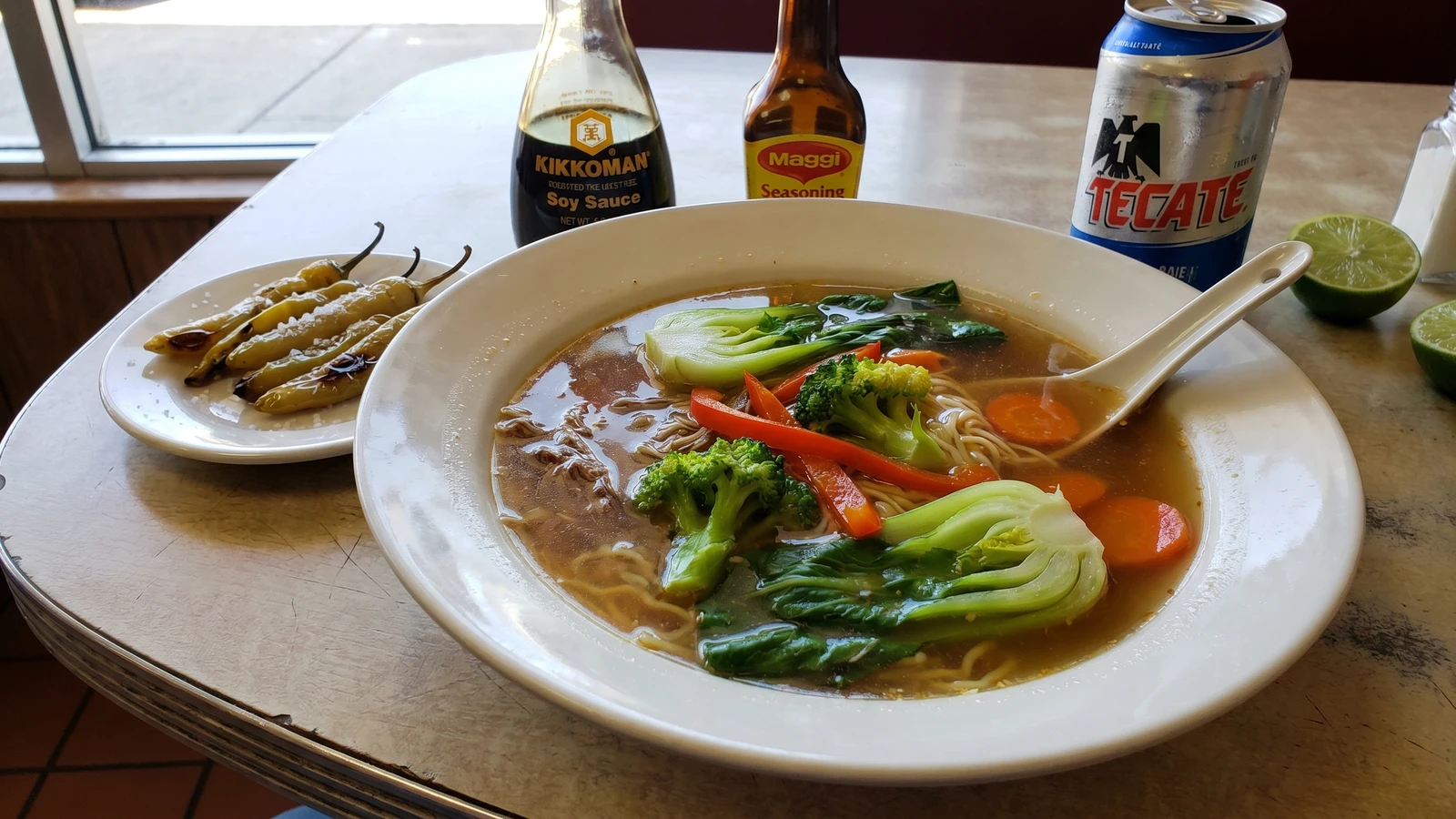
Mexicali's Cantonese-Mexican soup, a clear ginger-and-soy broth with crisp bok choy, broccoli, and bell pepper, served with lime wedges and blistered chiles guerito at the table.
This is from Mexicali, Baja California. Specifically from La Chinesca, the Chinatown neighborhood that has been the heart of the city since the early 1900s, when Cantonese laborers came north to dig the irrigation canals that turned the desert into farmland. They stayed. They opened restaurants. A century later, Mexicali has more Chinese restaurants per capita than any city in Mexico, and sopa china is the dish that lives at the intersection of those two kitchens.
This is not fusion. Fusion is a marketing word for a chef in another city pretending to invent something. Sopa china is cocina chicalense, a hundred years of Cantonese cooks adapting to Mexican ingredients and Mexican cooks borrowing the wok, the ginger, the soy sauce, and making them their own. The broth is clear, never thick. The vegetables are bright, never soft. The ginger and the soy do the work that the chile usually does in Mexican soup, and the chiles guerito come fried whole on a side plate so each diner squeezes their own heat into the bowl.
I sat in Café Nueva Asia in La Chinesca a few summers back with a senora who has been cooking sopa china for forty years. She told me her mother learned the broth from a cook named Wong who lived two doors down in the 1950s. She taught me to skim the foam early, to keep the ginger generous, to never cook the noodles in the broth. Saber cocinar es saber vivir, and Mexicali learned that lesson in two languages.
Mexicali's Chinese community took root between 1903 and 1920, when the Colorado River Land Company recruited thousands of Cantonese laborers, many recently displaced from California by the Chinese Exclusion Act, to dig the canals that opened the Mexicali Valley to cotton agriculture. By 1920, Chinese residents outnumbered Mexicans in Mexicali, and La Chinesca became the largest Chinatown in Mexico, with restaurants, associations, and underground tunnels still partially preserved today. Sopa china emerged in the mid-20th century as Cantonese cooks adapted clear-broth soups to local proteins, available vegetables, and the Mexican habit of finishing a soup with lime and chile at the table; the dish has no direct equivalent in Guangdong cuisine and is recognized as a distinctly Mexicali creation by both Mexican culinary historians and Chinese-Mexican families who have run restaurants in La Chinesca for four generations.
Quantity
2 pounds
Quantity
10 cups
Quantity
1 medium
halved
Quantity
1
halved crosswise
Quantity
1 thumb-sized piece
smashed
Quantity
2
cut into 3-inch pieces
Quantity
1 tablespoon, plus more to taste
Quantity
2 tablespoons, plus more for the table
Quantity
1 teaspoon
Quantity
1/2 small head
cut into 2-inch pieces
Quantity
2
quartered lengthwise
Quantity
1
cut into florets, stems peeled and sliced
Quantity
1
cut into thin strips
Quantity
1 medium
cut on the bias into thin coins
Quantity
4
cut into 2-inch lengths
Quantity
8 ounces
Quantity
8 to 12
Quantity
2 tablespoons
Quantity
for serving
Quantity
for serving
Quantity
for serving
| Ingredient | Quantity |
|---|---|
| beef shank with bone (chambarete) or bone-in chicken thighs | 2 pounds |
| cold water | 10 cups |
| white onionhalved | 1 medium |
| head of garlichalved crosswise | 1 |
| fresh gingersmashed | 1 thumb-sized piece |
| celery stalkscut into 3-inch pieces | 2 |
| kosher salt | 1 tablespoon, plus more to taste |
| soy sauce | 2 tablespoons, plus more for the table |
| toasted sesame oil | 1 teaspoon |
| Napa cabbagecut into 2-inch pieces | 1/2 small head |
| baby bok choyquartered lengthwise | 2 |
| small head broccolicut into florets, stems peeled and sliced | 1 |
| red bell peppercut into thin strips | 1 |
| carrotcut on the bias into thin coins | 1 medium |
| scallionscut into 2-inch lengths | 4 |
| fideo chino (thin egg noodles) or thin spaghetti (optional) | 8 ounces |
| fresh chiles guerito (yellow chiles) | 8 to 12 |
| vegetable oil for frying the chiles | 2 tablespoons |
| lime wedges (optional) | for serving |
| soy sauce (for the table) (optional) | for serving |
| Salsa Maggi or Salsa Huang (optional) | for serving |
Place the beef shank or chicken thighs in a heavy stockpot. Cover with the cold water. Bring to a gentle simmer over medium heat, never a hard boil. Skim the gray foam that rises in the first fifteen minutes. A clean caldo starts here. Cloudy broth means you walked away too soon.
Once the broth is clean, add the halved onion, garlic, ginger, celery, and salt. The ginger is not optional. This is what makes it sopa china and not caldo de res. The Cantonese cooks who came to Mexicali in the 1910s brought ginger with them and it stayed. Cada estado, su propia cocina, and Mexicali's kitchen has been bilingual for over a century.
Cover partially and simmer at a lazy bubble for one hour for chicken, or one and a half hours for beef. The meat should be tender enough to pull apart with a fork. Skim any foam that returns. Strain the broth through a fine-mesh sieve into a clean pot. Pull the meat off the bone, shred it into bite-sized pieces, and set aside. Discard the spent vegetables. Taste the broth for salt now.
While the broth simmers, heat the vegetable oil in a small skillet over medium-high heat. When the oil shimmers, add the whole chiles guerito. Fry them, turning with tongs, for two to three minutes total, until the skin blisters and the chiles turn a deeper yellow with brown spots. Lift them out onto a plate and sprinkle with salt while hot. These go on the table whole. The diner bites the tip and squeezes a little of the smoky heat into their bowl with each spoonful. This is how it is done at Café Nueva Asia in La Chinesca.
If using fideo chino, bring a pot of water to a boil and cook the noodles for three to four minutes, until just tender. Drain and rinse under cold water to stop them from cooking. Hold to one side. Cook them separately, never in the broth. Noodles cooked in the soup turn it cloudy and starchy and the broth you spent an hour building becomes a sad imitation of itself.
Bring the strained broth back to a simmer over medium heat. Stir in the soy sauce. Add the carrot first and cook for two minutes. Then the broccoli stems, then the florets, the bell pepper, and the Napa cabbage. Cook for three minutes more. Add the bok choy and the scallions last. Cook for ninety seconds. The vegetables should be bright, crisp-tender, never soft. This is the Cantonese hand at work in a Mexican kitchen. Mushy vegetables are not the tradition here.
Return the shredded meat to the pot. Drizzle in the toasted sesame oil. Taste one more time. The broth should be clean, savory, with the ginger and soy sauce sitting just behind the meat flavor, not in front of it. Place a small nest of noodles in the bottom of each bowl if using. Ladle the broth, meat, and vegetables over the top. Send the bowls to the table with lime wedges, the fried chiles guerito, soy sauce, and Salsa Maggi. Each diner finishes their own bowl. Asi se hace y punto.
1 serving (about 700g)
Culinary guides, cultural storytelling, and the editorial depth that makes cooking meaningful.
Discover Culinary ExplorerChef Lupita
Aguascalientes' Bajio pozole de lengua, built with cacahuazintle hominy, tender beef tongue, chile ancho and guajillo, with xoconostle brightness and table garnishes.

Chef Lupita
Veracruz's Gulf coast rice from Alvarado, built with seafood stock, tomato, chile chipotle, epazote, shrimp, fish, jaiba, and pulpo, served loose and brothy in a clay cazuela.

Chef Lupita
Costa Chica's wet salt-beef stew, built from chile costeño, guajillo, tomato, manteca, yuca, plantain, and masa dumplings, the ranching pot of Cuajinicuilapa and Pinotepa.

Chef Lupita
Michoacán's P'urhépecha atápakua is a masa-thickened sauce and stew at once, built with pork, chile guajillo, and hierbabuena added only at the end.