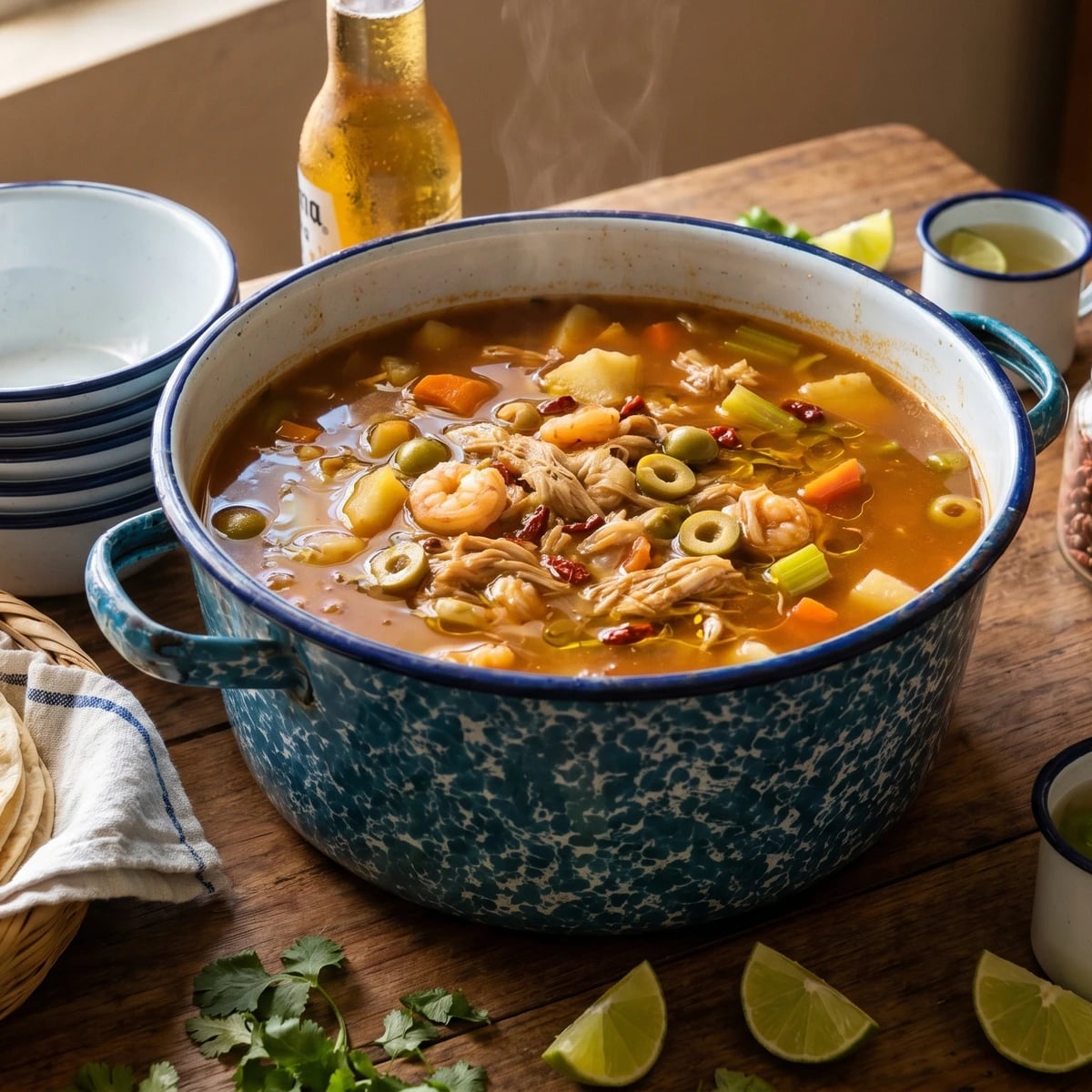
Sonora's manta ray and shrimp stew, with green olives, carrots, capers, and the wild chiltepin chile from the Sierra Madre Occidental. The pure broth, served first in a tin cup, is the bichi.
Soups & Stews
Mexican
Comfort Food
Special Occasion
Make Ahead
30 min
Active Time
1 hr 30 min cook•2 hr total
Yield6 to 8 servings
Caguamanta is Sonoran. Specifically of the Sea of Cortez coast, of Bahia de Kino, Guaymas, Empalme, and the fishing villages where the boats come in at dawn and the women on shore know how to turn what is landed into a stew that feeds a family for two days.
The name tells you the history. Caguama is sea turtle. Mantarraya is manta ray. The original dish was made with caguama, sea turtle, and when sea turtle was rightly banned in the 1990s the cooks of the coast did what cooks have always done: they kept the dish and changed the protein. The manta ray was already in the boats. The fishermen dried it on lines in the sun, and the dried fillet, salty and stiff and almost the color of paper, became the new caguamanta. The name stayed. The technique stayed. The soul of the dish stayed. That is how a cuisine survives.
This is a stew with a Mediterranean accent, and that is not a coincidence. Sonora was settled by Spanish and Sephardic merchants whose pantries left olive oil, green olives, and capers in the Sonoran kitchen. Combined with the wild chiltepin from the Sierra Madre Occidental and the dried shrimp powder of the coast, you get something that exists nowhere else. It is not Mediterranean and it is not generic Mexican. It is sonorense, and the people of the coast know it the moment they smell it.
There is a small ceremony to caguamanta that I want you to honor. Before the stew goes in the bowl, you ladle the pure broth into a small enameled tin cup. That cup is bichi. You drink it warm with a squeeze of lime and a few crushed chiltepines, and only after that comes the stew. My notebook from a trip to Guaymas in 2014 has a sketch of the cup that the senora at the marisqueria served me, with an arrow pointing at it and the word bichi underlined twice. She told me the broth tells you whether the stew will be any good. If the broth is right, the rest follows. Saber cocinar es saber vivir.
Caguamanta originated as caguama, a sea turtle stew that was a staple along Sonora's coast and among the Comcaac (Seri) people of the Sea of Cortez region for generations. Mexico banned the commercial harvest and consumption of sea turtle in 1990 to protect the critically endangered species, and Sonoran cooks transitioned to manta ray, which was already part of the local fishery and shared the dense, shreddable texture of the original ingredient. The dish's olive oil, green olives, and capers reflect the Mediterranean influence carried into northwestern Mexico through Spanish colonial trade routes and Sephardic merchant communities, while the chiltepin is the only chile native to what is now the United States and northern Mexico, gathered wild from the foothills of the Sierra Madre Occidental.
The technique, the tradition, and the story behind every dish.
•Sharp knife for dicing the mirepoix-style vegetables
•Molcajete for crushing chiltepines
•Enameled tin cups for serving the bichi
Instructions
1
Soak the manta ray
The dried manta ray comes from the fishermen of Bahia de Kino and Guaymas salted and stiff. It needs at least eight hours in cold water, and overnight is better. Change the water two or three times. Taste the soaking water at the end. If it is still aggressively salty, give it another hour. The fish should be flexible and clean-smelling, never sharp.
If your mantarraya seca is very thick, tear it into smaller strips before soaking. The salt comes out faster and the broth comes together cleaner.
2
Build the bichi base
Place the soaked and drained mantarraya in a heavy 8-quart pot. Cover with the eight cups of water. Add the halved onion, the halved head of garlic, and the bay leaves. Drop in the reserved shrimp shells and heads. Bring to a slow simmer over medium heat. Skim the foam that rises in the first ten minutes. Lower the heat and cook at a lazy simmer for 45 minutes. This is the base. The pure broth, ladled into a tin cup before any vegetables go in, is what Sonorenses call bichi. It is the soul of the dish.
3
Strain and shred
Strain the broth through a fine-mesh sieve into a clean pot. Pull the manta ray out and let it cool enough to handle. Discard the spent onion, garlic, bay, and shrimp shells. Shred the manta ray with your fingers along the natural grain. It pulls into long ribbons, almost like crab. Set the broth and the shredded fish aside.
Save out a cup or two of the strained broth in a separate jar. This is the bichi you serve in tin cups before the stew. Do not put vegetables in the cup. Bichi is broth, lime, and chiltepin. That is all.
4
Sweat the vegetables
Heat the olive oil in the same heavy pot over medium heat. Add the diced onion, chopped garlic, carrots, celery, and bell pepper. Cook for about ten minutes, stirring, until the onion turns translucent and the carrots start to soften at the edges. The kitchen will smell like a Sonoran Sunday. The olive oil is not negotiable here. The Sephardic and Spanish trade left its mark on Sonoran seafood cooking and this dish carries that olive-and-caper signature.
5
Add tomato and chiles
Stir in the chopped tomatoes and the diced chile Anaheim. Cook for five more minutes, until the tomatoes break down and release their juice. Add the crushed chiltepines now. Chiltepin is a Sonoran chile, small and round, hotter than it looks, and the wild bushes that grow in the Sierra Madre Occidental produce the best ones. No me vengas con atajos. Do not substitute jalapeno or serrano. The flavor is wrong.
6
Combine broth and stew
Pour the strained broth back into the vegetables. Add the diced potatoes, the shredded manta ray, the olives, the capers, the oregano, and the dried shrimp powder. The shrimp powder is what gives caguamanta its deep mariscos backbone. If you cannot find it ground, toast a handful of dried shrimp on a comal and pulverize it in a molcajete. Bring to a gentle simmer and cook for 20 minutes, until the potatoes are tender.
7
Finish with shrimp
Add the peeled raw shrimp and cook for three to four more minutes, just until they turn opaque and curl. Do not overcook them. Stir in the lime juice, the cilantro, and a generous crack of black pepper. Taste for salt now. The mantarraya, the olives, the capers, and the shrimp powder all bring salt of their own, so you may need very little. Adjust and pull off the heat.
8
Serve bichi first, then stew
Ladle the reserved pure broth into small enameled tin cups. Pass them around with lime wedges and a jar of crushed chiltepines. That is the bichi course. Drink it warm before the stew arrives. Then serve the caguamanta in deep bowls with hot flour tortillas sobaqueras to tear and dip. Cada estado, su propia cocina. Asi se hace y punto.
Chef Tips
•Dried manta ray is sold at any seafood vendor in the mercados of Hermosillo, Guaymas, or Bahia de Kino. Outside Sonora, look in Mexican seafood specialty stores or markets serving Sonoran communities. If you cannot find mantarraya seca at all, dried salt cod (bacalao) is the closest compromise in texture and salt curve. It is not the same dish, but it is honest about what it is.
•Chiltepin is non-negotiable. The dried wild chiltepin from Sonora has a heat that flashes and fades cleanly, very different from the lingering burn of a serrano. If your local supplier carries chiltepin in glass jars, buy two and keep one for the table. La manteca es el sabor and el chiltepin es el alma in this kitchen.
•The bichi tradition is not optional. Always reserve a cup or two of the pure strained broth and serve it first. That little tin cup of clear, briny, lime-bright broth is what tells your guests they are eating caguamanta and not generic seafood soup.
•Flour tortillas sobaqueras, the giant thin ones folded over the forearm, are the correct bread for this stew. Sonora is wheat country, not corn country in the same way as the central states. Do not bring corn tortillas to a caguamanta and call it dinner.
Advance Preparation
•The mantarraya seca must be soaked overnight. Plan for this. There is no shortcut around the desalting.
•The base broth (steps 2 and 3) can be made one day ahead and refrigerated. Build the rest of the stew the day you serve it.
•Caguamanta keeps refrigerated for three days and reheats well over low heat. Add a splash of water if it tightens up. Do not add the shrimp until the day of serving, because reheated shrimp turns rubbery.
Frequently Asked Questions
Nutrition Information
1 serving (about 580g)
Calories
440 calories
Total Fat
10 g
Saturated Fat
2 g
Trans Fat
0 g
Unsaturated Fat
7 g
Cholesterol
250 mg
Sodium
1300 mg
Total Carbohydrates
25 g
Dietary Fiber
5 g
Sugars
6 g
Protein
62 g
Where cooking meets culture.
Culinary guides, cultural storytelling, and the editorial depth that makes cooking meaningful.