
Chef Dimitra
Agrafa Batzina (Μπατζίνα), Courgette and Feta Pie
Agrafa's batzina is the no-phyllo pie of Karditsa: grated courgette, feta, eggs, milk, and flour poured thin into a hot oiled tapsi.
A cooking platform built around craft, culture, and the stories behind what we eat.
Created by
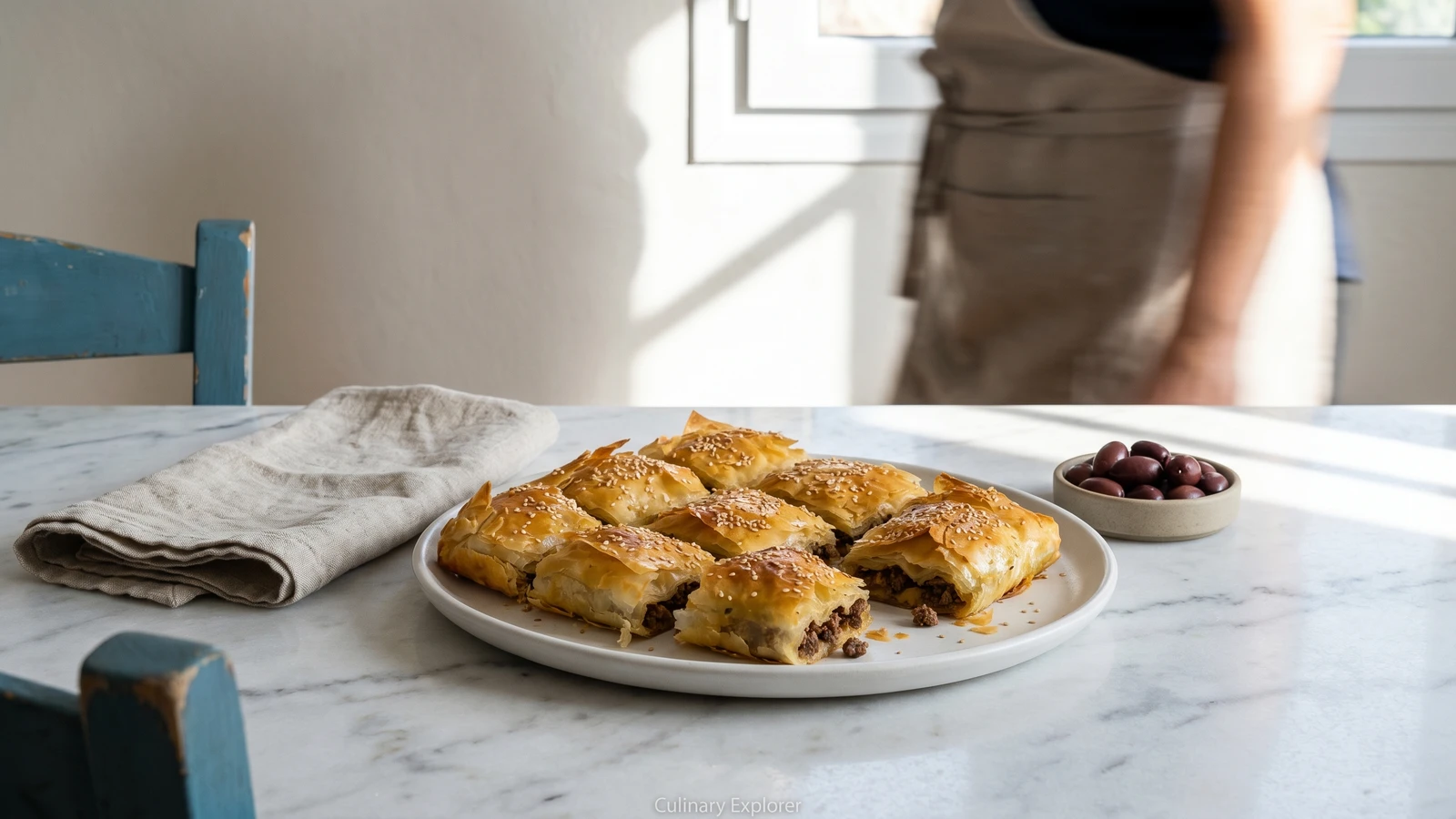
Serres gives bougatsa its sharp savory edge: thin phyllo folded around cooked minced meat, baked crisp, then cut into rough squares while still glossy with butter.
Bougatsa me kima belongs to Serres and the breakfast counters of northern Greece: tissue-thin phyllo folded around spiced minced meat, baked crisp, and chopped into squares with a heavy knife. It isn't a round pie and it isn't a neat little parcel. It is bougatsa, cut on paper, eaten hot, and filling enough to stand in for lunch.
The method that decides it is the filling. The meat must go into the phyllo already cooked and dry, not saucy, not wet with tomato. If the mince carries liquid, the inner sheets soften before the outside has time to crisp. Cook it down until it looks almost too dry in the pan, then trust the butter and phyllo to bring back tenderness.
Hand-stretched bougatsa phyllo is the Serres standard, elastic and thin enough to read light through it. At home, good commercial country phyllo or thin phyllo will still give you a proper tray if you keep it covered, butter it generously, and fold without fear. Your grandmother cooked by eye because she'd made it a thousand times. Here are the numbers until you have.
Bougatsa entered northern Greek city food through Constantinopolitan and Asia Minor pastry traditions, then settled strongly in Serres and Thessaloniki after the 1922 refugee movement. Serres became known for bougatsa shops that stretched the dough by hand, filled it with cream, cheese, spinach, or minced meat, and cut it fresh at the counter. The meat version belongs to the working morning as much as the home table: cheap, hot, portable, and very Greek in its regional name.
Quantity
500g
15 to 20 percent fat
Quantity
1 large, about 180g
finely chopped
Quantity
60ml
Quantity
2
finely grated
Quantity
1 tablespoon
Quantity
80ml
Quantity
1 teaspoon
Quantity
1/2 teaspoon
Quantity
1/2 teaspoon
Quantity
1/4 teaspoon
Quantity
1/4 teaspoon
Quantity
2 tablespoons
chopped
Quantity
450g
thawed if frozen
Quantity
120g
melted
Quantity
30ml
mixed with the melted butter
Quantity
1 tablespoon
for the top
| Ingredient | Quantity |
|---|---|
| beef mince15 to 20 percent fat | 500g |
| yellow onionfinely chopped | 1 large, about 180g |
| extra virgin olive oil | 60ml |
| garlic clovesfinely grated | 2 |
| tomato paste | 1 tablespoon |
| dry red wine | 80ml |
| fine sea salt | 1 teaspoon |
| freshly ground black pepper | 1/2 teaspoon |
| sweet paprika | 1/2 teaspoon |
| ground allspice | 1/4 teaspoon |
| ground cinnamon | 1/4 teaspoon |
| flat-leaf parsleychopped | 2 tablespoons |
| thin phyllo pastry (filo)thawed if frozen | 450g |
| unsalted buttermelted | 120g |
| extra virgin olive oilmixed with the melted butter | 30ml |
| sesame seeds (optional)for the top | 1 tablespoon |
Warm 60ml olive oil in a wide pan over medium heat. Add the onion with a pinch of the salt and cook for 8 to 10 minutes, until soft and pale gold, not browned hard. Stir in the garlic for 30 seconds, then add the tomato paste and cook it for 1 minute so it darkens and loses its raw edge.
Add the beef mince and break it up with a wooden spoon. Cook for 8 minutes, stirring often, until no pink remains and the meat separates into small grains. Add the wine, remaining salt, pepper, paprika, allspice, and cinnamon. Keep cooking until the pan is dry and the mince looks loose, fragrant, and almost crumbly, 10 to 12 minutes. This is the step that saves the phyllo. Wet filling makes soft bougatsa.
Take the pan off the heat and stir in the parsley. Spread the filling on a plate or shallow tray and let it cool for 15 minutes. Warm filling softens the phyllo before it reaches the oven, and we didn't come this far to make a damp pie.
Heat the oven to 190C. Mix the melted butter with 30ml olive oil. Lay the phyllo on the counter and cover it with a clean towel that is barely damp, not wet. Brush a 30cm round tapsi or a 25 by 35cm metal baking tray with the butter mixture.
Lay one phyllo sheet in the tray with the edges hanging over, then brush lightly with butter. Repeat with 5 more sheets, changing the angle as you go so the overhang covers all sides. Spread the cooled meat filling in an even layer. Fold the overhanging phyllo over the filling, brushing as you fold.
Top with the remaining phyllo sheets, brushing each one with butter and tucking the edges down the sides of the tray. Brush the top well. Scatter sesame seeds over it if you like them. Score only the top layers into large squares, shallowly, so the bougatsa cuts cleanly after baking without crushing the pastry.
Bake on the middle rack for 35 to 40 minutes, until the top is deep gold, crisp at the edges, and glossy where the butter has settled. Let it stand for 10 minutes, then cut through the scored lines into rough squares, the way the Serres shops do it, without making a ceremony of the knife.
1 serving (about 200g)
Culinary guides, cultural storytelling, and the editorial depth that makes cooking meaningful.
Discover Culinary ExplorerChef Dimitra
Agrafa's batzina is the no-phyllo pie of Karditsa: grated courgette, feta, eggs, milk, and flour poured thin into a hot oiled tapsi.

Chef Dimitra
Zagori's flour pie skips phyllo completely: a loose egg-and-flour batter, crumbled feta, and a hot buttered tapsi that makes the edges crisp.

Chef Dimitra
Hydra and Andros give amygdalota their island surname: ground almond, sugar, egg white, and rosewater, baked pale so the center stays soft as marzipan.

Chef Dimitra
Asia Minor ekmek kataifi is built in three clear layers: crisp syruped kataifi, thick semolina custard, and cold kaimaki cream under pistachios.