
Chef Dimitra
Agrafa Batzina (Μπατζίνα), Courgette and Feta Pie
Agrafa's batzina is the no-phyllo pie of Karditsa: grated courgette, feta, eggs, milk, and flour poured thin into a hot oiled tapsi.
A cooking platform built around craft, culture, and the stories behind what we eat.
Created by
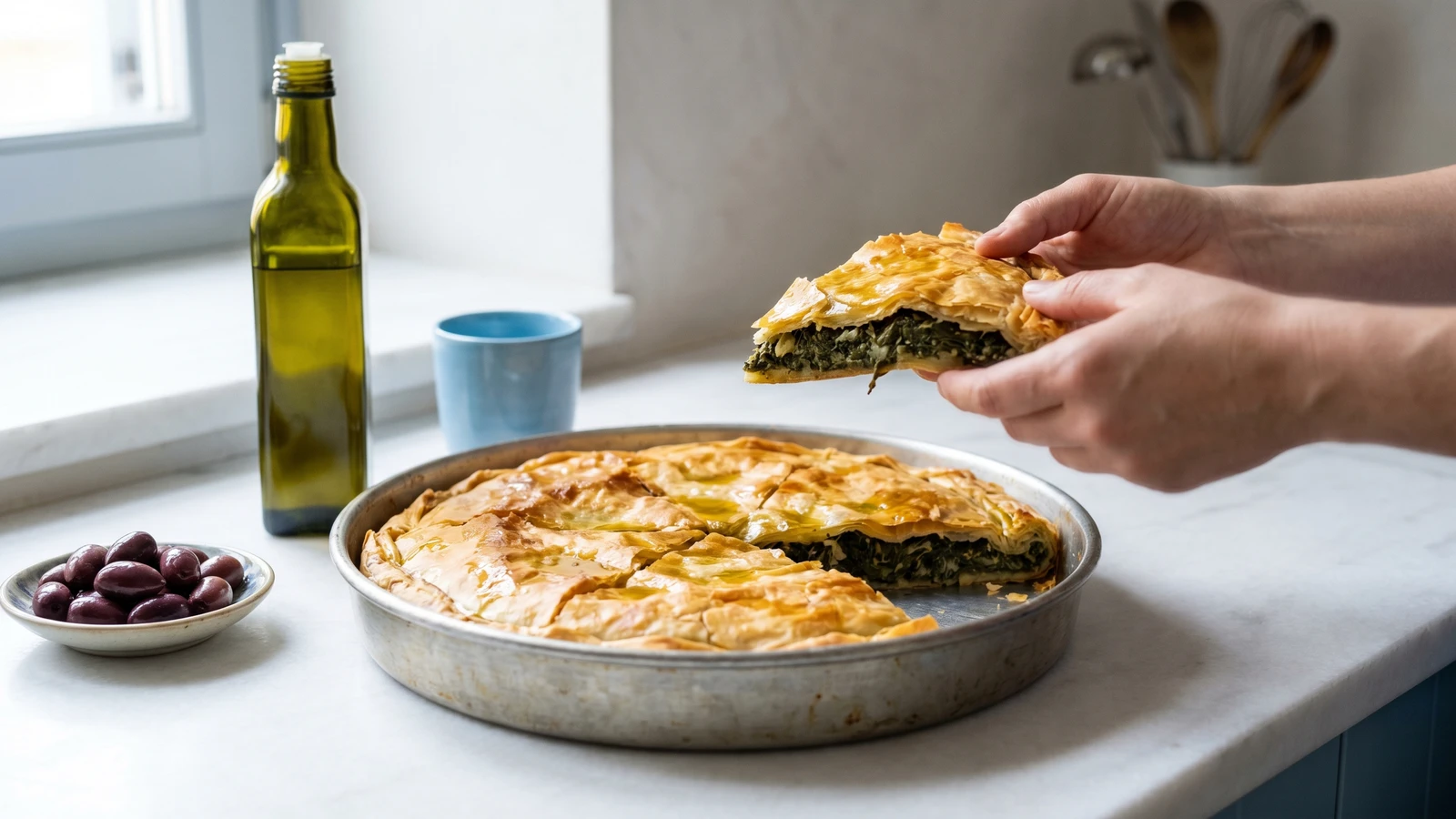
Epirotic hortopita is a mountain greens pie: handrolled phyllo, a sharp mix of horta, leeks, dill, mint and olive oil, baked until the edges crack and the bottom stays crisp.
Hortopita Ipeirotiki is Epirus folded into a tapsi: handrolled phyllo around chopped horta, leeks, dill, mint, and olive oil, with no cheese to lean on. It is green, lean, and full, the kind of pie a mountain house can make from flour, oil, and whatever the hillside gives that week.
The step that decides it is the wilting. Chop the greens fine, salt them, then squeeze out more water than you think is there before they meet the phyllo. If they go in raw and bulky, they collapse in the oven and leave you with a hollow pie and a wet bottom. Do this one thing and the filling stays even, dense, and tender.
I give the nistisimi version here, the fasting one, because it belongs in the old Epirot repertoire and it tastes clean. If you add feta, you've made another pie. Very good, yes, but another pie. Λίγα και καλά: greens that still smell alive, good olive oil, and patience with the rolling pin.
Hortopita belongs especially to Epirus, the mountain region where pites became daily food because flour, oil, and gathered greens could feed a household when meat was rare. The older fasting versions were often made without feta or egg, with a small handful of rice or cornmeal tucked into the filling to catch the greens' juices. In many Epirot villages the name followed the green, tsouknidopita for nettles, spanakopita for spinach, but the handrolled phyllo kept the family resemblance.
Quantity
500g
plus 80g more for rolling
Quantity
14g
divided
Quantity
60ml
for the dough
Quantity
15ml
Quantity
260ml
plus 15-30ml if needed
Quantity
1.2kg
washed, tough stems removed
Quantity
2 medium, about 220g
white and pale green parts thinly sliced
Quantity
6, about 100g
thinly sliced
Quantity
25g
finely chopped
Quantity
15g
finely chopped
Quantity
60g
rinsed and drained
Quantity
1/2 tsp
Quantity
160ml
divided, for the filling, pan and phyllo
| Ingredient | Quantity |
|---|---|
| all-purpose flourplus 80g more for rolling | 500g |
| fine sea saltdivided | 14g |
| extra virgin olive oilfor the dough | 60ml |
| red wine vinegar | 15ml |
| lukewarm waterplus 15-30ml if needed | 260ml |
| mixed horta (wild greens)washed, tough stems removed | 1.2kg |
| leekswhite and pale green parts thinly sliced | 2 medium, about 220g |
| spring onionsthinly sliced | 6, about 100g |
| fresh dillfinely chopped | 25g |
| fresh mintfinely chopped | 15g |
| short-grain ricerinsed and drained | 60g |
| freshly ground black pepper | 1/2 tsp |
| extra virgin Koroneiki olive oildivided, for the filling, pan and phyllo | 160ml |
Mix the flour with 6g of the salt in a large bowl. Make a well, add the 60ml olive oil, the vinegar, and 260ml lukewarm water, then bring it together with your hand until you have a rough dough. Knead for 8 to 10 minutes, adding only a spoonful more water if dry flour remains. The dough should feel smooth, soft, and alive under your palm, not sticky. Cover and rest it for 45 minutes.
Chop the horta fine, stems and leaves together where the stems are tender. Put them in a very large bowl with the remaining 8g salt, rub and turn them with your hands until they darken and slump, then leave them for 15 minutes. Squeeze the greens hard by the handful over the sink. This is the step that decides the pie. Greens that go in raw collapse in the oven and wet the bottom phyllo; greens that are wilted and squeezed fill the pie evenly.
Warm 40ml of the Koroneiki oil in a wide pan over medium heat. Add the leeks and spring onions and cook for 8 to 10 minutes, until glossy and sweet but not browned. Add the squeezed greens and turn them through the oil for 2 minutes, just to marry them with the leeks. Scrape everything into a bowl and let it cool for 10 minutes.
Fold the dill, mint, rice, black pepper, and 40ml more olive oil into the cooled greens. Taste the greens before you add more salt; they shrink, and they remember every pinch. The rice will cook inside the pie and catch the last bit of green liquor, so the filling stays tender without leaking.
Heat the oven to 190C conventional, or 170C fan. Divide the rested dough into 6 balls, making 3 of them a little larger for the bottom. On a well-floured surface, roll each ball into a thin round, about 38 to 42cm wide, dusting lightly as needed. Stack the sheets between clean towels so they don't dry while you roll the rest.
Brush a 34cm round metal tapsi with olive oil. Lay in the first large phyllo sheet, letting the edges hang over the rim, and brush it lightly with oil. Repeat with the next 2 large sheets, brushing each one. Use about 45ml oil for these bottom layers. The overhang will fold back later and make the good thick edge everyone reaches for first.
Spread the greens filling evenly over the phyllo, pressing it gently all the way to the sides. Cover with the remaining 3 phyllo sheets, brushing each with oil as you go and using another 45ml oil. Fold the overhanging bottom sheets inward to make a rim. Brush the top with the last of the oil, score into 10 or 12 pieces, and flick 2 tablespoons of water over the surface with your fingers.
Bake on the lower-middle rack for 50 to 60 minutes, until the top is deep gold, the rim is crisp, and the pie pulls slightly from the side of the pan. If your oven browns unevenly, turn the tapsi once after 35 minutes. Let the hortopita rest at least 25 minutes before cutting through the scored lines. It eats best warm or at room temperature, when the greens have settled and the phyllo still snaps under the knife.
1 serving (about 210g)
Culinary guides, cultural storytelling, and the editorial depth that makes cooking meaningful.
Discover Culinary ExplorerChef Dimitra
Agrafa's batzina is the no-phyllo pie of Karditsa: grated courgette, feta, eggs, milk, and flour poured thin into a hot oiled tapsi.

Chef Dimitra
Zagori's flour pie skips phyllo completely: a loose egg-and-flour batter, crumbled feta, and a hot buttered tapsi that makes the edges crisp.

Chef Dimitra
Hydra and Andros give amygdalota their island surname: ground almond, sugar, egg white, and rosewater, baked pale so the center stays soft as marzipan.

Chef Dimitra
Asia Minor ekmek kataifi is built in three clear layers: crisp syruped kataifi, thick semolina custard, and cold kaimaki cream under pistachios.