
Chef Dimitra
Alevropita Zagoriou (Αλευρόπιτα Ζαγορίου)
Zagori's flour pie skips phyllo completely: a loose egg-and-flour batter, crumbled feta, and a hot buttered tapsi that makes the edges crisp.
A cooking platform built around craft, culture, and the stories behind what we eat.
Created by
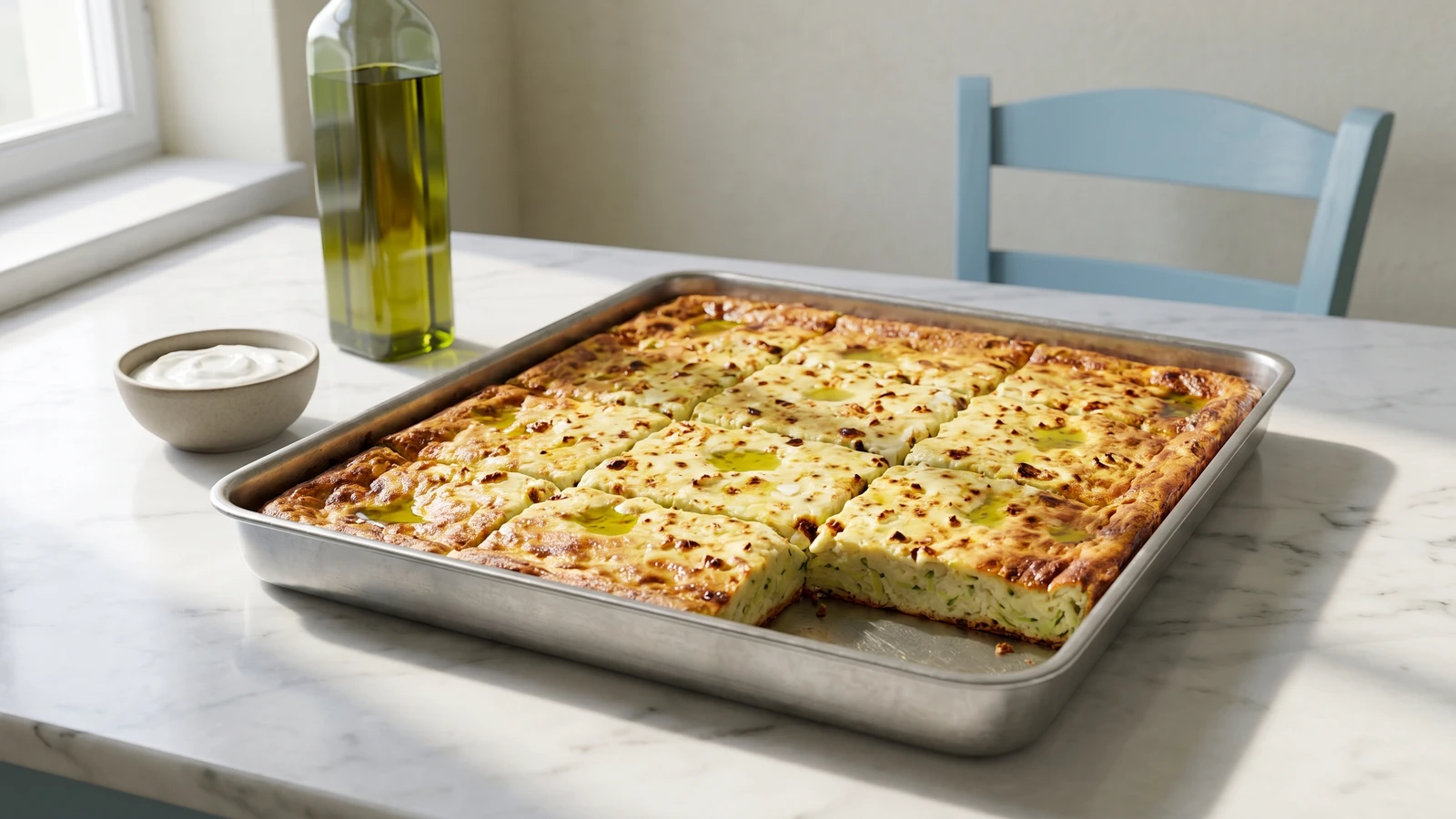
Agrafa's batzina is the no-phyllo pie of Karditsa: grated courgette, feta, eggs, milk, and flour poured thin into a hot oiled tapsi.
Batzina is Agrafa's crustless courgette and cheese pie, a thin slab from the mountains above Karditsa where a pita can be made without rolling one sheet of phyllo. Grated courgette, feta, eggs, milk, and flour go into a wide oiled tapsi and bake until the rim browns and the middle sets tender, not cakey. The region is the dish's surname here: this is a Thessalian mountain pie, plain and useful, the kind that feeds a table on a Tuesday.
The method that decides it is thinness. Salt the courgette, squeeze it hard, then loosen the batter enough that it pours and spreads no deeper than a finger in the pan. Too much water gives you a pale, heavy middle; too much flour gives you a brick. Keep it loose, keep it shallow, and the oven does the rest.
I like it warm, cut into squares after it has settled, with yogurt and olives beside it. No phyllo, no fussing, no decoration. Good olive oil, and patience. A recipe written down is a recipe saved, especially for these mountain pites that look simple until one small habit goes missing.
Batzina belongs to the mountain and plain kitchens of Thessaly, especially Karditsa and the villages around Agrafa, where a pita did not always mean phyllo. The name is linked in Thessaly to batzos, the firm brined sheep and goat cheese once made in the region before feta became the easier household cheese. The dish records a poor but clever kitchen: garden courgettes, dairy, flour, and a wide pan that made supper without rolling a single sheet.
Quantity
800g
trimmed and coarsely grated
Quantity
8g
divided
Quantity
3
Quantity
300ml
plus up to 60ml extra if needed
Quantity
100ml
divided
Quantity
220g
Quantity
45g
divided
Quantity
250g
crumbled
Quantity
1g
| Ingredient | Quantity |
|---|---|
| courgettes (kolokythakia)trimmed and coarsely grated | 800g |
| fine sea saltdivided | 8g |
| large eggs | 3 |
| whole milkplus up to 60ml extra if needed | 300ml |
| extra virgin Koroneiki olive oildivided | 100ml |
| all-purpose flour | 220g |
| fine yellow cornmealdivided | 45g |
| firm sheep's milk fetacrumbled | 250g |
| freshly ground black pepper | 1g |
Put the grated courgettes in a bowl with 5g of the salt and toss well. Leave them for 15 minutes, then pile them into a clean cotton towel and squeeze hard over the sink until the water runs out in a stream and then slows to drops. You should have about 500g squeezed courgette. Water is the thief in batzina: leave too much in, and the pie bakes pale and heavy instead of thin and tender.
Heat the oven to 200C, or 180C fan. Set a shallow 30x40cm metal tapsi in the oven for 5 minutes. Lift it out carefully, brush the bottom and sides with 40ml of the olive oil, and scatter over 15g of the cornmeal so the base has something to grip.
In a large bowl, whisk the eggs, 300ml milk, 40ml olive oil, the remaining 3g salt, and the pepper. Whisk in the flour and 30g cornmeal until you have a smooth, loose batter. Fold in the squeezed courgette and 200g of the feta. The batter should pour slowly, like thick cream with vegetables in it; if it sits in a mound, loosen it with a little of the extra milk.
Pour the batter into the hot oiled tapsi and spread it right to the corners. It should be about 1cm deep, no more than a finger. Scatter the remaining 50g feta over the top and drizzle with the last 20ml olive oil. If your pan is smaller, bake in two pans. Thick batzina is not generosity, it's a different pie.
Bake for 40 to 45 minutes, rotating the pan once, until the top is deep gold, the feta freckles have browned, and the edges pull away from the metal. Let the batzina rest for 15 minutes before cutting it into squares. Serve warm or at room temperature, with strained yogurt, olives, or a tomato cut open beside it.
1 serving (about 200g)
Culinary guides, cultural storytelling, and the editorial depth that makes cooking meaningful.
Discover Culinary ExplorerChef Dimitra
Zagori's flour pie skips phyllo completely: a loose egg-and-flour batter, crumbled feta, and a hot buttered tapsi that makes the edges crisp.

Chef Dimitra
Hydra and Andros give amygdalota their island surname: ground almond, sugar, egg white, and rosewater, baked pale so the center stays soft as marzipan.

Chef Dimitra
Asia Minor ekmek kataifi is built in three clear layers: crisp syruped kataifi, thick semolina custard, and cold kaimaki cream under pistachios.

Chef Dimitra
Athens loukoumades are yeasted honey puffs, fried gold and hollow, then drenched with warm thyme honey, cinnamon, and walnuts while still crisp-edged.