
Chef Margarida
Aletria
The Christmas twin of arroz doce, where angel hair pasta meets warm milk, golden egg yolks, and cinnamon. Convent sweetness born from surplus yolks, humble magic from grandmother's kitchen.
A cooking platform built around craft, culture, and the stories behind what we eat.
Created by
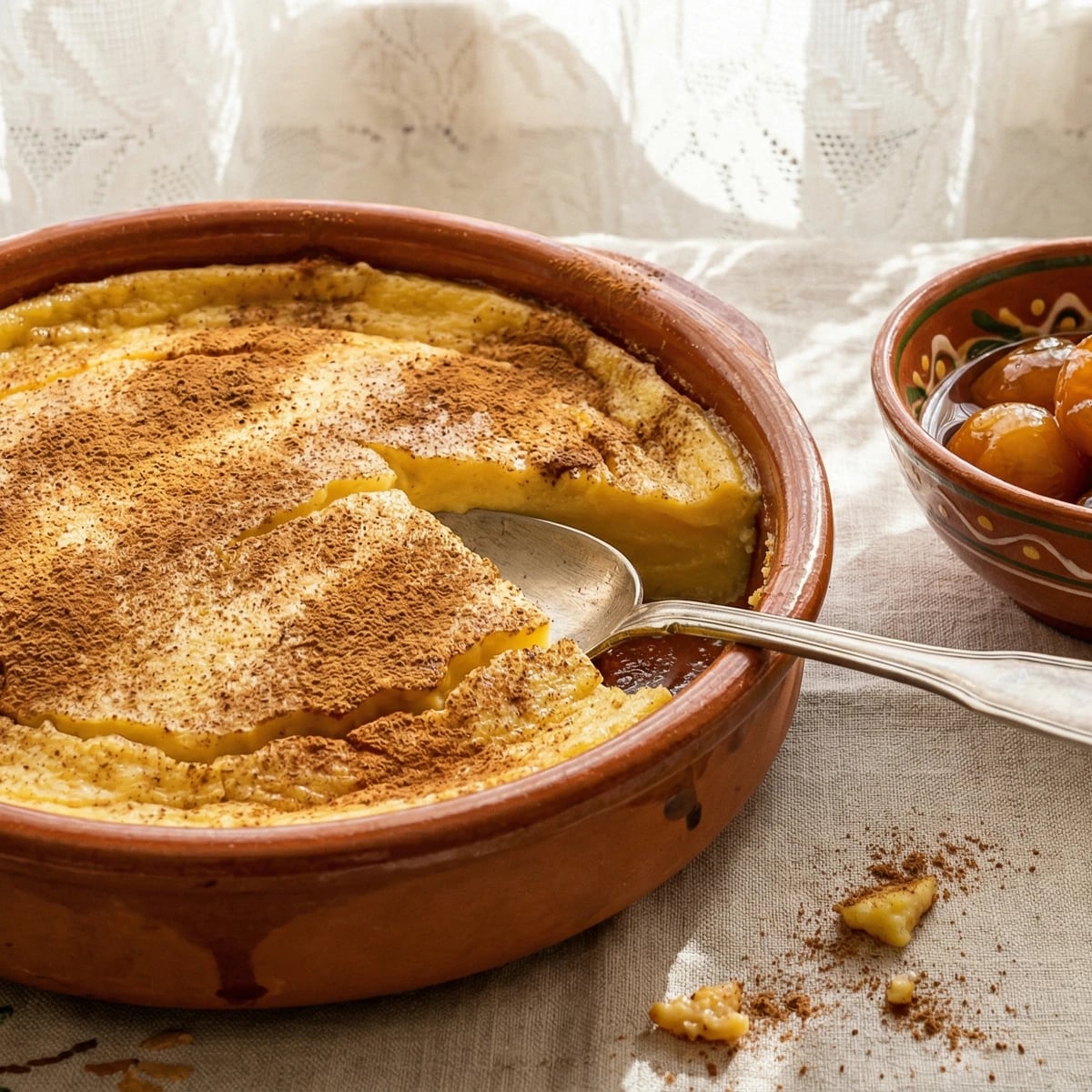
The convent custard of Alentejo, where cloistered nuns transformed surplus egg yolks into something sacred. Silky, trembling, dusted with cinnamon, best eaten with the sweet preserved plums of Elvas.
This is what happens when nuns have more egg yolks than they know what to do with. The monasteries of Alentejo received eggs by the cartload, yolks separated from whites that went to clarify wine and starch the nuns' habits. What remained became some of Portugal's most beloved desserts. Sericaia is one of the finest.
Avó Leonor made this for special occasions. Baptisms. First communions. The feast of Our Lady of the Assumption in August. She'd pull the dish from the oven still trembling in the center, dust it with cinnamon that perfumed the whole kitchen, and serve it with a bowl of ameixas de Elvas on the side. The plums are not optional, she'd say. The sweetness of the custard needs the deeper sweetness of the fruit. Together they're complete.
The technique is simpler than you'd think, but it demands attention. The eggs must be at room temperature. The milk must be warm, not hot. The baking must stop while the center still wobbles. Overbake it and you have scrambled eggs. Underbake it and it won't hold. There's a moment, and you have to catch it.
At Mesa da Avó, I serve sericaia the way the convents did: in the same earthenware dish it baked in, a spoon resting on the side, the ameixas glistening in their syrup nearby. No individual portions. Everyone reaches in. That's the tradition. A cozinha é memória.
Sericaia originated in the convents of Alentejo, most likely the Convento de Santa Clara in Elvas, sometime in the 16th or 17th century. Like most doces conventuais, it was born from the surplus egg yolks that accumulated when whites were used to clarify wine and starch religious garments. The pairing with ameixas de Elvas (sweet greengage plums preserved in sugar syrup) made the dish inseparable from the town of Elvas, which holds a Protected Geographical Indication for both the custard and the plums.
Quantity
500ml
Quantity
1
Quantity
from 1/2 lemon
in wide strips
Quantity
6 large
Quantity
2 large
Quantity
200g
Quantity
50g
sifted
Quantity
for dusting
Quantity
for the dish
Quantity
for serving
| Ingredient | Quantity |
|---|---|
| whole milk | 500ml |
| cinnamon stick | 1 |
| lemon zestin wide strips | from 1/2 lemon |
| egg yolks | 6 large |
| whole eggs | 2 large |
| sugar | 200g |
| all-purpose floursifted | 50g |
| ground cinnamon | for dusting |
| butter | for the dish |
| ameixas de Elvas (optional) | for serving |
Pour the milk into a small saucepan. Add the cinnamon stick and lemon zest strips. Heat over medium-low until small bubbles form around the edges, then remove from heat. Let it steep for 15 minutes. The milk should smell of cinnamon and citrus, warm and comforting. Remove the cinnamon stick and lemon zest. Let the milk cool to warm, not hot. If the milk is too hot when you add it to the eggs, you'll cook them.
Preheat your oven to 180°C (350°F). Generously butter a traditional earthenware dish or a ceramic baking dish about 20cm wide and 5cm deep. Set a larger roasting pan nearby and boil a kettle of water. You'll need this for the bain-marie.
In a large bowl, combine the egg yolks, whole eggs, and sugar. Beat with a whisk or electric mixer until the mixture is pale, thick, and falls in ribbons when you lift the whisk. This takes 4 to 5 minutes by hand, less with a mixer. The volume should nearly double. This is where the silkiness comes from.
Sift the flour over the egg mixture a little at a time, folding gently with a spatula after each addition. Don't beat it. You want to keep the air you've worked into the eggs. The batter should be smooth with no lumps.
Slowly pour the warm infused milk into the egg mixture, stirring constantly with a gentle hand. The batter will thin out but should remain smooth and homogeneous. Taste it. You should taste cinnamon, a whisper of lemon, and sweetness. If it tastes flat, something went wrong.
Pour the batter into your prepared dish. Place the dish in the larger roasting pan. Slide the pan into the oven, then carefully pour the hot water from the kettle into the roasting pan until it reaches halfway up the sides of the baking dish. This bain-marie creates gentle, even heat that prevents the custard from curdling.
Bake for 40 to 50 minutes. The sericaia is ready when the top is golden and puffed, the edges are set, but the center still trembles like a wave when you gently shake the pan. This wobble is essential. The custard continues cooking from residual heat after you remove it. If the center is firm in the oven, it will be overcooked on the plate.
Carefully remove the dish from the water bath. Let it cool for 10 minutes. Dust the entire surface generously with ground cinnamon through a fine sieve. The cinnamon should cover the top like a blanket of earth. Serve warm or at room temperature, directly from the dish, with a bowl of ameixas de Elvas alongside. Each serving should include a spoonful of the plums and their syrup. This is how it's meant to be eaten.
1 serving (about 125g)
Culinary guides, cultural storytelling, and the editorial depth that makes cooking meaningful.
Discover Culinary Explorer
Chef Margarida
The Christmas twin of arroz doce, where angel hair pasta meets warm milk, golden egg yolks, and cinnamon. Convent sweetness born from surplus yolks, humble magic from grandmother's kitchen.

Chef Margarida
The rice pudding that appears on every Portuguese celebration table, golden with egg yolks from the convent tradition, crowned with cinnamon art that tells you someone cared enough to make it beautiful.

Chef Margarida
The cake that defines Portuguese childhood. Layers of Maria biscuits soaked in coffee, bound with golden egg yolk cream, chilled until it becomes something magical. Every birthday, every Sunday, every grandmother's kitchen.

Chef Margarida
The dark, dense Christmas cake of Madeira, perfumed with cinnamon and cloves, sweetened with sugarcane molasses, and packed with walnuts. Break it by hand. Never cut it. This is how it's been done for six centuries.