Culinary Explorer

A cooking platform built around craft, culture, and the stories behind what we eat.
Discover Culinary Explorer
Bolo de Mel da Madeira

Bolo de Mel da Madeira

Created by

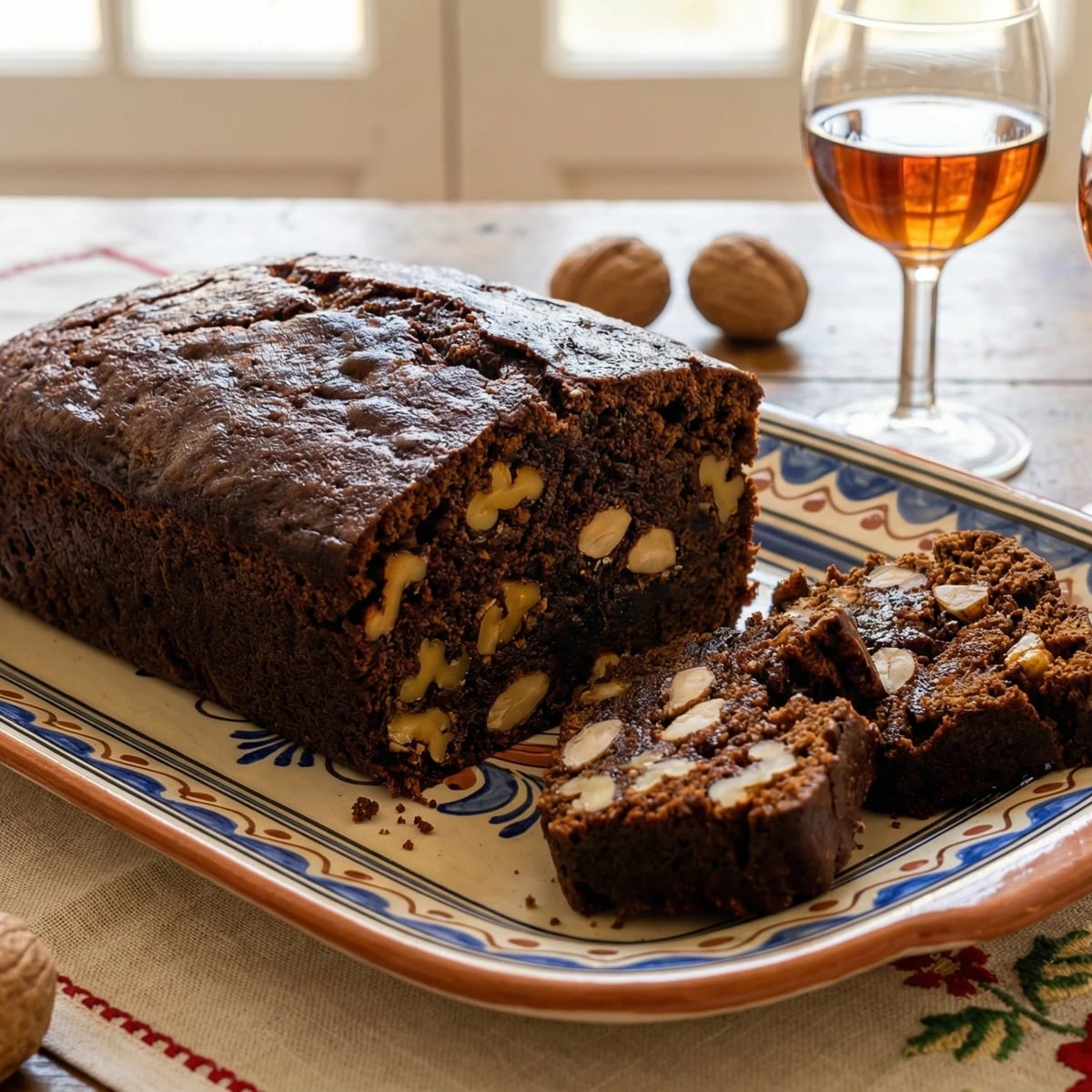
The dark, dense Christmas cake of Madeira, perfumed with cinnamon and cloves, sweetened with sugarcane molasses, and packed with walnuts. Break it by hand. Never cut it. This is how it's been done for six centuries.

Desserts
Portuguese
Christmas
Holiday
Make Ahead
30 min
Active Time
1 hr 30 min cook2 hr total
Yield2 loaves (about 24 servings)

This cake taught me that some recipes aren't just recipes. They're rituals. They're identity. They're the thing that makes Christmas feel like Christmas.

I first tasted true bolo de mel in Funchal, in the kitchen of Dona Emília, a grandmother who'd been making this cake for seventy years. She measured nothing. Her hands knew. The mel de cana went in dark and thick, the spices by smell, the walnuts by the handful. When I asked how long to bake it, she laughed. "Until the house smells right."

This is not a light cake. This is not a delicate cake. This is a cake built to last, dense with nuts and molasses, scented with the warming spices that Madeira's ships brought from the East. It improves with age. Wrapped properly, it will keep for months. The tradition says one cake can last from Christmas to Christmas, broken piece by piece throughout the year.

You break it by hand. Never cut it. The knife is an insult to this cake. You tear off a piece, let the dense crumb give way between your fingers. Dona Emília told me that breaking the cake together is part of the ritual, a way of sharing that feels more intimate than slicing.

Mel de cana is not honey. This matters. Mel de cana is sugarcane molasses, dark and complex, the product of Madeira's 600-year sugarcane industry. Regular honey won't give you the same depth. If you can't find mel de cana, use the darkest molasses you can find. But if you're making this cake to honor tradition, find the real thing. As avós sabem. The grandmothers know.

Bolo de mel emerged from Madeira's sugarcane industry, which began in the 15th century when Prince Henry the Navigator introduced sugarcane from Sicily. The island became Europe's primary sugar producer, and mel de cana (sugarcane molasses) became so abundant that cooks created this dense, spiced cake to use the surplus. The tradition of breaking rather than cutting may date to medieval beliefs about preserving luck, though Madeirans will tell you it's simply how their grandmothers always did it.

The technique, the tradition, and the story behind every dish.

Discover Culinary Explorer

Ingredients

mel de cana (sugarcane molasses)

Quantity

500g

unsalted butter or lard

Quantity

250g

dark brown sugar

Quantity

250g

egg yolks

Quantity

6 large

whole eggs

Quantity

2 large

all-purpose flour

Quantity

500g

walnuts

Quantity

300g

roughly chopped

blanched almonds

Quantity

100g

roughly chopped

ground cinnamon

Quantity

2 teaspoons

ground cloves

Quantity

1 teaspoon

ground anise (erva-doce)

Quantity

1 teaspoon

nutmeg

Quantity

1/2 teaspoon

freshly grated

baking soda

Quantity

1 teaspoon

fine sea salt

Quantity

pinch

orange zest

Quantity

from 1 orange

aguardente or brandy (optional)

Quantity

2 tablespoons

whole walnuts and almonds

Quantity

for decorating

Equipment Needed

  • Two 23cm (9-inch) loaf pans
  • Large heavy saucepan
  • Large mixing bowl
  • Wire cooling rack
  • Parchment paper

Instructions

  1. 1

    Warm the molasses mixture

    In a large heavy saucepan, combine the mel de cana, butter, and brown sugar. Set over low heat and stir until the butter melts and everything becomes one dark, glossy mixture. Don't let it boil. You want it warm enough to dissolve the sugar completely, no more. Remove from heat and let it cool until you can comfortably hold your hand against the outside of the pot, about 20 minutes.

    Dona Emília tested temperature by touch. If it's too hot when you add the eggs, you'll scramble them. Patience here. Let it cool.
  2. 2

    Prepare the pans

    Preheat your oven to 160°C (325°F). Line two 23cm loaf pans with parchment paper, letting it hang over the long sides for easy removal later. Butter the parchment. This cake sticks if you let it.

  3. 3

    Mix the spiced flour

    In a large bowl, whisk together the flour, cinnamon, cloves, anise, nutmeg, baking soda, and salt. Add the chopped walnuts and almonds, tossing to coat them in flour. This coating helps the nuts stay suspended in the batter rather than sinking to the bottom.

  4. 4

    Add the eggs

    Beat the egg yolks and whole eggs together. When the molasses mixture has cooled sufficiently, add the eggs in a slow stream, whisking constantly. The mixture should be smooth and even darker now. Stir in the orange zest and aguardente if using.

    The extra yolks are traditional. Portuguese convent desserts used egg yolks by the dozen, a legacy of using egg whites to starch nun's habits. This cake carries that tradition.
  5. 5

    Combine wet and dry

    Pour the molasses mixture into the flour and nuts. Fold with a large wooden spoon or spatula until just combined. The batter will be thick and heavy, almost like a dense bread dough. Don't overmix. You want to see some flour streaks disappear, then stop.

  6. 6

    Fill and decorate

    Divide the batter between the prepared pans, smoothing the tops with a wet spatula. Press whole walnuts and almonds into the surface in whatever pattern pleases you. Dona Emília made a cross. Others make flowers. Some just scatter them. There's no wrong way.

  7. 7

    Bake low and slow

    Bake for 1 hour and 15 minutes to 1 hour and 30 minutes. The cake is done when a skewer inserted into the center comes out with just a few moist crumbs, not wet batter. The top will be very dark, almost black in places. This is correct. Don't panic. The mel de cana caramelizes and darkens dramatically.

    If the top is browning too quickly, tent loosely with foil after the first 45 minutes. The inside needs time to set.
  8. 8

    Cool completely

    Let the cakes cool in their pans for 30 minutes, then use the parchment overhang to lift them out. Cool completely on a wire rack. This takes at least 2 hours. The cake firms up as it cools. If you try to break it while warm, it will crumble rather than tear properly.

  9. 9

    Store for aging

    Wrap the cooled cakes tightly in parchment paper, then in foil. Store in a cool, dark place. The cake improves dramatically after 1 week and continues to develop flavor for months. When ready to serve, break pieces by hand. Never cut it. This is tradition. This is how it's done.

    Dona Emília kept hers wrapped in a linen cloth inside a tin. She said the cake needs to breathe a little, but not too much. The first piece always went to the oldest person at the table.

Chef Tips

  • Mel de cana is not honey. It's sugarcane molasses, specific to Madeira's 600-year sugarcane tradition. You can find it in Portuguese specialty shops or online. If you absolutely cannot find it, use the darkest blackstrap molasses you can source, but know that you're making an approximation.
  • The eggs must be at room temperature. Cold eggs hitting warm molasses can cause the mixture to seize. Take them out of the refrigerator at least an hour before you begin.
  • This cake is better after a week. The spices mellow, the molasses deepens, everything comes together. Make it in early December for Christmas. Better yet, make it in November.
  • Lard was traditional. Butter is more common now. Either works. Lard gives a slightly denser texture and keeps longer. Use what your grandmother would have used.
  • The breaking tradition matters. Breaking creates irregular pieces that expose more of the dense interior, releasing more aroma. It also forces people to gather around the cake together. That's the point.

Advance Preparation

  • This cake must be made at least 3 days ahead, preferably 1 to 2 weeks. It needs time for the flavors to develop and the texture to set properly.
  • Wrapped tightly and stored in a cool, dark place, bolo de mel keeps for up to 6 months. Some families keep one cake from Christmas to Christmas, breaking off pieces throughout the year.
  • The spice mixture can be prepared weeks ahead and stored in an airtight container.

Frequently Asked Questions

Nutrition Information

1 serving (about 85g)

Calories
390 calories
Total Fat
21 g
Saturated Fat
7 g
Trans Fat
0 g
Unsaturated Fat
13 g
Cholesterol
85 mg
Sodium
70 mg
Total Carbohydrates
45 g
Dietary Fiber
2 g
Sugars
22 g
Protein
6 g

Note: Chef personas and recipes are created with AI assistance. Cook with care: follow safe food-handling practices, check doneness with a thermometer when needed, and adapt for allergies and your kitchen.

Where cooking meets culture.

Culinary guides, cultural storytelling, and the editorial depth that makes cooking meaningful.

Discover Culinary Explorer

More from Chef Margarida's Desserts

Browse the full collection