Culinary Explorer

A cooking platform built around craft, culture, and the stories behind what we eat.
Discover Culinary Explorer
Aletria

Aletria

Created by

The Christmas twin of arroz doce, where angel hair pasta meets warm milk, golden egg yolks, and cinnamon. Convent sweetness born from surplus yolks, humble magic from grandmother's kitchen.

Desserts
Portuguese
Christmas
Holiday
15 min
Active Time
30 min cook45 min total
Yield8 servings

At Christmas in Portugal, there are two desserts that matter: arroz doce and aletria. They're siblings, really. Same soul, different body. One made with rice, one with angel hair pasta. Both swimming in milk, enriched with egg yolks, fragrant with cinnamon and lemon. Both waiting on every grandmother's table come December.

Avó Leonor made both, but aletria was her favorite. She said it was faster than arroz doce (it is), more delicate (debatable), and reminded her of her own grandmother in the Alentejo who couldn't always afford rice but could always get pasta. Necessity shaped tradition. That's the Portuguese way.

This is a convent dessert at heart. For centuries, Portuguese convents used egg whites to starch their habits and clarify their wine. The yolks piled up. What do you do with mountains of yolks? You make sweets. Doces conventuais. Aletria, ovos moles, toucinho do céu, all born from this golden surplus. The nuns became famous for their desserts, and those recipes eventually left the convents and entered our grandmothers' kitchens.

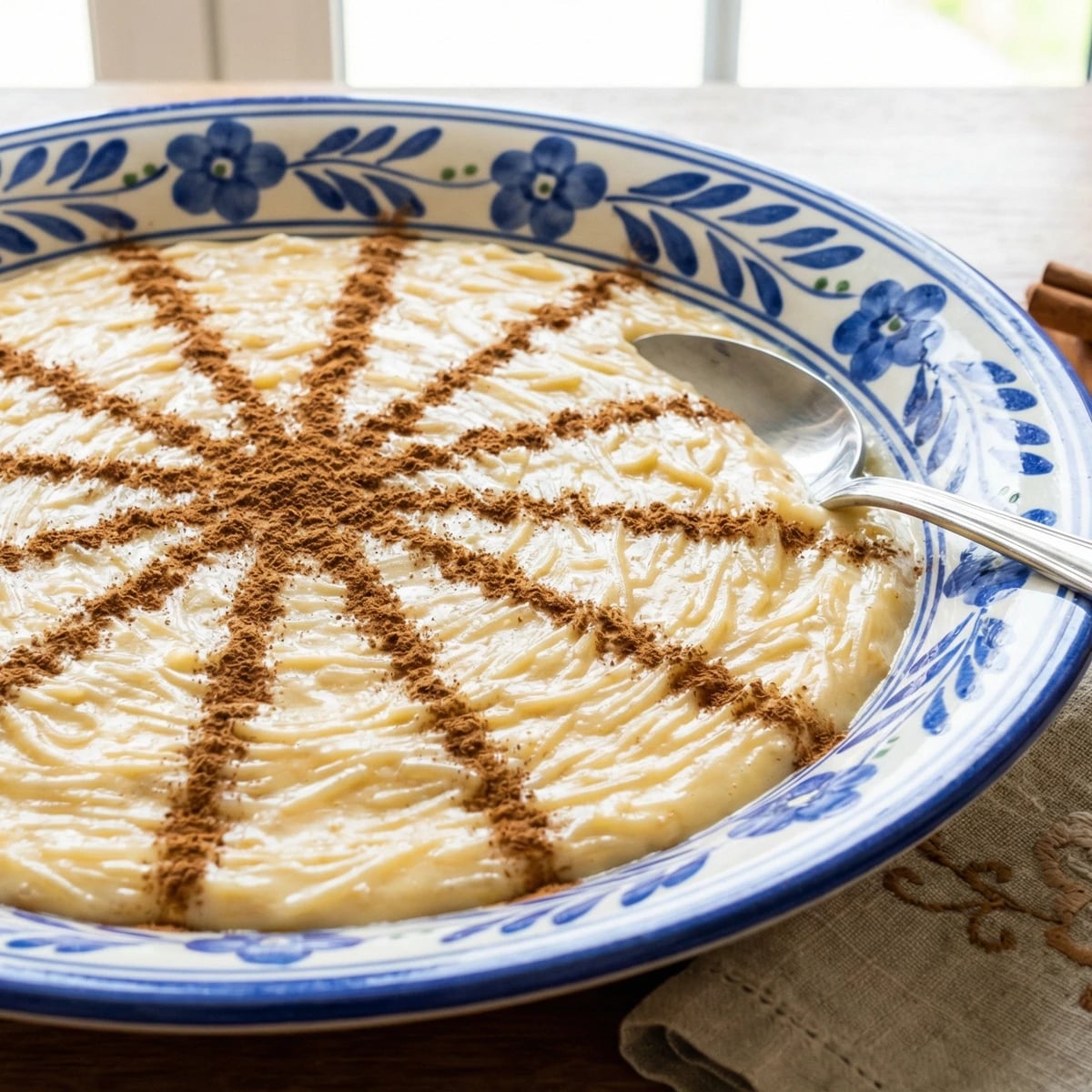
The cinnamon patterns on top aren't just decoration. They're identity. Every family draws them differently. Ask a Portuguese person about their aletria and they'll tell you about the design their grandmother made, the serving dish she used, the way the kitchen smelled on Christmas Eve. A cozinha é memória. The kitchen is memory.

Aletria traces its origins to medieval Portugal, where Arab influence introduced both pasta and the technique of cooking it in sweetened milk. The dish became intertwined with convent cooking traditions from the 15th century onward, when surplus egg yolks (left over from clarifying wine and starching habits) were transformed into rich desserts. The name itself derives from the Arabic 'itriyya,' meaning a type of thin noodle.

The technique, the tradition, and the story behind every dish.

Discover Culinary Explorer

Ingredients

angel hair pasta (aletria)

Quantity

200g

broken into 3cm pieces

whole milk

Quantity

1 liter

sugar

Quantity

200g

egg yolks

Quantity

6 large

unsalted butter

Quantity

50g

lemon zest

Quantity

from 1 lemon

in wide strips

cinnamon sticks

Quantity

2

fine sea salt

Quantity

1 pinch

ground cinnamon

Quantity

for decoration

Equipment Needed

  • Wide heavy-bottomed pot (at least 3 liters)
  • Wooden spoon
  • Wide shallow serving dish or individual bowls
  • Small whisk for tempering eggs

Instructions

  1. 1

    Infuse the milk

    Pour the milk into a wide, heavy-bottomed pot. Add the cinnamon sticks, lemon zest strips, and butter. Set it over medium heat and bring just to a gentle simmer. Don't let it boil. Let it warm slowly for 5 minutes so the aromatics perfume the milk. The kitchen should smell like Christmas morning at your avó's house.

    Wide strips of lemon zest are easier to fish out later. Use a vegetable peeler and avoid the bitter white pith.
  2. 2

    Cook the pasta in milk

    Add the broken pasta and the pinch of salt to the infused milk. Stir gently to separate the strands. Reduce heat to medium-low and cook, stirring frequently to prevent sticking, until the pasta is completely soft and has absorbed much of the milk, about 15 to 18 minutes. The mixture will look creamy and thick. This isn't al dente territory. We want the pasta tender, almost dissolving into the milk.

    Stir from the bottom. Angel hair loves to clump and stick to the pot. A wooden spoon with a flat edge works best.
  3. 3

    Add the sugar

    Once the pasta is soft and the mixture has thickened, stir in the sugar until completely dissolved. Continue cooking for another 2 to 3 minutes. The aletria should be loose but creamy, like a thick porridge. It will firm up as it cools.

  4. 4

    Temper the egg yolks

    Remove the pot from heat. Fish out the cinnamon sticks and lemon zest strips and discard them. In a small bowl, beat the egg yolks until smooth. Take a ladleful of the hot pasta mixture and slowly drizzle it into the yolks while whisking constantly. This tempers the eggs so they won't scramble. Add another ladleful, still whisking. Now pour this tempered yolk mixture back into the pot, stirring constantly.

    This step cannot be rushed. Cold yolks meeting hot milk without tempering will give you sweet scrambled eggs. Avó Leonor's voice is in my head: 'Devagar, menina.' Slowly, girl.
  5. 5

    Final cooking

    Return the pot to low heat. Cook, stirring constantly, for 2 to 3 minutes until the mixture thickens slightly and coats the back of your spoon. The eggs should be fully incorporated, giving everything a golden, silky richness. Do not let it boil or the yolks will curdle. The moment it thickens, remove from heat.

  6. 6

    Set and decorate

    Pour the aletria into a wide, shallow serving dish, or divide among individual bowls. Smooth the top gently with the back of a spoon. While still warm, dust generously with ground cinnamon. If you want to be traditional, use a fork or toothpick to draw decorative patterns in the cinnamon: crosshatches, spirals, or the lines my grandmother always made, radiating out from the center like sun rays. Let it cool to room temperature, then refrigerate for at least 2 hours before serving.

Chef Tips

  • Use proper angel hair pasta, the thinnest you can find. Some Portuguese shops sell packages labeled 'aletria' specifically. If you can't find it, capellini works. Don't use thicker pasta; it won't absorb the milk the same way.
  • The egg yolks must be at room temperature. Cold yolks are harder to temper and more likely to scramble. Take them out of the refrigerator an hour before you start.
  • Some families add a splash of port wine at the end, just a tablespoon or two, for depth. Avó Leonor didn't, but I've tasted versions that do and they're beautiful. Make it your own.
  • The cinnamon decoration is best done while the surface is still slightly warm and tacky. If you wait until it's fully cold, the cinnamon won't stick in clean lines.
  • Aletria tastes even better the next day, after a night in the refrigerator. The flavors meld and the texture sets perfectly. Make it Christmas Eve morning for Christmas dinner.

Advance Preparation

  • Aletria must be made at least 2 hours ahead to allow it to cool and set properly. It's best made the morning of or even the day before serving.
  • Stored covered in the refrigerator, aletria keeps beautifully for 3 to 4 days. The texture firms up more each day.
  • Decorate with cinnamon before refrigerating. Adding cinnamon to a cold surface won't give you clean patterns.

Frequently Asked Questions

Nutrition Information

1 serving (about 170g)

Calories
350 calories
Total Fat
13 g
Saturated Fat
7 g
Trans Fat
0 g
Unsaturated Fat
5 g
Cholesterol
165 mg
Sodium
30 mg
Total Carbohydrates
49 g
Dietary Fiber
1 g
Sugars
31 g
Protein
9 g

Note: Chef personas and recipes are created with AI assistance. Cook with care: follow safe food-handling practices, check doneness with a thermometer when needed, and adapt for allergies and your kitchen.

Where cooking meets culture.

Culinary guides, cultural storytelling, and the editorial depth that makes cooking meaningful.

Discover Culinary Explorer

More from Chef Margarida's Desserts

Browse the full collection