Chef Elsa
Almjause (Alpine Hut Snack Board)
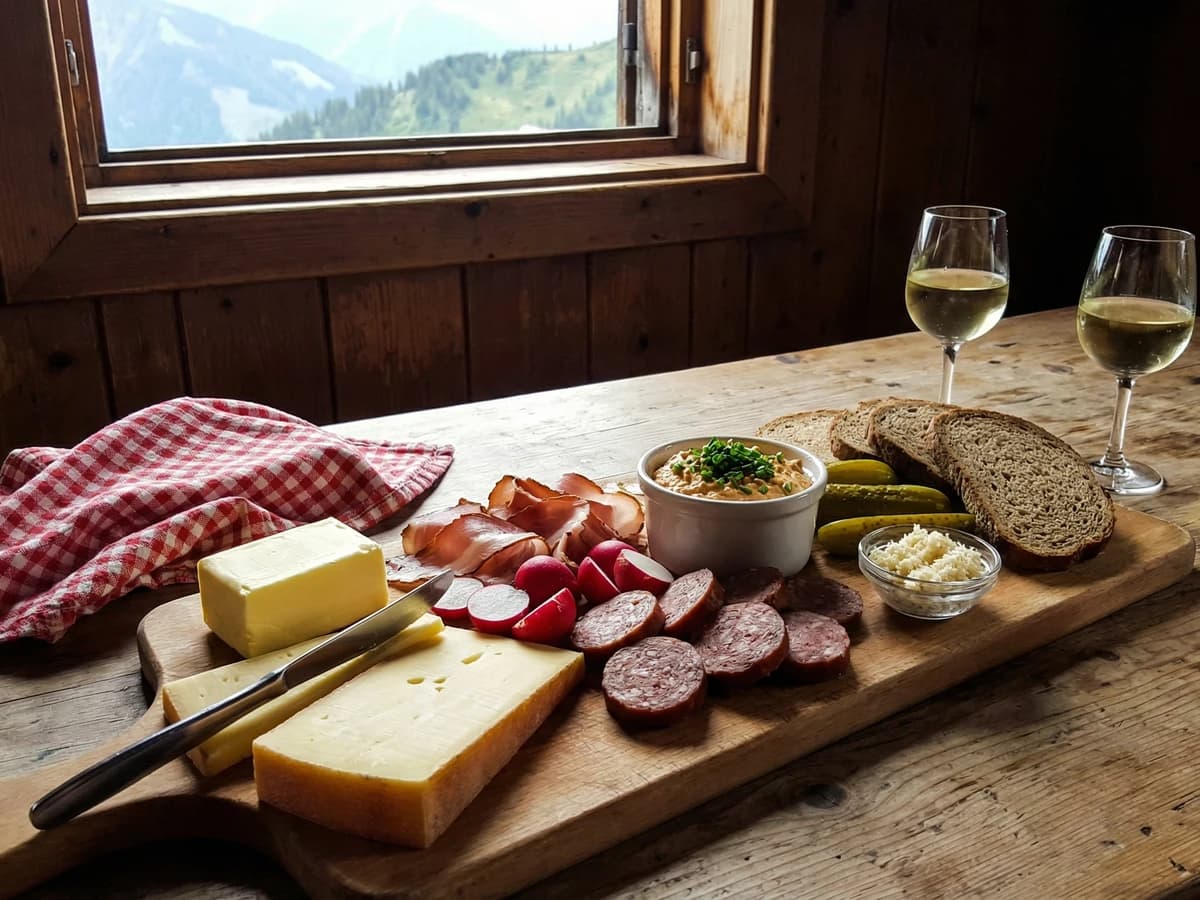
A wooden board loaded with mountain cheese, juniper-smoked Speck, air-dried Hauswürstel, handmade Liptauer, fresh Kren, and thick-cut Bauernbrot, the way Austrian Almhütten have fed hikers for generations.
A cooking platform built around craft, culture, and the stories behind what we eat.

Created by
Cold-set pork aspic from the Austrian Heuriger tradition, sliced thick and dressed with sharp cider vinegar, raw onion rings, and a generous pour of dark Styrian pumpkin seed oil on a wooden Brettl.
The first time I ate Schweinssulz properly was at a Heuriger outside Gumpoldskirchen on one of those childhood trips with Gretel and my grandmother Eva. I was maybe ten. The wine tavern had a garden under old chestnut trees, and somebody put a wooden board in front of me with sliced aspic, dark bread, and a little jug of pumpkin seed oil so green it looked almost black. I remember Gretel telling me to try it before I decided I didn't like it. She was right, of course. The pork was tender and clean-tasting, the jelly firm but not rubbery, and the Kernöl turned the whole plate into something I couldn't stop eating.
Schweinssulz is peasant thrift at its most elegant. You take the parts of the pig that are rich in collagen, the knuckle, the trotter, a bit of shoulder for good meat, and you simmer them low and slow until the cooking liquid turns to natural jelly when it cools. No packet gelatin. No shortcuts. The pork sets itself. You slice it cold, dress it with vinegar and raw onion, and pour Styrian Kernöl over everything. That's the whole dish.
This is Heuriger food, wine tavern food, the kind of thing you eat outside on a warm evening with a glass of Grüner Veltliner and nowhere to be. It's not complicated. It's not fancy. But it depends entirely on good ingredients and patience, and that's Austrian cooking at its most honest. Make it a day ahead. It needs the night in the fridge to set. Then slice it, dress it, and put it on the table with good bread and let people help themselves.
Schweinssulz belongs to the Brettljause tradition of Austrian wine taverns, where cold meats, spreads, pickles, and bread are served on a wooden board alongside local wine. The Heuriger itself dates to a 1784 decree by Emperor Joseph II permitting winemakers to sell their own wine directly to the public, and the simple cold food that accompanied it became a cuisine in its own right. Sulz, or aspic made from natural pork gelatin without commercial setting agents, was a farmhouse preservation method long before refrigeration, a way to use every part of the animal and keep cooked meat edible for days in a cool cellar.
Quantity
1, about 800g
Quantity
1
split lengthwise by the butcher
Quantity
500g
Quantity
2 medium
peeled
Quantity
1/2
peeled and quartered
Quantity
2 medium
peeled and halved
Quantity
2
Quantity
8
Quantity
4
Quantity
1 tablespoon
Quantity
3 tablespoons
Quantity
2 cloves
lightly crushed
Quantity
small bunch
stalks and leaves separated
Quantity
1 teaspoon
Quantity
2 liters (approximately)
Quantity
4-5
finely diced
Quantity
2 tablespoons
finely chopped
Quantity
freshly ground, to taste
Quantity
for serving
Quantity
1 medium
sliced into thin rings, for serving
Quantity
for serving
Quantity
for serving
| Ingredient | Quantity |
|---|---|
| pork knuckle (Stelze) | 1, about 800g |
| pig's trottersplit lengthwise by the butcher | 1 |
| boneless pork shoulder | 500g |
| carrotspeeled | 2 medium |
| celeriacpeeled and quartered | 1/2 |
| onionspeeled and halved | 2 medium |
| bay leaves | 2 |
| whole black peppercorns | 8 |
| allspice berries | 4 |
| salt | 1 tablespoon |
| white wine vinegar | 3 tablespoons |
| garliclightly crushed | 2 cloves |
| fresh parsleystalks and leaves separated | small bunch |
| mustard seeds | 1 teaspoon |
| cold water | 2 liters (approximately) |
| cornichonsfinely diced | 4-5 |
| fresh parsley leaves (for aspic)finely chopped | 2 tablespoons |
| black pepper | freshly ground, to taste |
| cider vinegar | for serving |
| white onionsliced into thin rings, for serving | 1 medium |
| Styrian Kernöl (pumpkin seed oil) | for serving |
| dark rye bread or Bauernbrot | for serving |
Rinse the pork knuckle, trotter, and shoulder under cold running water. Place them in your largest pot. The trotter is here for one reason: collagen. It will dissolve into the cooking liquid over the next few hours and set the whole thing into a firm, clean jelly without you adding a single gram of packet gelatin. If the idea of a pig's trotter makes you uneasy, this is the moment to get over it. It's doing all the structural work.
Cover the pork with about two liters of cold water. As with any good broth, cold water is essential here. It draws the proteins out gradually and gives you a cleaner liquid. Add the carrots, celeriac, halved onions, garlic, bay leaves, peppercorns, allspice berries, mustard seeds, parsley stalks, salt, and white wine vinegar. The vinegar does two things: it helps clarify the liquid and it gives the finished Sulz a gentle acidity that keeps the pork from tasting flat.
Bring the pot to a gentle simmer over medium heat. Gray foam will rise. Skim it off patiently until the surface stays clear. Then reduce the heat until you see only the laziest, most occasional bubble. This is the same principle as a good Tafelspitz broth: if the liquid rolls and boils, the meat tightens, the fat emulsifies, and your jelly turns cloudy. You want a surface that barely trembles. Let it go for three to three and a half hours. The knuckle meat should be falling off the bone. The trotter will have given up most of its structure. The kitchen will smell like a very good farmhouse.
Carefully lift the pork pieces out of the liquid and set them on a large plate to cool. Discard the trotter, the vegetables, and the aromatics. They've done their work. Strain the cooking liquid through a fine-mesh sieve lined with muslin or a clean tea towel into a clean pot. You should have roughly a liter of strained liquid. It will look like a rich, slightly golden broth. Taste it. It should be well-seasoned and faintly sharp from the vinegar. Adjust salt now if needed.
When the knuckle and shoulder are cool enough to handle, pull the meat apart with two forks or your fingers. Discard any skin, fat, cartilage, or gristle you don't want. Some people leave small pieces of soft skin in for texture. That's your call, but the meat itself should be in rough, bite-sized shreds, not minced and not in perfect cubes. Uneven pieces look right and eat well.
Spoon a tablespoon of the strained liquid onto a cold saucer and put it in the fridge for fifteen minutes. It should set to a firm jelly that holds its shape when you tilt the plate. If it's too soft, return the liquid to the heat and reduce it by a quarter. The trotter should have given you more than enough gelatin, but every animal is different. If the set is too firm, add a splash of water. You're looking for a jelly that slices cleanly but melts on the tongue.
Spread the shredded pork evenly into a loaf tin, terrine mould, or deep rectangular dish lined with cling film. The lining makes unmoulding easy later. Scatter the diced cornichons and chopped parsley through the meat. Grind black pepper generously over everything. Slowly pour the strained liquid over the pork until it just covers the meat. Tap the dish on the counter a few times to release any trapped air bubbles. The meat should be submerged but not swimming.
Cover the dish tightly and refrigerate for at least twelve hours, overnight is ideal. The jelly needs this time to set completely. Don't touch it, don't check it, don't open the fridge to peek. Walk away. Make the Kernöl dressing tomorrow.
Run a thin knife around the edges of the mould. Invert it onto a cutting board and peel away the cling film. The Sulz should hold its shape beautifully, a solid block of pork suspended in clear, amber-tinted jelly with flecks of green parsley and pale cornichon visible throughout. Slice it about a centimeter thick with a sharp knife dipped in hot water between cuts. The slices should be clean and firm.
Lay the slices on a wooden Brettl or a simple plate. Separate the onion rings and scatter them generously over the top. Drizzle cider vinegar over the slices, just enough to make the surface glisten. Then pour Styrian Kernöl in a slow, deliberate stream over everything. The oil is so dark it looks nearly black, but where it pools against the pale jelly it shows its true color: a deep, almost iridescent green. Serve with thick slices of dark rye bread and nothing else. This is good Austrian home cooking. Mahlzeit!
1 serving (about 270g)
Culinary guides, cultural storytelling, and the editorial depth that makes cooking meaningful.
Discover Culinary ExplorerChef Elsa
A wooden board loaded with mountain cheese, juniper-smoked Speck, air-dried Hauswürstel, handmade Liptauer, fresh Kren, and thick-cut Bauernbrot, the way Austrian Almhütten have fed hikers for generations.

Chef Elsa
Dark, spiced, and wickedly good: Blunzn mashed with onion, mustard, and marjoram into the kind of spread that disappears first from every Heuriger Brettl, scooped up on torn hunks of dark bread.

Chef Elsa
A silky potato and sour cream spread with raw onion and paprika, piled onto dark rye bread the way they serve it at every Heuriger in Lower Austria. No cheese, despite the name. Just good potatoes and honest cooking.
Chef Elsa
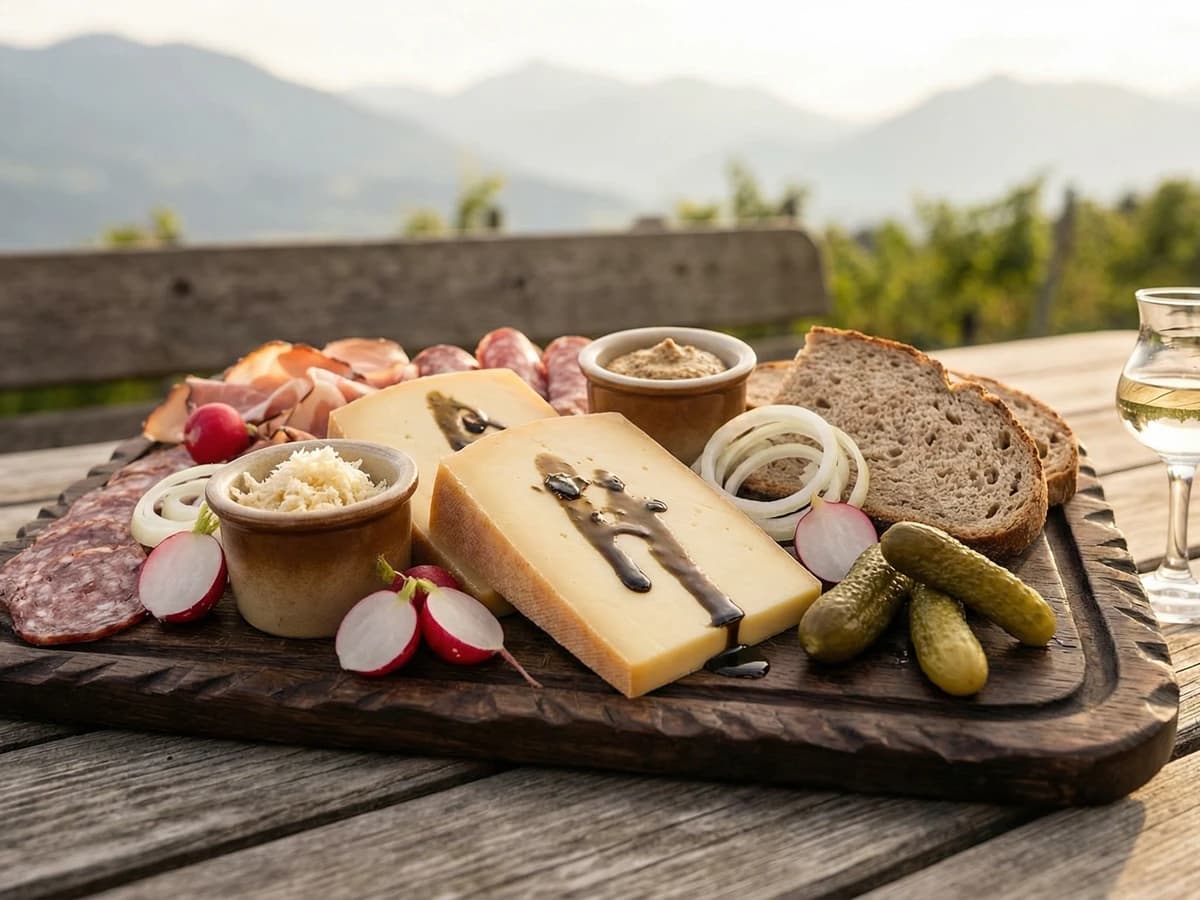
A proper Carinthian Brettljause built around PDO Gailtaler Almkäse, nutty raw-milk alpine cheese served with Speck, dark Bauernbrot, pickles, fresh horseradish, and everything you need for an afternoon on an Almhütte terrace.