
Chef Klaus
Badischer Wurstsalat
Baden's sharp, no-mayonnaise Vesper salad lives by the cut and the rest: fine Lyoner strips drinking vinegar and mustard before the oil softens the whole bowl.
A cooking platform built around craft, culture, and the stories behind what we eat.
Created by
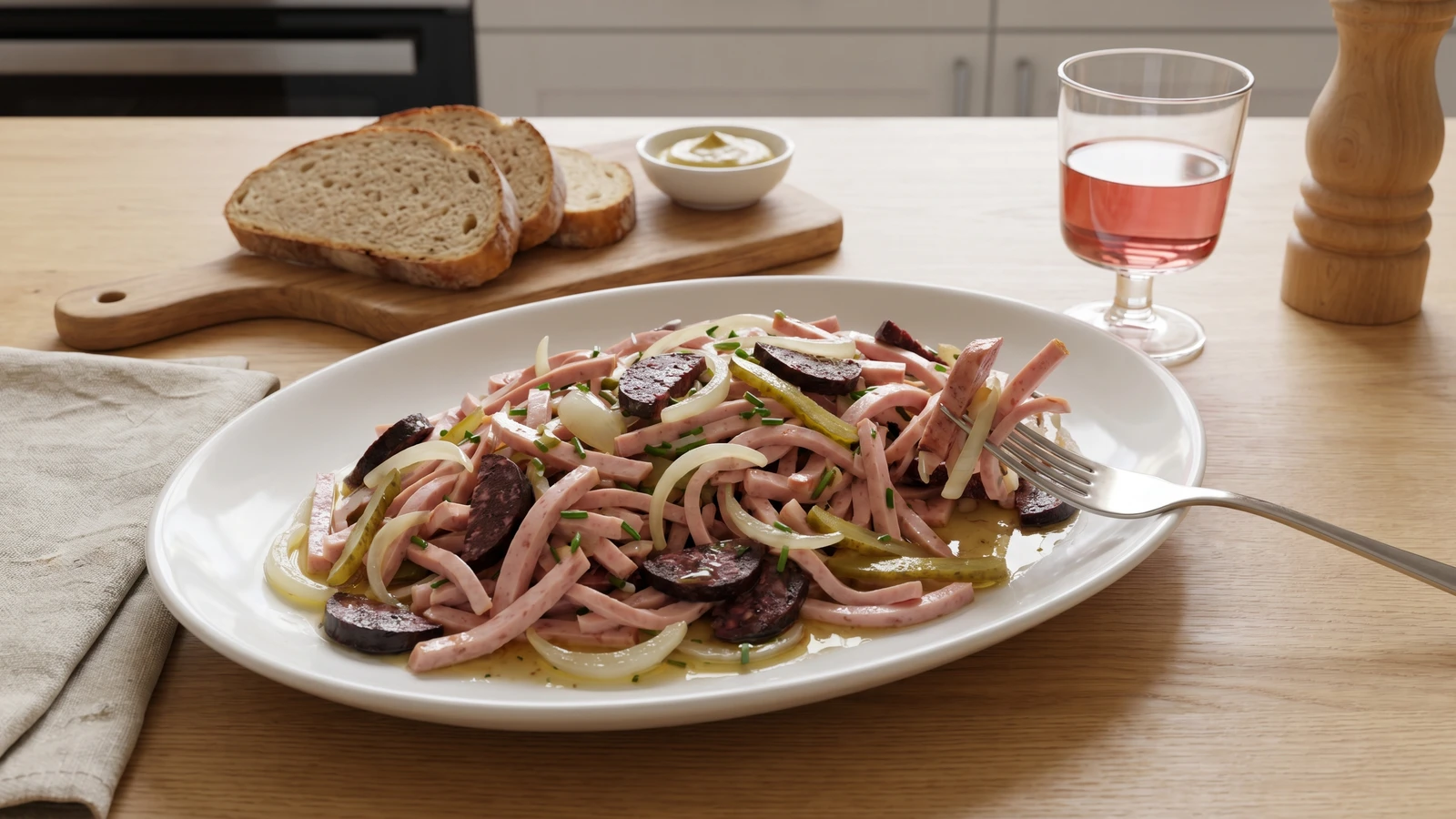
The Swabian Vesper salad that knows what it is: pale Fleischwurst, dark Schwarzwurst, onions, pickles, and a sharp vinegar-oil dressing given thirty minutes to do its work.
Schwäbischer Wurstsalat is Vesper food from Württemberg and Swabia, Vesper meaning the cold bread-and-sausage meal that lands on the table after work or in a picnic basket. I make it when the stove can stay off: two cooked sausages from the butcher, onions, pickles, vinegar, oil, and Bauernbrot, farmer's bread, beside it. It belongs to warm weather, but the logic is older than summer. The larder did the cooking already.
Swabia wants two sausages. Fleischwurst, a mild boiled sausage, gives you the pale strips; Schwarzwurst, firm blood sausage, gives the dark strips and the deep iron note. Bavaria may use Regensburger, Switzerland puts Emmentaler in and calls it Schweizer Wurstsalat, and Franconia has its own Stadtwurst arguments. Im Norden anders, im Süden anders. Here the black sausage is not garnish. It is the Swabian signature.
The dish works or fails on the cut and the wait. Slice the sausage thin enough to bend, slice the onion thin enough to soften, dress it sharply, and leave it alone for thirty minutes. Acid cannot do much with a thick cube. It needs surface and time, so it can get under the fat and make the sausage taste like salad, not cold lunch meat in sour water.
No mayonnaise, not even a polite spoonful. Nicht aus dem Glas. Mayonnaise mutes the vinegar and turns a clean Vesper into a pale paste. The dressing should shine at the bottom of the bowl, sharp enough that the bread wants it.
Schwäbischer Wurstsalat grew out of the Württemberg Vesper, the cold evening meal of bread, sausage, pickles, and local wine that was common in farm and workshop households by the 19th century. Schwarzwurst ties the dish to the winter Schlachtfest, slaughter feast, when blood, rind, and trim were put into sausage because Weggeworfen wird nichts, nothing gets thrown away. The regional split is still visible on menus: Swabia adds the black sausage, Switzerland adds Emmentaler, and Bavaria often uses Regensburger or Stadtwurst without the blood sausage.
Quantity
300g
casing removed, cut into thin strips
Quantity
200g
casing removed, cut into thin strips
Quantity
1 medium
sliced into very thin half-moons
Quantity
3 medium
cut into thin strips
Quantity
3 tablespoons
Quantity
4 tablespoons
Quantity
1 teaspoon
Quantity
1/2 teaspoon
Quantity
1/4 teaspoon, plus more to taste
Quantity
to taste
Quantity
4 tablespoons
Quantity
2 tablespoons
to loosen the dressing
Quantity
1 small bunch
finely snipped
Quantity
4 thick slices
to serve
Quantity
to serve
| Ingredient | Quantity |
|---|---|
| Fleischwurst or Lyonercasing removed, cut into thin strips | 300g |
| firm Schwarzwurstcasing removed, cut into thin strips | 200g |
| yellow or red onionsliced into very thin half-moons | 1 medium |
| Gewürzgurkencut into thin strips | 3 medium |
| brine from the Gewürzgurken | 3 tablespoons |
| white wine vinegar | 4 tablespoons |
| mild German mustard | 1 teaspoon |
| sugar | 1/2 teaspoon |
| fine salt | 1/4 teaspoon, plus more to taste |
| freshly ground black pepper | to taste |
| sunflower or rapeseed oil | 4 tablespoons |
| cold beef broth or water (optional)to loosen the dressing | 2 tablespoons |
| chivesfinely snipped | 1 small bunch |
| Bauernbrotto serve | 4 thick slices |
| extra German mustard (optional) | to serve |
Peel the casing from the Fleischwurst and Schwarzwurst, then cut both into thin strips, about 3mm wide and long enough to twist on a fork. Thin strips matter because the dressing clings to cut surfaces and slips between them; thick cubes stay greasy in the middle and taste like sausage with sour edges. Keep the Schwarzwurst cold while you cut it, because firm blood sausage slices clean while a warm one smears into the dressing.
Put the sliced onion in a wide bowl with the vinegar, pickle brine, mustard, sugar, salt, and plenty of black pepper. Work it once with a spoon and leave it 10 minutes. The vinegar pulls the raw bite from the onion, the salt draws out a little juice, and that onion juice becomes part of the dressing instead of sitting harsh on top.
Whisk in the sunflower or rapeseed oil after the onion has softened, then add the cold broth or water if the dressing looks too tight. Oil goes in after the acid because oil coats the sausage; give vinegar the first word and it cuts the fat instead of sliding over it. Taste the dressing now. It should be sharper than you want the finished salad, because cold sausage and bread will calm it.
Add the Fleischwurst, Schwarzwurst, and pickle strips to the bowl and fold until every strip shines. Press the salad down lightly so the lower pieces sit in the dressing, cover it, and leave it 30 minutes in the refrigerator, or at cool room temperature if you're serving soon. Das braucht seine Zeit, even for a quick meal: the acid moves into the cut sausage, the onion softens, and the black sausage gives the dressing a dark savoury edge.
Fold once more, then taste before you carry it out. Add a splash more vinegar if it tastes flat, a pinch of salt only if the sausage needs it, and chives at the end so they stay green. Serve with thick Bauernbrot, farmer's bread, and extra mustard. Keep picnic bowls chilled and don't let cooked sausage sit in the sun; thrift cooking still has rules. Schön ist, was schmeckt.
1 serving (about 275g)
Culinary guides, cultural storytelling, and the editorial depth that makes cooking meaningful.
Discover Culinary ExplorerChef Klaus
Baden's sharp, no-mayonnaise Vesper salad lives by the cut and the rest: fine Lyoner strips drinking vinegar and mustard before the oil softens the whole bowl.

Chef Klaus
The capital's creamy potato salad, built on warm waxy potatoes that drink the dressing before mayonnaise binds the bowl, with pickle, onion, and egg doing the sharpening.

Chef Klaus
A Brandenburg country potato salad, lighter than Berlin's mayonnaise bowl: warm potatoes drinking hot broth and vinegar before the sausage, pickle, and egg go in.

Chef Klaus
The butcher-counter salad for Abendbrot and picnics: fine strips of Lyoner and pickled cucumber, bound lightly with tart mayonnaise, rested until the brine does its work.