
Chef Jeong-sun
Al-tang (Fish Roe Stew)
A weeknight fish roe stew with radish and crown daisy in a clean spicy broth, where the whole success depends on adding the roe late enough that it sets tender, not chalky.
A cooking platform built around craft, culture, and the stories behind what we eat.
Created by
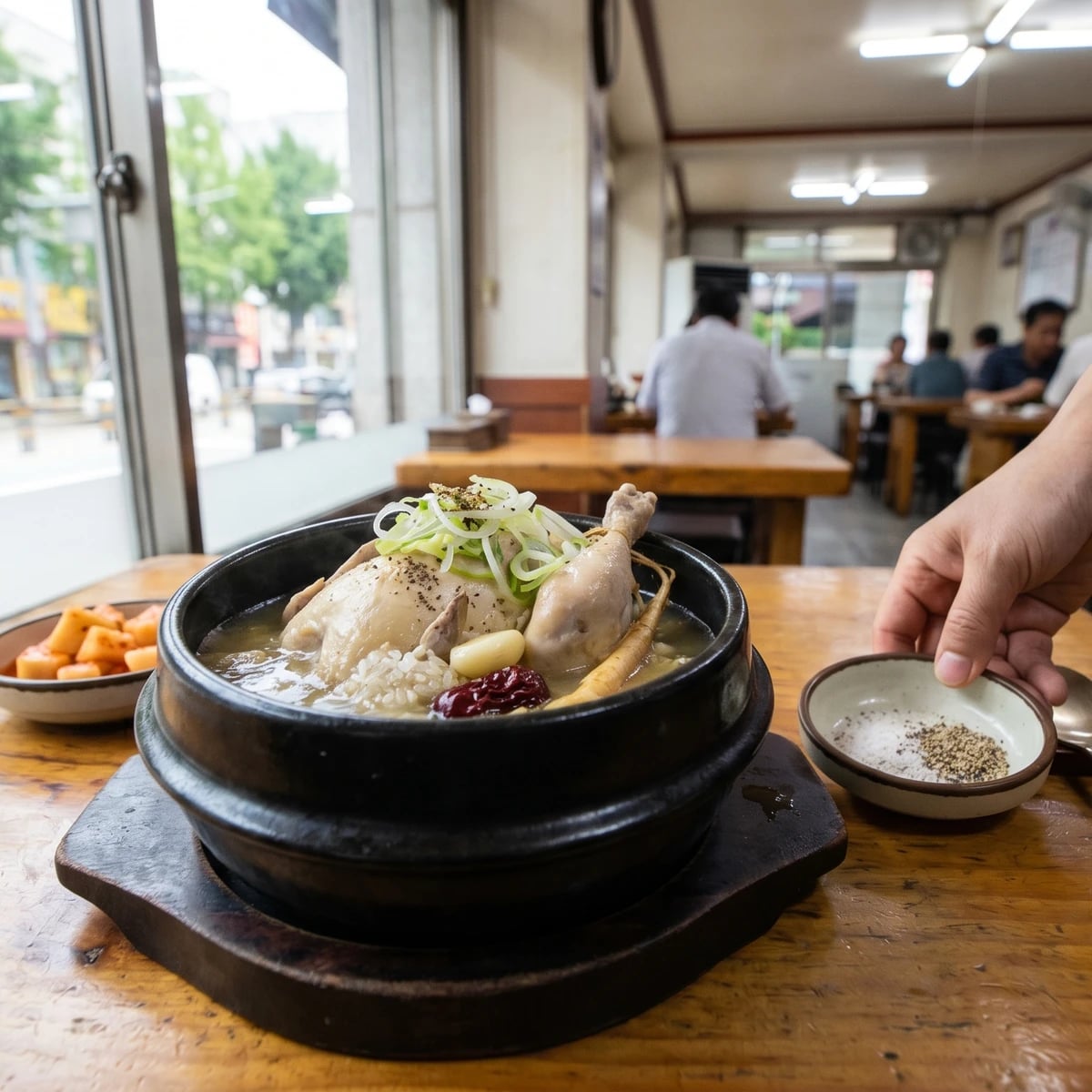
The boknal soup that fights summer heat with heat: a whole young chicken stuffed with sweet rice, ginseng, garlic, and jujube, simmered clean and seasoned only after the broth speaks.
On boknal, the poultry stalls empty early. Chobok, jungbok, malbok: the three hottest markers of summer arrive, and Koreans line up for a boiling bowl of chicken soup. Outsiders laugh at that. Why eat hot soup when the air already sits on your shoulders? The old answer is i yeol chi yeol (fight heat with heat). I won't argue medicine at the table, but I know this much: a clean bowl of samgyetang can steady a person who has been worn thin by summer.
Samgyetang is not fiery. That is the first correction. It is a whole young chicken stuffed with sweet rice, ginseng, garlic, and jujube, simmered until the meat loosens and the broth tastes clear, round, and faintly sweet from the roots and fruit. The seasoning is quiet. You finish it at the table with salt and pepper, dipping the chicken piece by piece, because the broth should still taste of chicken and ginseng, not of someone's heavy hand.
Notebook 31 says not to overstuff the bird. My teacher Master Seong-nyeo marked that twice, and she was right both times. The rice swells, the chicken tightens, and impatience makes a gluey center. Tonight this dish asks you for simple discipline: soak the rice, stuff loosely, simmer gently, skim when the pot tells you to skim, and let it taste like itself. Write it down. Memory is a borrowed bowl.
Samgyetang grew from older Korean ginseng chicken preparations often called gyesamtang, with the modern name becoming common as cultivated ginseng became more available in the twentieth century. Its strongest calendar tie is sambok, the three hottest days of summer, when Koreans eat fortifying foods under the idea of i yeol chi yeol, meeting heat with heat. By the 1960s and 1970s, dedicated samgyetang restaurants in Seoul helped make the whole young chicken version a summer standard.
Quantity
2, 550 to 700g each
giblets removed
Quantity
1/2 cup
rinsed, soaked 1 hour, drained
Quantity
2 small roots, about 15 to 20g each
gently scrubbed
Quantity
10 large
peeled
Quantity
4
rinsed
Quantity
2
Quantity
6
Quantity
4 thin slices
Quantity
2
whites bruised, greens thinly sliced
Quantity
8 cups, plus more as needed
Quantity
1 teaspoon
for the broth
Quantity
2 teaspoons
for serving
Quantity
1/2 teaspoon
for serving
| Ingredient | Quantity |
|---|---|
| small young chickens or Cornish hensgiblets removed | 2, 550 to 700g each |
| sweet rice (chapssal)rinsed, soaked 1 hour, drained | 1/2 cup |
| fresh ginseng rootsgently scrubbed | 2 small roots, about 15 to 20g each |
| garlic clovespeeled | 10 large |
| dried jujubes (daechu)rinsed | 4 |
| peeled chestnuts (optional) | 2 |
| peeled gingko nuts (optional) | 6 |
| fresh ginger | 4 thin slices |
| scallionswhites bruised, greens thinly sliced | 2 |
| water | 8 cups, plus more as needed |
| fine sea saltfor the broth | 1 teaspoon |
| fine sea saltfor serving | 2 teaspoons |
| freshly ground black pepperfor serving | 1/2 teaspoon |
Rinse the sweet rice in several changes of water until the water runs mostly clear, then soak it in cool water for 1 hour. Drain it well. This rice cooks inside the bird, so it needs that head start; dry rice in the cavity stays hard while the chicken grows tired.
Pat the chickens dry and remove any large yellow fat from the cavity opening and tail end. Do not rinse poultry under the faucet; it spreads raw chicken juices around the sink. If the cavity needs cleaning, wipe it with a damp paper towel and wash your hands and board well afterward.
Put 1/4 cup drained sweet rice into each chicken with 1 ginseng root, 3 garlic cloves, 1 jujube, and 1 chestnut if using. Add 3 gingko nuts to each if you like their faint bitterness. Leave room. The rice will swell, and a packed cavity turns pasty instead of tender. Cross the legs and tie them with kitchen twine, or tuck the legs through small slits in the skin if you know that old market trick.
Set the stuffed chickens in a heavy 5 to 6 quart pot. Add the remaining 4 garlic cloves, remaining 2 jujubes, ginger slices, bruised scallion whites, and 8 cups water. The water should nearly cover the chickens; add a little more if your pot is wide. Bring it just to a boil over medium-high heat, then skim the gray foam from the surface. Skimming now keeps the broth clean later.
Lower the heat so the broth moves in small, steady bubbles, not a hard boil. Partly cover the pot and cook 55 to 70 minutes, turning the chickens once if the top sits above the broth. Add hot water by the half cup if the level drops too far. Hard boiling makes the meat rough and clouds the soup; samgyetang should taste strong but look calm.
The chicken is done when the thickest part of the thigh reaches 74 C or 165 F and the rice inside is tender. If the meat is done but the rice still has a hard center, cover the pot and simmer 10 minutes more. This is why we measure and check. 손맛 is real; I measure it anyway, so the next cook does not have to guess.
Lift out the ginger and scallion whites. Stir 1 teaspoon fine sea salt into the broth, then taste. It should be lightly seasoned, almost shy, because each person will finish the bowl with salt and pepper at the table. Mix the 2 teaspoons salt with the 1/2 teaspoon black pepper in a small dish for dipping pieces of chicken.
Place one chicken in each deep bowl and ladle the broth around it with the garlic, jujubes, and ginseng. Scatter sliced scallion greens over the top. Serve with the salt-pepper dish, ripe kkakdugi (radish kimchi), and rice if the table is hungry. Tear the chicken open at the table and spoon the rice into the broth as you eat.
1 serving (about 1150g)
Culinary guides, cultural storytelling, and the editorial depth that makes cooking meaningful.
Discover Culinary Explorer
Chef Jeong-sun
A weeknight fish roe stew with radish and crown daisy in a clean spicy broth, where the whole success depends on adding the roe late enough that it sets tender, not chalky.

Chef Jeong-sun
A northern summer soup of clear chicken broth, shredded meat, cucumber, pear, and jidan, sharpened with vinegar and Korean mustard until the cold wakes you up before it cools you down.

Chef Jeong-sun
Freshwater loach simmered until the bones soften, pressed into its own broth, then carried with doenjang, greens, perilla seed, and sancho pepper the way Namwon autumn tables know it.

Chef Jeong-sun
A clear winter cod soup with radish, bean sprouts, and scallion, cooked gently so the broth stays clean and the fish tastes like the sea it came from.