
Chef Jeong-sun
Aehobak-guk (애호박국, Korean Zucchini Soup)
A clean summer soup of Korean zucchini and salted shrimp, built on quick anchovy-kelp broth and finished before the half-moons lose their shape on a weeknight table.
A cooking platform built around craft, culture, and the stories behind what we eat.
Created by
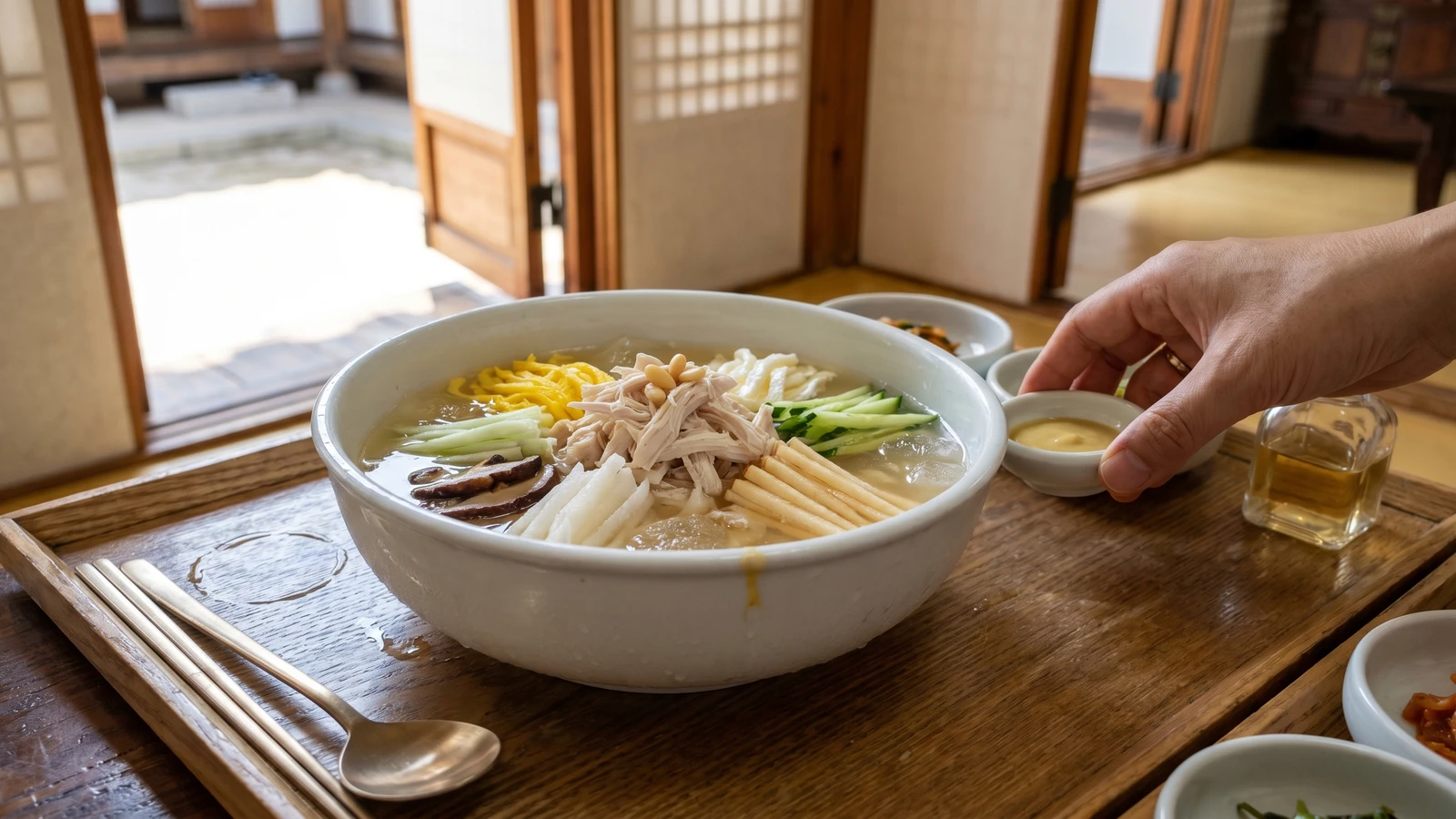
A northern summer soup of clear chicken broth, shredded meat, cucumber, pear, and jidan, sharpened with vinegar and Korean mustard until the cold wakes you up before it cools you down.
Chogye-tang lives or dies after the pot comes off the heat. A hot chicken soup forgives a little fat. A cold one does not. If you leave even a spoonful on the broth, it floats up and coats the tongue, and then no vinegar or mustard can wake it. So tonight the real work is patience: poach gently, chill hard, skim clean.
This is a northern summer soup, the cousin to naengmyeon in the way it cools you, but it eats more like a special-occasion bowl: shredded chicken, crisp cucumber, pear, egg jidan (thin egg garnish), and broth sharpened with cho (vinegar) and gyeoja (Korean mustard). My teacher Master Seong-nyeo made us taste the broth warm, then cold, then over ice, because cold steals salt and sourness. Notebook 37 says the broth must taste one step too bright before it meets the bowl.
I won't tell you this is quick. It asks you to cook the chicken without bullying it, to cut the garnish into thin, even threads, and to season with restraint so the chicken still tastes like chicken. Make the broth the day before if your evening is crowded. 시대가 바뀌면 음식도 바뀌어야 해요. When times change, food must change too. The refrigerator may do what an icy crock once did; the skimmed broth and the mustard balance still have to be right.
Chogye-tang is associated with the northern provinces of Korea, especially Pyeongan and Hamgyeong, where tart cold broths and mustard-seasoned dishes sat alongside naengmyeon in the regional table. The name is often written as cho, vinegar, and gye, chicken, but the flavor people remember is the gyeoja mustard's sting against a carefully skimmed broth. After the Korean War, displaced northern families and restaurants carried versions south, and the noodle variation, chogye-guksu, grew from the same chilled chicken broth.
Quantity
1 (1.2 to 1.4 kg)
cut into 4 pieces, excess fat trimmed
Quantity
10 cups
Quantity
1/2 large
peeled and halved
Quantity
8 cloves
lightly crushed
Quantity
1 thumb-size piece (about 20g)
sliced
Quantity
2
cut into 3-inch lengths
Quantity
1 teaspoon
Quantity
3 1/4 teaspoons, divided
plus more if needed
Quantity
4 tablespoons plus 1 teaspoon, divided
plus more to serve
Quantity
1 tablespoon
Quantity
1 tablespoon
Quantity
3 teaspoons, divided
Quantity
1 Korean cucumber or 1/2 English cucumber (about 180g)
seeded if watery and cut into fine matchsticks
Quantity
150g
cut into fine matchsticks
Quantity
1/2
peeled and cut into fine matchsticks
Quantity
2 large
separated
Quantity
1 teaspoon
for the skillet
Quantity
4
Quantity
1 teaspoon
Quantity
1/2 teaspoon
Quantity
1 tablespoon
Quantity
2 cups
for serving
| Ingredient | Quantity |
|---|---|
| small whole chickencut into 4 pieces, excess fat trimmed | 1 (1.2 to 1.4 kg) |
| cold water | 10 cups |
| onionpeeled and halved | 1/2 large |
| garliclightly crushed | 8 cloves |
| fresh gingersliced | 1 thumb-size piece (about 20g) |
| scallionscut into 3-inch lengths | 2 |
| black peppercorns | 1 teaspoon |
| fine sea saltplus more if needed | 3 1/4 teaspoons, divided |
| rice vinegarplus more to serve | 4 tablespoons plus 1 teaspoon, divided |
| Korean mustard powder (gyeoja-garu) | 1 tablespoon |
| warm water | 1 tablespoon |
| sugar | 3 teaspoons, divided |
| Korean cucumber or English cucumberseeded if watery and cut into fine matchsticks | 1 Korean cucumber or 1/2 English cucumber (about 180g) |
| Korean radish (mu)cut into fine matchsticks | 150g |
| firm Korean pearpeeled and cut into fine matchsticks | 1/2 |
| eggsseparated | 2 large |
| neutral oilfor the skillet | 1 teaspoon |
| dried shiitake mushrooms (optional) | 4 |
| soup soy sauce (guk-ganjang) (optional) | 1 teaspoon |
| sugar for mushrooms (optional) | 1/2 teaspoon |
| pine nuts (optional) | 1 tablespoon |
| ice cubes or half-frozen seasoned brothfor serving | 2 cups |
Pat the chicken dry and trim away the yellow fat near the cavity and tail. Put the chicken and cold water in a heavy pot and bring it slowly to a bare simmer over medium heat. Skim the gray foam as it rises, then add the onion, garlic, ginger, scallions, peppercorns, and 1 teaspoon of the salt. Cold water pulls flavor from the bones; gentle heat keeps the broth clear.
Keep the pot at a quiet simmer, only a few bubbles breaking the surface. Pull the breast pieces when the thickest part reaches 160°F, usually 25 to 30 minutes after the simmer begins, and let them rest so they carry to 165°F. Continue cooking the leg pieces 10 to 15 minutes longer, until the thigh meat reaches 175°F and loosens at the bone. A hard boil makes cloudy broth and dry meat, and cold soup forgives neither.
Lift out the chicken and strain the broth through a fine sieve. Do not press on the aromatics, or the broth turns muddy. Measure 6 cups of broth; simmer it down if you have more, or add a little boiling water if you have less. Set the broth in a shallow container in an ice bath for 20 minutes, then refrigerate at least 4 hours or overnight. Skim off every cap of fat once it hardens. A hot chicken soup tolerates a little fat. A cold one lets it sit on your tongue.
Remove the skin and bones from the cooled chicken. Shred the meat by hand into thin, even strands, about 3 cups total. Toss it with 1 teaspoon rice vinegar, 1/4 teaspoon salt, and 2 tablespoons of the chilled broth. This small seasoning keeps the chicken from tasting separate and plain when it meets the cold soup.
Stir the Korean mustard powder with the warm water, cover it, and let it bloom for 10 minutes. Whisk 5 1/2 cups of the cold skimmed broth with 3 tablespoons rice vinegar, 2 teaspoons sugar, 1 1/2 teaspoons salt, and 2 teaspoons of the bloomed mustard paste. Taste it with one ice cube in the spoon. It should be a little sharper and saltier than you expect, because ice and cold chicken will soften it. If it tastes flat, add rice vinegar 1 teaspoon at a time, up to 1 tablespoon. If it tastes dull, add salt 1/8 teaspoon at a time, up to 1/4 teaspoon. Keep the remaining mustard for the table.
Toss the cucumber matchsticks with 1/4 teaspoon salt and let them stand 10 minutes, then squeeze gently. Toss the radish with 1 tablespoon rice vinegar, 1 teaspoon sugar, and 1/4 teaspoon salt and let it stand 20 minutes, then drain. Cut the pear just before serving so it stays pale and crisp. Each garnish is seasoned alone because each one gives the bowl a different kind of cold: cucumber clean, radish sharp, pear sweet.
Beat the egg yolks and whites separately, each with 1 teaspoon water. Wipe a small skillet with the oil and cook the yolks and whites into thin sheets over low heat, then cool and slice into fine jidan (egg garnish) threads. If using shiitake, soak the mushrooms in warm water for 20 minutes, remove the stems, slice the caps thinly, and simmer them 5 minutes with 1/2 cup broth, the soup soy sauce, and 1/2 teaspoon sugar. Chill them before they go into the bowl.
Chill four bowls for 10 minutes. Divide the shredded chicken among them, then arrange cucumber, radish, pear, jidan, and shiitake over the top in separate small piles. Pour about 1 1/4 cups of seasoned broth into each bowl and add ice or the half-frozen broth slush. Scatter pine nuts if using. Serve at once with extra vinegar and the remaining mustard on the side, so each person can sharpen the bowl without drowning it.
1 serving (about 600g)
Culinary guides, cultural storytelling, and the editorial depth that makes cooking meaningful.
Discover Culinary ExplorerChef Jeong-sun
A clean summer soup of Korean zucchini and salted shrimp, built on quick anchovy-kelp broth and finished before the half-moons lose their shape on a weeknight table.
Chef Jeong-sun
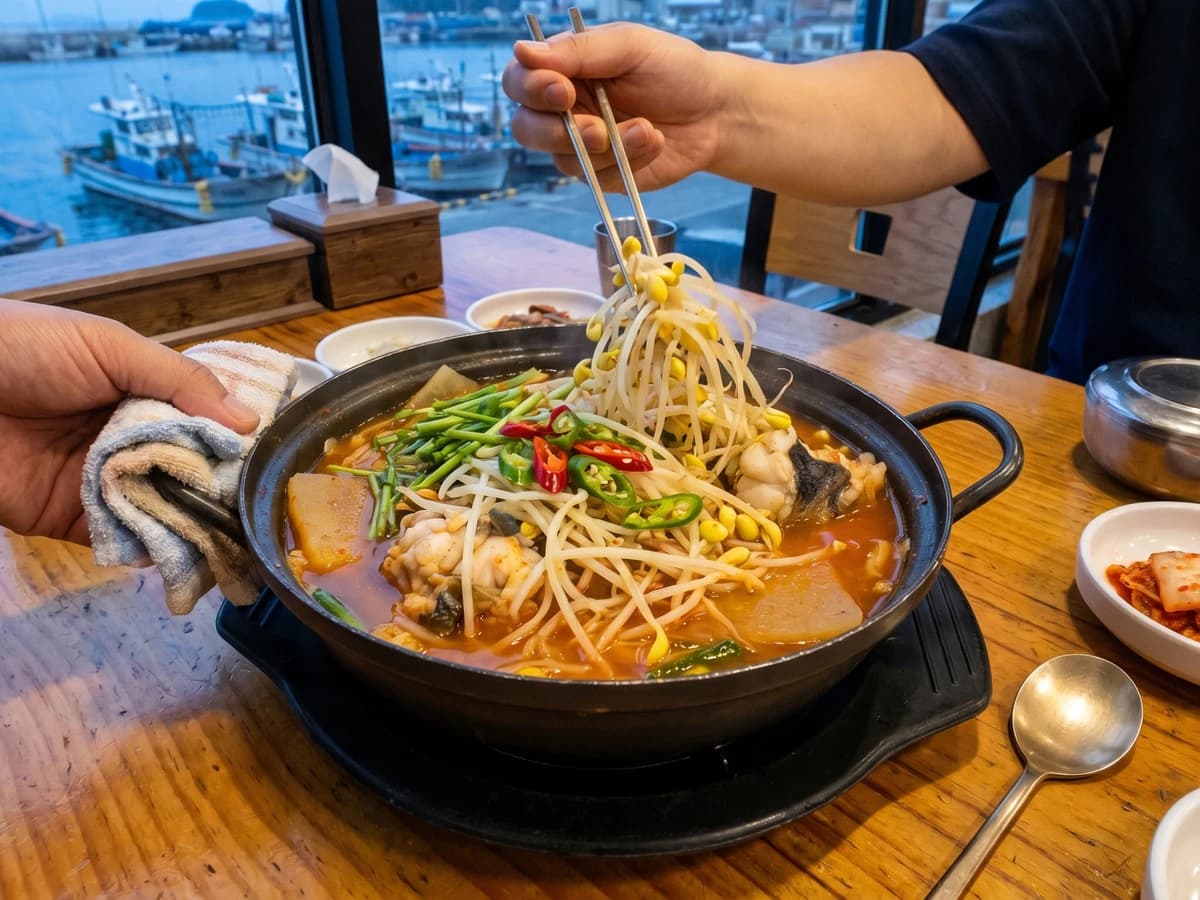
A Masan coast monkfish stew with firm white meat, gelatin at the bones, soybean sprouts for crunch, and a red broth seasoned to carry the fish, not bury it.

Chef Jeong-sun
A weeknight fish roe stew with radish and crown daisy in a clean spicy broth, where the whole success depends on adding the roe late enough that it sets tender, not chalky.

Chef Jeong-sun
Late-summer mallow leaves rubbed with salt until the bitter green water runs off, then simmered in a clean doenjang broth with dried shrimp, the quiet soup a Korean weeknight deserves.