
Chef Elsa
Allerheiligenstriezel
A rich, buttery braided bread that Austrian godfathers bring their godchildren on All Saints' Day. The golden six-strand braid is as much ritual as recipe, and the kitchen smells like love while it bakes.
A cooking platform built around craft, culture, and the stories behind what we eat.
Created by
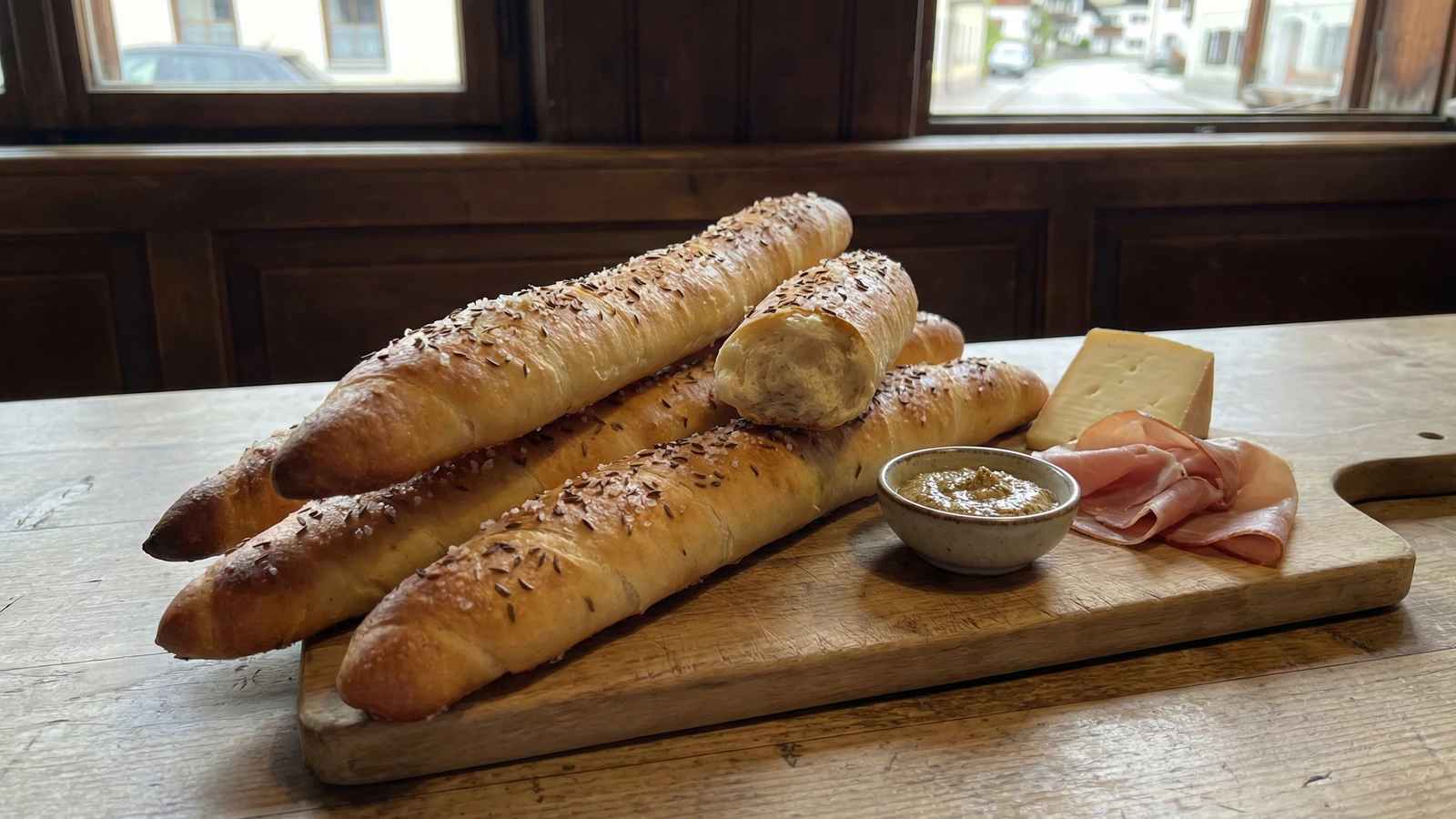
Crisp, golden caraway salt sticks from the Austrian Bäckerei tradition, shaped by hand and baked until they crack when you break them. The bread that makes a Jause complete.
Every Bäckerei in Austria has a basket of Salzstangerl by the register. They sit there looking simple, almost plain, and that's exactly why people underestimate them. A good Salzstangerl has a thin, shattering crust rolled in coarse salt and caraway seeds, and a soft, slightly chewy interior that pulls apart in long strands when you break it open. You eat them with cold cuts, sharp mountain cheese, pickled gherkins, and a smear of good mustard. This is Jause food. The Austrian answer to the question of what to eat between meals, or instead of a meal entirely if you're honest about it.
I grew up eating these on our trips to Austria with Gretel and my grandmother Eva. We'd stop at a Bäckerei on the way from Salzburg to the Salzkammergut and Eva would buy a paper bag full of Salzstangerl and Laugenstangerl and we'd eat them in the car, warm, tearing off pieces and passing them around. Gretel always said the caraway was what made them Austrian. Take away the Kümmel and you've just got a bread stick. Put it back and suddenly you're in Vienna.
The dough is straightforward. Flour, yeast, a little butter and milk, a touch of sugar to feed the yeast. You knead it until it's smooth, let it rise, then roll each piece into a tapered stick with your palms. The shaping takes a few tries to get right but there's nothing fussy about it. Brush them with egg wash, press them into a scattering of caraway and coarse salt, and bake them hot until the kitchen smells like an Austrian bakery at six in the morning. That smell alone is worth the effort.
Salzstangerl belong to Austria's Kleingebäck tradition, the family of small baked goods that also includes Semmel, Kipferl, and Mohnflesserl. The use of caraway (Kümmel) as a defining flavor in Austrian bread baking traces back centuries and distinguishes Austrian Gebäck from its neighbors. Salzstangerl became a fixed part of the Jause, the mid-morning or afternoon cold meal that is a cultural institution in Austria, served on wooden boards alongside Aufschnitt (cold cuts), cheese, pickles, and mustard.
Quantity
300g
plus extra for dusting
Quantity
7g
Quantity
150ml
lukewarm
Quantity
30g
softened
Quantity
1 teaspoon
Quantity
1 teaspoon
Quantity
1
Quantity
1 tablespoon
Quantity
2 tablespoons
Quantity
1 tablespoon
for topping
| Ingredient | Quantity |
|---|---|
| plain flourplus extra for dusting | 300g |
| dried yeast | 7g |
| whole milklukewarm | 150ml |
| unsalted buttersoftened | 30g |
| granulated sugar | 1 teaspoon |
| fine salt | 1 teaspoon |
| egg yolk | 1 |
| milk (for egg wash) | 1 tablespoon |
| whole caraway seeds | 2 tablespoons |
| coarse salt or flaky sea saltfor topping | 1 tablespoon |
Warm the milk until it feels like bathwater, not hot. If you can't hold your finger in it comfortably, it's too warm and you'll kill the yeast. Stir the sugar and yeast into the warm milk and let it sit for five minutes until it turns foamy on top. That foam tells you the yeast is alive and working. No foam means dead yeast, and you should start again with a fresh packet.
Put the flour and salt in a large bowl and make a well in the center. Pour in the yeast mixture and add the softened butter. Bring the dough together with your hands, then turn it out onto a lightly floured surface and knead for eight to ten minutes. You're looking for a dough that's smooth, soft, and springs back when you press it with your finger. It should feel alive under your hands, elastic and willing. If it's sticky, add flour a pinch at a time. If it's stiff and dry, wet your hands and keep kneading.
Shape the dough into a ball and place it back in the bowl. Cover with a clean tea towel and put it somewhere warm for about an hour, until it's doubled in size. The top of the fridge works. Near a warm oven works. Don't put it in direct heat or on a radiator. You want steady, gentle warmth. The yeast needs time, not force.
Punch the dough down gently and turn it out onto a clean surface. Divide it into twelve equal pieces. A kitchen scale helps here. Each piece should be about 40 grams. Take one piece and roll it under your palms into a stick about 18 to 20 centimeters long, tapering slightly at both ends so they're thinner than the middle. Use light pressure and let your hands do the work. If the dough keeps springing back, let it rest for two minutes and come back to it. The gluten is tightening up and it needs a moment to relax.
Preheat your oven to 210°C (410°F). Line a baking tray with parchment. Beat the egg yolk with the tablespoon of milk to make a thin wash. Spread the caraway seeds and coarse salt on a flat plate or board and mix them together loosely. Brush each Stangerl with the egg wash on all sides, then lay it on the caraway and salt mixture and roll it gently, pressing lightly so the seeds and salt stick. Place the Stangerl on the baking tray with a couple of centimeters between each one. They won't spread much, but they need air around them to crisp evenly.
Slide the tray into the middle of the oven and bake for 13 to 15 minutes. You'll know they're done when they've turned a deep golden brown all over and the kitchen smells intensely of toasted caraway. Tap the bottom of one. It should sound hollow. If the tops are coloring too fast, drop the temperature by ten degrees and give them another two minutes. Pull them out and let them cool on a wire rack. They'll crisp up further as they cool. Eat the first one warm, because you've earned it. Mahlzeit!
1 serving (about 45g)
Culinary guides, cultural storytelling, and the editorial depth that makes cooking meaningful.
Discover Culinary ExplorerChef Elsa
A rich, buttery braided bread that Austrian godfathers bring their godchildren on All Saints' Day. The golden six-strand braid is as much ritual as recipe, and the kitchen smells like love while it bakes.

Chef Elsa
Austria's rye sourdough farmhouse loaf, dark-crusted and tangy, laced with hand-crushed Brotgewürz, the kind of bread that fills a kitchen with the smell of caraway and makes everything else on the table taste better.
Chef Elsa
Buttery Viennese crescents, golden with egg wash and soft as a Sunday morning, shaped the way Viennese bakers have shaped them for eight hundred years.

Chef Elsa
Vienna's five-petaled imperial roll, hand-folded into a star and baked until the crust shatters at first touch, with a crumb so soft and airy it barely weighs a thing.