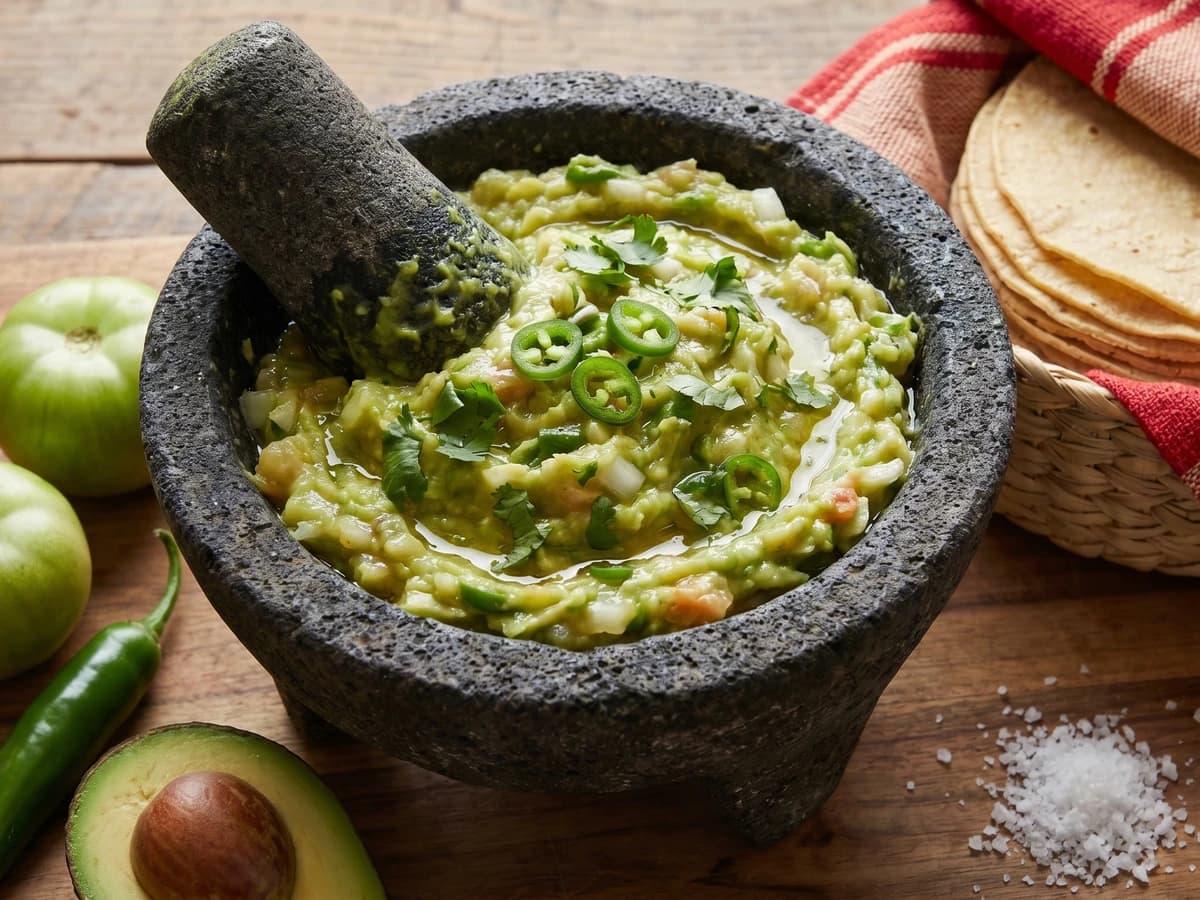
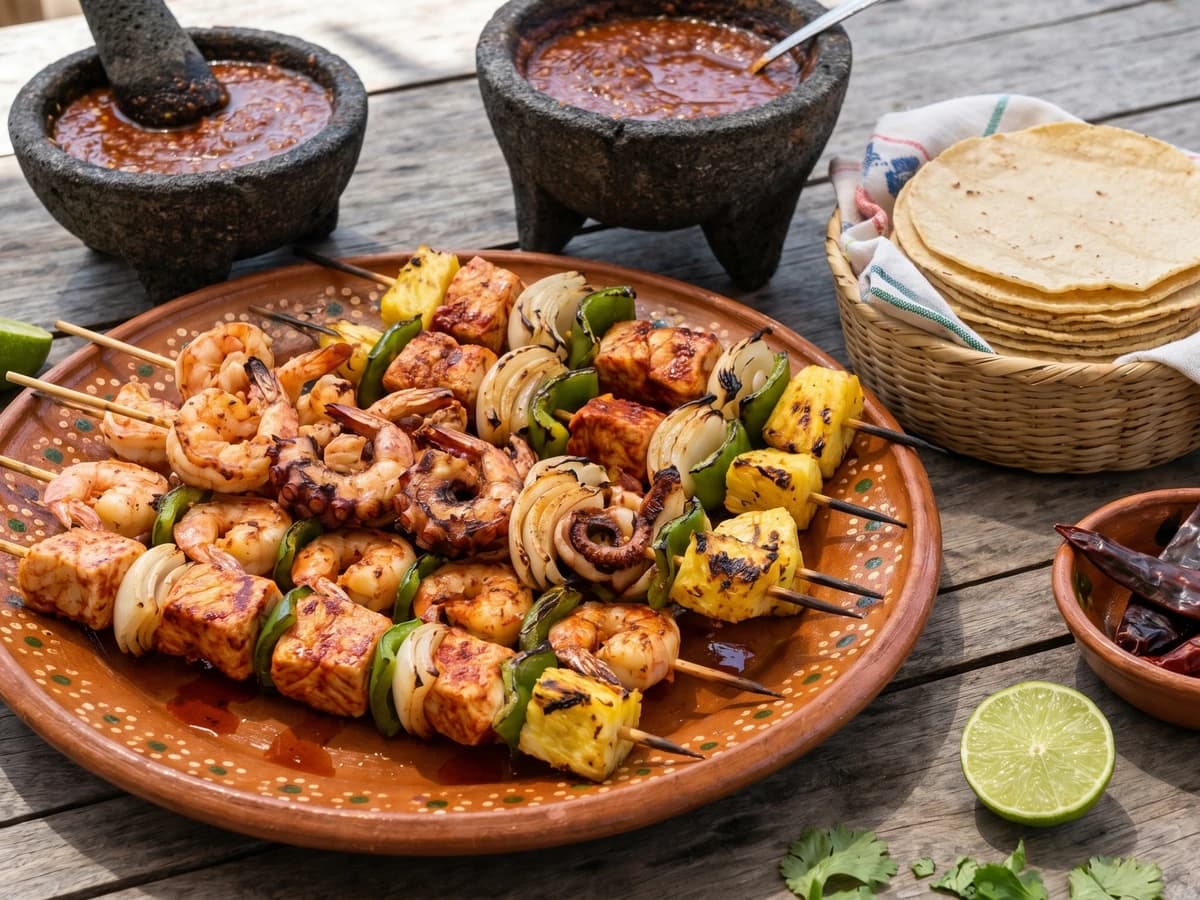
The Peninsula's puffy fried tortillas, masa with a touch of flour dropped into hot lard until they balloon, crowned with shredded turkey, avocado, and the fuchsia pickled onions that sit on every Yucatecan table.
Appetizers & Snacks
Mexican
Dinner Party
Weeknight
Comfort Food
45 min
Active Time
1 hr 30 min cook•2 hr 15 min total
Yield12 salbutes, 4 to 6 servings
Salbutes are from Yucatan. Not from Mexico generally, from Yucatan specifically. The Peninsula has its own grammar in the kitchen: recado rojo, naranja agria, banana leaf, pavo instead of pollo, cebolla morada encurtida on every table. Salbutes belong to that grammar. They are not a tostada. They are not a sope. They are a puffed disc of masa fried in lard until it inflates like a small pillow, topped with shredded turkey, avocado, and pickled red onion. The order matters. The ingredients matter. The fat matters.
The puff is the whole engineering problem. Pure masa will not reliably balloon. Yucatecan cooks figured out generations ago that a small amount of wheat flour gives the dough the elasticity it needs to trap steam and lift off the surface in the hot lard. Two tablespoons of flour in two cups of masa. That is the difference between a salbut and a flat fried tortilla, and the cocineras at the cantinas in Merida have been doing it this way for as long as anyone can remember. La manteca es el sabor, and the lard has to be hot enough that the disc puffs before it absorbs fat. Spoon the hot lard over the top of the disc the moment you drop it in. That move is the recipe.
I watched a senora in the Mercado Lucas de Galvez in Merida make these for me one morning when I was researching the Peninsula chapter of my third book. She had a comal, a cazo of lard, and a pile of golf-ball-sized masa rounds covered in a damp cloth. She did not measure anything. She pressed, fried, spooned the lard over, lifted out, topped, served, all without speaking. The salbut hit the plate at the same moment as the pickled onions, and I understood why this dish has lasted. It is fast, it is honest, and it tastes like the Peninsula. Saber cocinar es saber vivir, and in Yucatan, knowing how to fry a salbut is part of knowing how to live there.
The word 'salbut' likely derives from the Yucatec Maya phrase 'saal but,' meaning something puffed or filled with air, a name that describes the dish's defining quality. Salbutes belong to a family of Peninsula corn antojitos that includes panuchos (the stuffed sibling, filled with refried black beans) and codzitos, all of which trace back to pre-Hispanic Maya preparations of nixtamalized corn that were adapted after the Spanish introduction of pork lard and the European turkey, which had paradoxically originated in Mexico, returned to the Peninsula as the domesticated bird. The pickled red onion that crowns every salbut is itself a colonial-era development, combining the Old World onion with naranja agria, the bitter Seville orange brought by the Spanish in the 16th century and now so deeply embedded in Yucatecan cooking that the Peninsula's cuisine is unimaginable without it.
The technique, the tradition, and the story behind every dish.
masa harina (nixtamalized corn flour)Maseca or Bob's Red Mill
2 cups
all-purpose flour
2 tablespoons
kosher salt (for the masa)
1/2 teaspoon
warm water
1 1/2 cups, plus more as needed
manteca de cerdo (pork lard)for frying
4 cups
red onionsliced into thin half-moons
1 large
naranja agria juice (sour orange)or substitute 1/3 cup fresh orange juice mixed with 3 tablespoons fresh lime juice and 1 tablespoon white vinegar
1/2 cup, fresh
dried Mexican oregano (for the onions)crumbled
1 teaspoon
kosher salt (for the onions)
1/2 teaspoon
ripe Hass avocadosliced
1
fresh chile habanerofinely chopped, for serving
1
lime wedges (optional)
for serving
Equipment Needed
•Heavy 6-quart pot for poaching the turkey
•Tortilla press with two squares of freezer-bag plastic
•Wide, deep heavy skillet or cazuela for frying
•Candy or deep-fry thermometer
•Slotted spoon or kitchen spider
•Wire rack set over a sheet pan
Instructions
1
Poach the turkey
Place the turkey legs in a heavy pot. Cover with cold water by two inches. Add the half onion, garlic cloves, bay leaves, oregano, peppercorns, and the tablespoon of salt. Bring to a gentle simmer over medium heat. Skim the gray foam that rises in the first ten minutes. Reduce the heat and cook at a lazy simmer for one hour, until the meat pulls away from the bone with a fork. In Yucatan this is pavo, turkey, not chicken. Chicken is a compromise the rest of Mexico made. The Peninsula did not.
Save the broth. Strain it and freeze what you do not use. It is the base for sopa de lima and a dozen other Yucatecan dishes.
2
Pickle the onions
While the turkey poaches, place the sliced red onion in a heatproof bowl. Pour boiling water over it, count to thirty, drain. This blanching softens the onion's raw edge without cooking it. Return the onion to the bowl. Add the naranja agria juice, the crumbled oregano, and the half teaspoon of salt. Toss with your hands. Let it sit at room temperature for at least 30 minutes. The onions will turn fuchsia pink. That color is the signal. Cebolla morada encurtida sits on every Yucatecan table the way salt and pepper sit on tables elsewhere.
3
Shred the turkey
Lift the turkey legs from the broth. Let them cool until you can handle them. Pull the meat from the bone in shreds, discarding the skin, gristle, and bones. Toss the shredded meat with about half a cup of the warm broth so it stays moist. Taste for salt. The seasoning of the meat carries the whole salbut, so do not be timid here.
4
Make the masa
In a bowl, combine the masa harina, the all-purpose flour, and the half teaspoon of salt. The flour is the trick. Pure masa puffs unreliably. The small amount of wheat flour gives the dough the elasticity it needs to balloon in the lard. This is how they make them in Merida and they have nothing to apologize for. Add the warm water slowly, mixing with your hand. Knead for two minutes. The dough should feel like soft Play-Doh, smooth and slightly tacky, holding together without cracking. If it cracks at the edges when you press it, add a tablespoon of water. If it sticks to your palm, add a tablespoon of masa harina. Cover with a damp cloth and let it rest for 15 minutes.
5
Heat the lard
Pour the lard into a deep, heavy skillet or wide cazuela. You want at least an inch and a half of fat. La manteca es el sabor and it is also the engineering. Heat over medium-high until the lard reaches 360 to 375F. If you drop a small pinch of masa in, it should sizzle aggressively and float within a second. Too cool and the salbut will absorb fat and turn greasy. Too hot and the outside will brown before the inside puffs. Use a thermometer if you have one.
6
Shape and press the salbutes
Divide the dough into 12 equal balls, about the size of a golf ball. Keep them covered with the damp cloth so they do not dry out. Line a tortilla press with two squares of plastic cut from a freezer bag. Press each ball into a thick disc, slightly thicker than a regular tortilla, about four inches across and the thickness of two stacked nickels. Thickness is what makes a salbut a salbut. A thin disc gives you a tortilla. A thick disc gives you a salbut. Asi se hace y punto.
7
Fry until they puff
Peel the pressed disc carefully off the plastic and slide it gently into the hot lard, away from you. Almost immediately, spoon hot lard over the top of the disc. This is the move that forces the puff. The hot fat hitting both sides at once traps steam inside the masa and the salbut balloons up like a small pillow. Fry for 45 to 60 seconds per side, turning once with a slotted spoon, until both sides are golden and the puff has set. Lift out and drain on a wire rack set over a sheet pan. Fry one at a time until you get the rhythm. Two at a time once you do.
Not every salbut will puff perfectly. A flat one is still good. Eat it yourself in the kitchen and serve the puffy ones to your guests. This is how every Yucatecan cook learned, by frying their way through a batch and getting better with each one.
Spooning the hot lard over the top of the disc is non-negotiable. If you just drop the disc in and walk away, it will not puff. No me vengas con atajos.
8
Build and serve
Lay each salbut on a plate, puffed side up. Top with a generous mound of the warm shredded turkey. Lay two slices of avocado across the meat. Crown with a tangle of the pickled red onions, including some of their pink juice. Scatter a few pieces of finely chopped habanero on top for the cook who knows what they are doing. Serve immediately with lime wedges on the side. Salbutes do not wait. They soften within minutes of being topped. Eat them with your hands, standing up if you have to. That is how they are eaten in Merida and that is how you should eat them.
Chef Tips
•Naranja agria, the bitter Seville orange, is the acid that defines Yucatecan cooking. If you can find it at a Latin or Caribbean market, buy it. If you cannot, the substitution of orange, lime, and a touch of white vinegar gets you close. It is a compromise, not an upgrade. The real fruit has a deeper, more floral bitterness that the substitution cannot fully replicate.
•The wheat flour in the masa is traditional in the Peninsula. Cooks in Merida and Campeche have used this trick for generations to guarantee the puff. Do not let anyone tell you it is not authentic. It is exactly authentic. Cada estado, su propia cocina.
•Pavo, turkey, is the meat of the Peninsula. It comes from the pre-Hispanic Maya tradition and persists today in cochinita, in escabeche oriental, in salbutes. If you must substitute, use chicken thighs, never breast. Breast meat will dry out and embarrass the dish.
•The lard is not optional. Vegetable oil will fry the salbut but it will not give you the flavor or the proper crust. Buy good rendered manteca from a Mexican carniceria or render it yourself from pork fatback. It keeps in the refrigerator for months.
Advance Preparation
•The pickled red onions can be made up to three days ahead and refrigerated. They get better as they sit. Make a double batch and keep them on the table for everything else you cook this week.
•The turkey can be poached and shredded one day ahead. Refrigerate the meat in some of its broth so it stays moist. Reheat gently in a covered skillet with a splash of broth before serving.
•The masa should be made the day you fry. It dries out in the refrigerator and the dough loses the elasticity that gives you the puff. Do not try to make it ahead.
Frequently Asked Questions
Nutrition Information
1 serving (about 350g)
Calories
685 calories
Total Fat
37 g
Saturated Fat
11 g
Trans Fat
0 g
Unsaturated Fat
24 g
Cholesterol
130 mg
Sodium
750 mg
Total Carbohydrates
46 g
Dietary Fiber
5 g
Sugars
3 g
Protein
39 g
Where cooking meets culture.
Culinary guides, cultural storytelling, and the editorial depth that makes cooking meaningful.