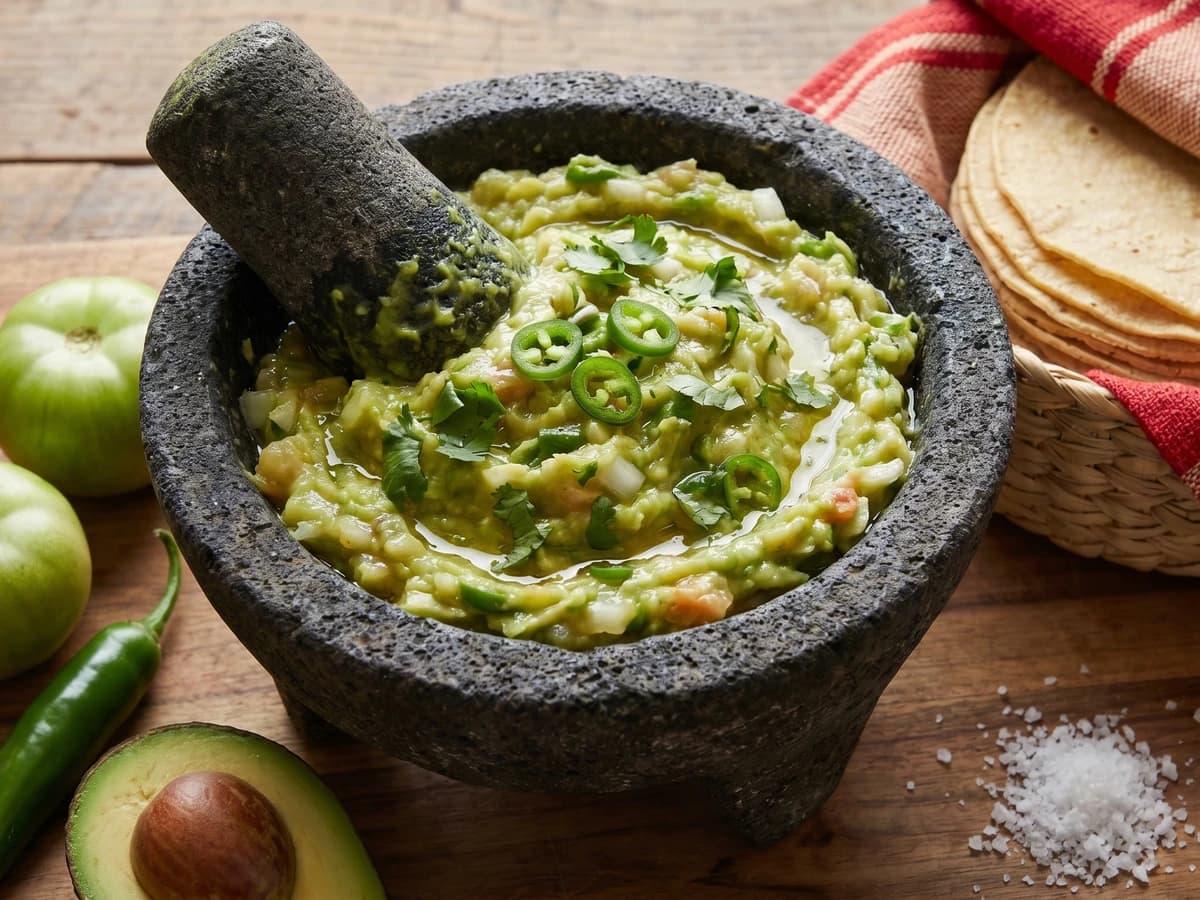
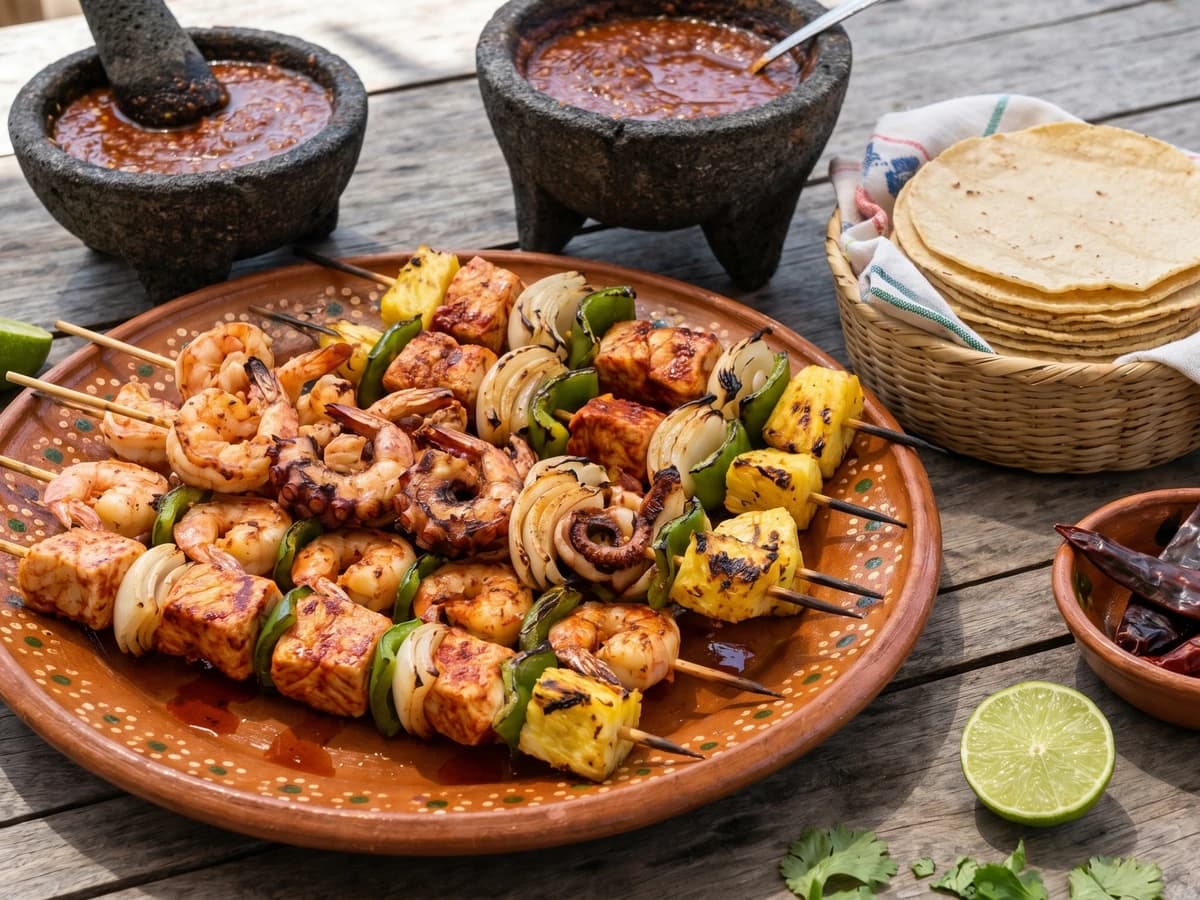
Yucatan's pork belly chicharron, slow-rendered in lard until the meat surrenders and the skin cracks under the knife, folded into warm tortillas with xnipec and bright pink pickled onion.
Appetizers & Snacks
Mexican
Game Day
BBQ
Dinner Party
30 min
Active Time
2 hr 30 min cook•3 hr total
Yield8 servings
Castacan is Yucateco. Not Mexican-generic. Yucateco. The Peninsula has its own grammar, recado, sour orange, banana leaf, pib, habanero, and castacan sits squarely inside it. You eat it at the cantinas in Merida on a Saturday afternoon, folded into a hand-pressed corn tortilla with pickled red onion and a spoonful of xnipec that makes you sweat at the temples. That is the dish.
The technique is pork belly slow-cooked in its own lard until the meat is tender, then crisped under high heat so the skin shatters when you cut it. This is not bacon. This is not American chicharron. This is the Peninsula's confit, and it carries the marks of Yucatan everywhere: the naranja agria in the seasoning, the oregano yucateco, the habanero in the salsa, the cebolla morada turned magenta by the sour orange. If you substitute regular orange and skip the sour, you have made something. You have not made castacan.
My first castacan was at a small cantina off Calle 47 in Merida, served on a piece of butcher paper with a stack of tortillas and a clay bowl of xnipec. The senora at the comal pressed the tortillas one at a time and would not let me leave until I had eaten at least three tacos. She told me that her father, who taught her, used to say the dog's nose tells you when the xnipec is right. That is where the name comes from. Saber cocinar es saber vivir.
Castacan belongs to the broader Yucatecan tradition of pork preparations developed after the Spanish introduction of pigs in the 16th century, grafted onto a Mayan culinary foundation that had cooked native game in underground pibes for centuries. The naranja agria used in its seasoning was brought by the Spanish from Seville and adapted into the regional cooking so thoroughly that it became the defining acid of the Peninsula, displacing lime in most traditional recipes. The xnipec salsa that accompanies castacan takes its name from the Maya words for dog (pek) and nose (ni), a reference to the way the habanero's heat makes the eater's nose run, and the use of habanero distinguishes Yucatecan salsa traditions from the chile cultures of central and southern Mexico.
The technique, the tradition, and the story behind every dish.
or 1/4 cup orange juice mixed with 1/4 cup fresh lime juice
dried Mexican oregano
Quantity
1 tablespoon
preferably oregano yucateco
red onion
Quantity
1 large
sliced into thin half-moons, for pickling
fresh naranja agria juice (for pickling)
Quantity
1 cup
or equal parts orange and lime juice
kosher salt (for pickling)
Quantity
1 teaspoon
dried oregano yucateco (for pickling)
Quantity
1 teaspoon
ripe Roma tomatoes
Quantity
4
finely diced, for xnipec
small white onion
Quantity
1
finely diced, for xnipec
chile habanero
Quantity
2
stemmed and finely minced, for xnipec
fresh cilantro
Quantity
1/4 cup
chopped, for xnipec
fresh naranja agria juice (for xnipec)
Quantity
1/4 cup
kosher salt (for xnipec)
Quantity
1/2 teaspoon
hand-pressed corn tortillas (optional)
Quantity
for serving
warmed
Ingredient
Quantity
pork belly with skin oncut into 2-inch by 4-inch slabs
3 pounds
pork lard (manteca de cerdo)
2 pounds
head of garlichalved crosswise
1
garlic cloves
4
white onionhalved
1 medium
bay leaves
2
black peppercorns
1 tablespoon
kosher salt
1 tablespoon, plus more for finishing
fresh naranja agria juiceor 1/4 cup orange juice mixed with 1/4 cup fresh lime juice
1/2 cup
dried Mexican oreganopreferably oregano yucateco
1 tablespoon
red onionsliced into thin half-moons, for pickling
1 large
fresh naranja agria juice (for pickling)or equal parts orange and lime juice
1 cup
kosher salt (for pickling)
1 teaspoon
dried oregano yucateco (for pickling)
1 teaspoon
ripe Roma tomatoesfinely diced, for xnipec
4
small white onionfinely diced, for xnipec
1
chile habanerostemmed and finely minced, for xnipec
2
fresh cilantrochopped, for xnipec
1/4 cup
fresh naranja agria juice (for xnipec)
1/4 cup
kosher salt (for xnipec)
1/2 teaspoon
hand-pressed corn tortillas (optional)warmed
for serving
Equipment Needed
•Wide heavy cazuela or 6-quart Dutch oven
•Wire rack set over a rimmed sheet pan
•Sharp chef's knife and wooden cutting board
•Glass or ceramic bowls for the pickle and the xnipec (never aluminum, the sour orange will react)
Instructions
1
Pickle the red onion
Place the sliced red onion in a heatproof bowl. Pour boiling water over it, count to thirty, then drain. This takes the raw bite out without cooking the onion. Return it to the bowl and add the cup of naranja agria juice, the teaspoon of salt, and the teaspoon of oregano yucateco. Press the onions down so the liquid covers them. Let them sit for at least one hour. They will turn bright magenta. This is the cebolla morada encurtida that goes on everything in the Peninsula.
Make these the day before if you can. The longer they sit in the sour orange, the deeper the pink and the cleaner the flavor.
2
Season the pork belly
Pat the pork belly slabs dry. Rub them with the tablespoon of salt and the half cup of naranja agria juice. Smash the four extra garlic cloves with the side of a knife and rub them into the meat. Let the belly sit on a rack for at least 30 minutes, uncovered, in the refrigerator. The skin needs to dry. Wet skin will not crackle. This is the step most cooks skip and then wonder why their castacan is leathery.
3
Render in lard
In a wide heavy cazuela or Dutch oven, melt the lard over medium-low heat. You want enough fat to come halfway up the pork belly once it goes in. Lay the slabs in skin side up, then add the halved onion, halved garlic head, bay leaves, peppercorns, and oregano. The lard should bubble lazily around the meat, not aggressively. La manteca es el sabor. Cook uncovered for one hour and forty-five minutes, turning the slabs once at the halfway point.
Do not let the lard boil. If it does, lower the heat. A rolling fry will toughen the meat before the collagen has time to break down.
4
Make the xnipec
While the pork cooks, make the xnipec. The name means dog's nose in Maya because the heat from the habanero should make the dog's nose run. Combine the diced tomato, finely diced white onion, minced habanero, chopped cilantro, naranja agria juice, and salt in a glass bowl. Stir and let it sit at room temperature for at least 30 minutes. Use gloves when you handle the habanero. Two habaneros for an honest Yucatecan version. One for guests who do not know what they are getting into.
Do not blend or process the xnipec. The texture of small, even dice is part of the dish. The habanero must remain identifiable so the eater can see what they are about to bite into.
5
Crisp the skin
After an hour and forty-five minutes, the meat should be tender enough to pierce easily with a knife but still holding its shape. Lift the slabs out with a slotted spatula and drain on a wire rack set over a sheet pan. Pat the skin dry. Heat the oven to 450F. Arrange the slabs skin side up on a fresh rack over a sheet pan and roast for 20 to 30 minutes, until the skin blisters and crackles. Listen for the snap. That sound is castacan ready.
6
Chop and serve
Let the castacan rest for five minutes. Chop the slabs into rough bite-sized pieces, skin and all, on a wooden board. The skin should shatter under the knife. Pile the pieces on a warm platter and sprinkle with finishing salt. Serve with warm corn tortillas, the pickled red onion, and a bowl of xnipec set in the center of the table. Each person folds their own taco. Asi se hace y punto.
Chef Tips
•Naranja agria is not optional. If your Latin market does not carry it, mix equal parts fresh orange juice with fresh lime juice and add a small splash of grapefruit juice. It is a compromise, not an upgrade, but it gets closer than orange alone.
•Oregano yucateco is a different plant from Mediterranean oregano, with a more anise-like, almost citrus note. Find it at a Mexican grocer specializing in Peninsula ingredients. Mexican oregano is the next best substitute. Italian oregano is wrong for this dish.
•Handle the habanero with gloves and never touch your eyes after. The chile vendors at the Mercado Lucas de Galvez in Merida will laugh at anyone who picks one up bare-handed.
Advance Preparation
•The pickled red onion can be made up to one week ahead and keeps refrigerated in its own brine. The color and flavor deepen with time.
•The pork belly can be rendered in lard one day ahead and refrigerated in its rendered fat. Crisp the skin under high oven heat just before serving.
•The xnipec is best made within an hour or two of serving. After that, the tomato breaks down and the salsa turns watery.
Frequently Asked Questions
Nutrition Information
1 serving (about 250g)
Calories
780 calories
Total Fat
65 g
Saturated Fat
22 g
Trans Fat
0 g
Unsaturated Fat
40 g
Cholesterol
85 mg
Sodium
720 mg
Total Carbohydrates
28 g
Dietary Fiber
6 g
Sugars
3 g
Protein
16 g
Where cooking meets culture.
Culinary guides, cultural storytelling, and the editorial depth that makes cooking meaningful.