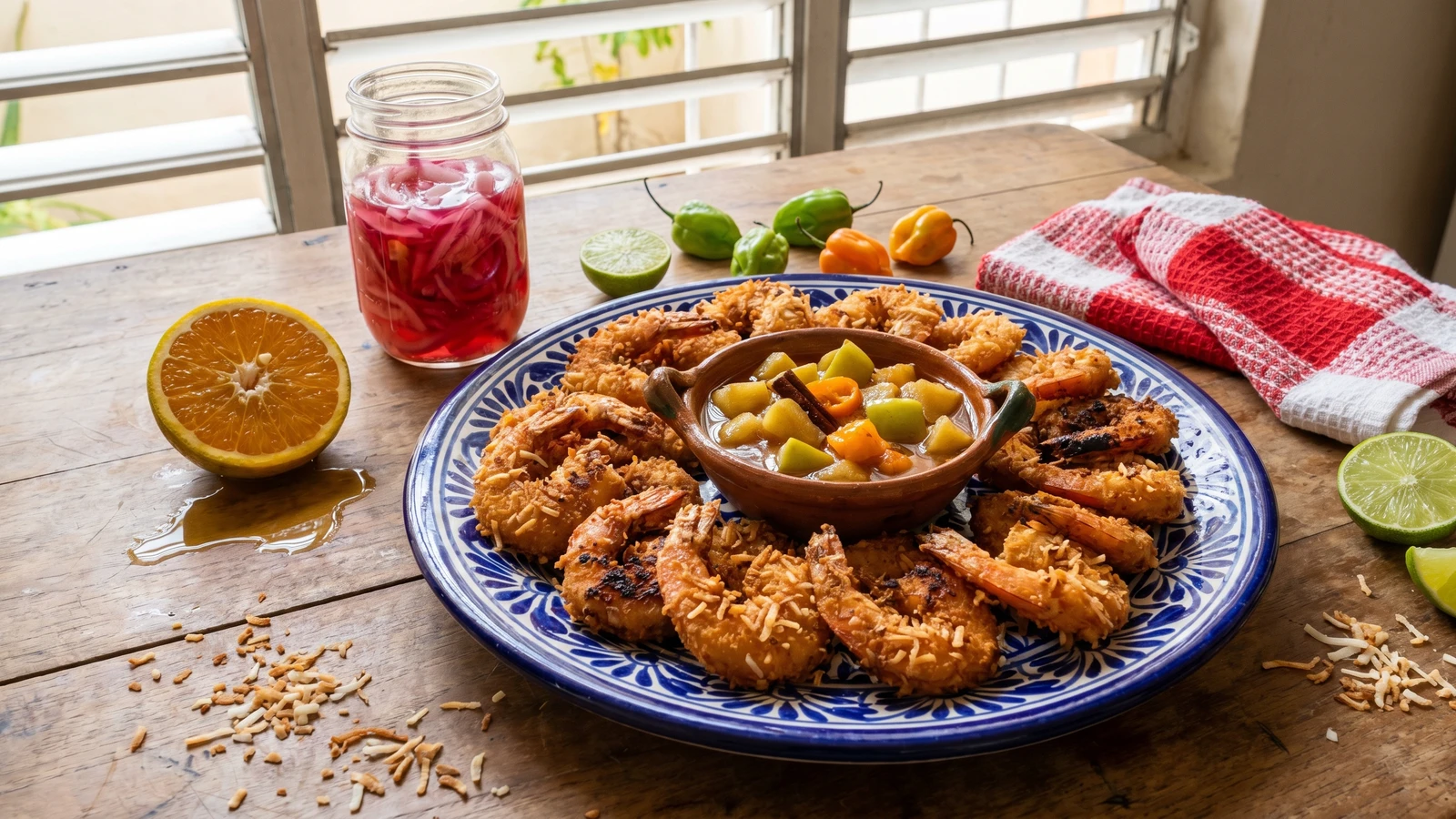
Campeche's Gulf-port coconut shrimp, dipped in egg, rolled in grated dry coconut, fried to gold and served alongside a warm green-apple and naranja agria compote perfumed with habanero and canela.
Appetizers & Snacks
Mexican
Dinner Party
Special Occasion
Celebration
30 min
Active Time
20 min cook•50 min total
Yield4 to 6 servings
This is Campeche. Not Cancun. Not the cruise-ship version of the Peninsula. Campeche, the walled Gulf port where the shrimp boats come in at dawn and the cocineras have been cooking with coconut and Gulf seafood for four hundred years.
Camarones al coco belongs to the marisquerias along the malecon and to the home cooks of San Francisco de Campeche who learned this dish from their mothers and grandmothers. The coconut is not a tropical garnish. The Peninsula has coconut palms along its coasts and dry grated coconut has been a pantry staple in Campechano kitchens since the colonial trade routes ran through the port. The shrimp is Gulf shrimp, sweet and firm, the kind that does not need to be hidden under heavy sauce.
The green-apple compote is what separates the Campechano version from every imitation. The senoras balance the sweetness of the coconut and the richness of the fry with something tart and bright, perfumed with canela, a whole clove, and a habanero that is there for its perfume and not its burn. The compote is warm. It is glossy. It tastes of the Peninsula's grammar: sour orange, habanero, sugar tempered by acid. Cada estado, su propia cocina, and this one is Campeche's.
My mother never made this dish. She was from Jalisco and the closest she came to the Peninsula was a postcard from a cousin. I learned camarones al coco from a woman named Dona Eulalia who ran a marisqueria three blocks from the Baluarte de Santiago. She told me the rule that I will pass to you: the oil cannot be too hot, the coconut must be two kinds mixed together, and the compote is not optional. Recetas probadas y garantizadas.
Coconut entered Campechano cuisine through the colonial trade routes that connected the port of Campeche to the Pacific and the Philippines starting in the 16th century, when the Manila galleon trade brought Asian coconut palms and culinary techniques into New Spain by way of Acapulco and then overland to the Gulf. Campeche's walled-city status as a fortified Spanish port made it a hub of pirate raids and creole cuisine alike; the dish's pairing of fried coconut with a sweet-tart fruit compote reflects the Iberian medieval tradition of combining fried seafood with fruit-based agridulces, adapted to Peninsular ingredients. The use of naranja agria and habanero rather than imported European citrus and pepper marks the recipe as fully Yucatecan rather than purely colonial, an example of how Peninsular cooks rewrote European templates in their own grammar.
The technique, the tradition, and the story behind every dish.
neutral oil for fryingor rendered lard mixed half-and-half with oil
4 cups
green apples (Granny Smith)peeled, cored, and diced small
2 large
naranja agria juiceor 3 tablespoons fresh orange juice mixed with 1 tablespoon fresh lime juice
1/4 cup
sugar
1/3 cup
Mexican canela (Ceylon cinnamon)
1 stick, about 2 inches
whole clove
1
fresh chile habanerohalved and seeded
1
kosher salt for compote
pinch
unsalted butter
1 tablespoon
lime wedges (optional)
for serving
pickled red onion with naranja agria (optional)
for serving
Equipment Needed
•Heavy 4-quart pot or wide clay cazuela for frying
•Deep-fry or candy thermometer
•Slotted spoon or kitchen spider
•Wire rack set over a sheet pan for draining
•Three shallow bowls for the breading station
Instructions
1
Prepare the shrimp
Pat the shrimp very dry with paper towels. Wet shrimp will not hold the coconut and the coating will slide off in the oil. Season them all over with a generous pinch of salt and let them sit on the towels while you set up the breading station. In Campeche, the shrimp comes off the boat and onto the plate the same morning. Buy the best Gulf shrimp you can find, head-on if your fishmonger will sell it that way. The freshness of the camaron is the recipe.
Leave the tail shell on. It gives you a handle for dipping and for eating, and it looks the way it looks at the marisquerias on the malecon of Campeche.
2
Build the compote
In a small saucepan, combine the diced green apple, naranja agria juice, sugar, canela stick, whole clove, halved habanero, and a pinch of salt. Cook over medium-low heat, stirring occasionally, for about 15 minutes. The apple should soften but still hold its shape. The compote should be glossy and the syrup thick enough to coat the back of a spoon. Stir in the butter off the heat. Fish out the habanero, the canela, and the clove. Set aside warm.
The habanero is there for perfume, not for heat. Halve it, seed it, and pull it out before serving. You want the floral aroma of the Peninsula's signature chile, not a burning compote.
3
Set up the breading station
Three shallow bowls. First bowl: the flour mixed with the salt, white pepper, and habanero powder. Second bowl: the eggs beaten with the milk until uniform. Third bowl: the unsweetened grated coconut mixed with the sweetened shredded coconut. Mixing the two coconuts is the trick. The dry coconut gives you the toasted gold color and crunch. The sweetened coconut gives you the chew and the caramelization at the edges. Use only one and you miss half the dish.
4
Bread the shrimp
Holding each shrimp by the tail, dredge it in the seasoned flour and shake off the excess. Dip into the egg wash. Then press it firmly into the coconut, coating every side and packing the coconut on with your fingers. Lay each one on a sheet pan. Do not crowd them. When all the shrimp are breaded, refrigerate the tray for ten minutes. This sets the coating and keeps the coconut from sliding off the moment it hits the oil. No me vengas con atajos. Skip the chill and you will see the coconut floating in the pot while the shrimp comes out naked.
5
Heat the oil
Pour the oil into a heavy 4-quart pot or wide cazuela. The oil should be at least two inches deep. Heat over medium until it reaches 340F. Lower than you think. The coconut burns fast. If you fry at 375F like you would for chicken, the coconut blackens before the shrimp cooks through. Test with one piece. The coconut should turn pale gold in about a minute and a half, not in twenty seconds.
If you have rendered lard, use half lard and half neutral oil. La manteca es el sabor. The coconut takes on a deeper flavor and the shrimp tastes like it came out of a Campechano kitchen instead of a hotel restaurant.
6
Fry in batches
Lower the shrimp into the oil four or five at a time, holding each one by the tail until it sets. Do not dump them in. Fry for about two minutes total, turning once, until the coconut is the color of a Yucatan sunset and the shrimp has just turned opaque and curled into a loose C shape. A tight O shape means overcooked. Lift them out with a slotted spoon and drain on a wire rack. Salt them lightly the moment they come out of the oil. Skim any loose coconut from the pot between batches or it will burn and turn the oil bitter.
7
Plate and serve
Arrange the shrimp around a small bowl of the warm green-apple compote. Scatter the pickled red onion alongside and put the lime wedges on the side. Serve immediately, while the coconut is still crackling and the shrimp inside is still hot and juicy. Coconut shrimp that has been sitting on a buffet is not coconut shrimp. It is sadness. Asi se hace y punto.
Chef Tips
•Use unsweetened dry grated coconut as the base of the coating and sweetened shredded coconut for the second 30 percent. The Peninsula's marisquerias work with a similar balance. All sweetened coconut burns and tastes like a candy bar. All unsweetened coconut tastes flat and never browns properly. The mix is the answer.
•Naranja agria is the Peninsular citrus and there is no perfect substitute, but if you cannot find one at a Latin market, three parts orange juice to one part lime juice gets you close. Bottled mojo or sour orange concentrate is a compromise, not an upgrade.
•If you serve this with rice, make arroz blanco with a slick of lard and a sprig of epazote. Yellow turmeric rice does not belong on the same plate. This is Campeche, not a hotel buffet.
Advance Preparation
•The green-apple compote can be made one day ahead and held in the refrigerator. Warm it gently before serving so the butter and syrup come back together.
•The shrimp can be breaded and held on a sheet pan in the refrigerator, uncovered, for up to four hours before frying. Do not bread them the day before; the coating gets gummy.
•Camarones al coco does not hold. Fry them at the last minute. Reheated coconut shrimp is a different dish, and not a better one.
Frequently Asked Questions
Nutrition Information
1 serving (about 360g)
Calories
775 calories
Total Fat
47 g
Saturated Fat
26 g
Trans Fat
0 g
Unsaturated Fat
21 g
Cholesterol
378 mg
Sodium
685 mg
Total Carbohydrates
57 g
Dietary Fiber
8 g
Sugars
26 g
Protein
36 g
Where cooking meets culture.
Culinary guides, cultural storytelling, and the editorial depth that makes cooking meaningful.