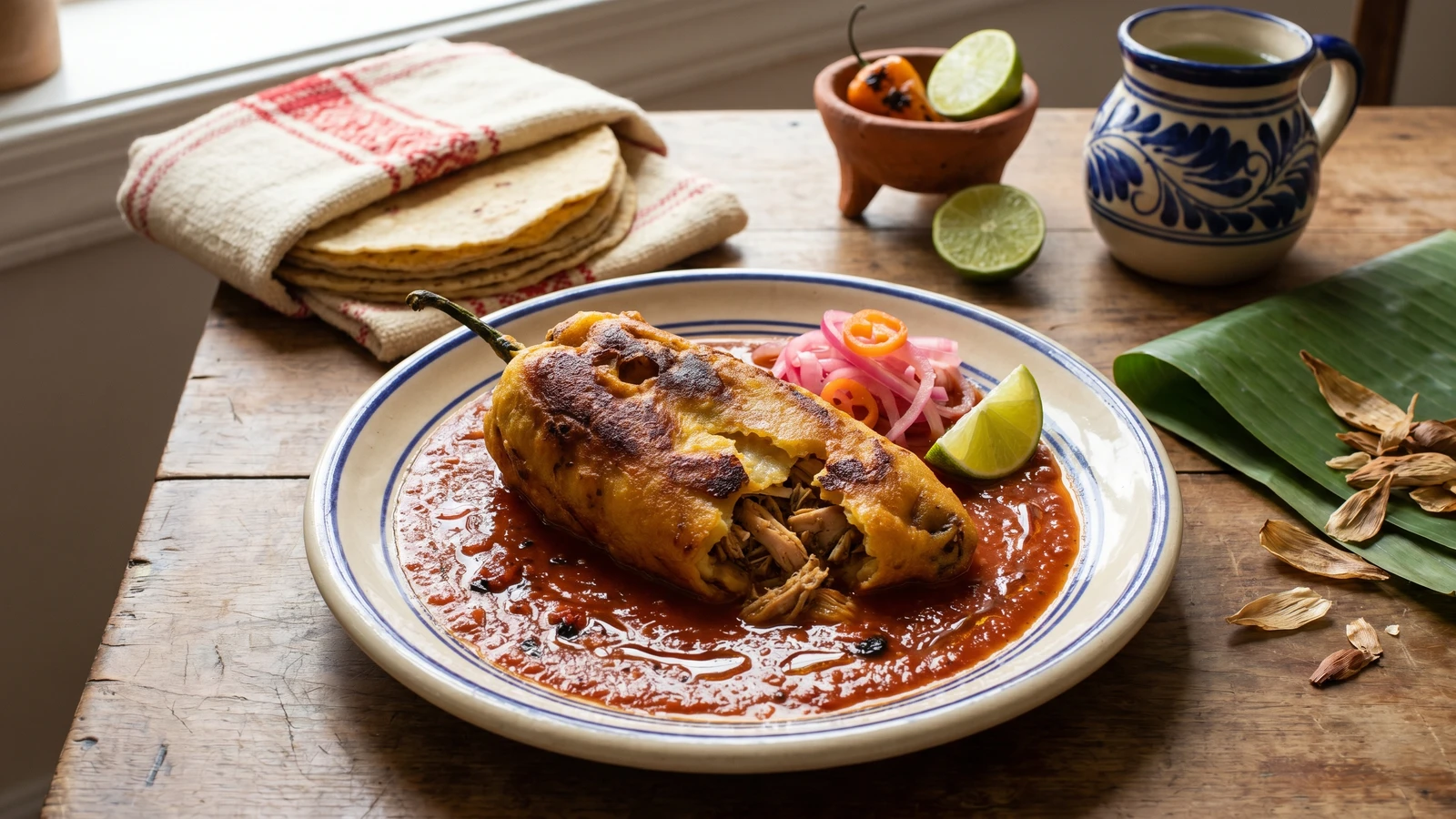
Campeche's yellow x'catic chile stuffed with cazón cooked in charred tomato, epazote, and the perfume of a whole habanero, dipped in capeado batter, fried gold, and served on a pool of chiltomate.
Appetizers & Snacks
Mexican
Dinner Party
Special Occasion
Celebration
50 min
Active Time
45 min cook•1 hr 35 min total
Yield6 servings (6 stuffed chiles)
This is a Campeche dish. Not a Yucatan dish, not a Quintana Roo dish, Campeche, the smaller, older Gulf-coast state whose cooking gets folded into 'Yucatecan' by people who have never crossed the Peninsula. Campeche has its own seafood tradition, its own market in the centro historico, and its own version of the stuffed chile that lives next door to the Poblana but has nothing in common with it except the shape.
The chile is x'catic. Yellow, long, thin-walled, with a clean grassy heat. It does not exist outside the Peninsula's markets in any serious quantity. If you cannot find it, the closest substitutes are a Hungarian wax or a guero, and I will tell you honestly that the dish will be close but not the same. The filling is cazón, baby shark, which has been the working-class protein of the Gulf coast since the colonial period. Cazón is poached, shredded fine, then cooked in charred tomato with onion, garlic, epazote, and one whole habanero laid on top, never broken. The habanero gives perfume. If it breaks, the dish becomes a different dish.
Underneath everything is chiltomate, the charred-tomato salsa of the Peninsula, finished with naranja agria and a slick of manteca. Chiltomate is to Yucatecan and Campechano cooking what a good tomato sauce is to a southern Italian: the base everything sits on. It cannot be skipped. It cannot be replaced with a generic Mexican red salsa. The smoky-sweet weight of the chiltomate is what the crisp capeado batter and the cool pickled red onion play against. This is a composed dish, three temperatures, three textures, three flavors of red and yellow and pink on the plate.
I collected this recipe from a senora named Doña Marta in the mercado of San Francisco de Campeche in 2009. She had been making it the same way since her aunt taught her in the sixties. She told me, 'Si lo haces con el habanero roto, no me lo enseñes' (If you make it with the habanero broken, do not show it to me). My mother's notebook has nothing from Campeche. This was a state I had to learn from the women in its markets, plate by plate. Saber cocinar es saber vivir.
Cazón, or small shark, became central to Campechano cooking during the colonial period when the Gulf of Mexico's coastal fisheries supplied an inexpensive, durable protein to a poor population, and the meat's mild flavor and easy shredding made it a natural pairing with the Peninsula's pre-Hispanic tomato and chile sauces. The chile x'catic, whose name comes from the Yucatec Maya word for 'blond' or 'fair,' is a Peninsula-endemic cultivar that does not appear in central or northern Mexican cuisines, and its scarcity outside the region is one of the reasons Yucatecan and Campechano food remained insulated from the national flattening that homogenized so much of Mexican cooking in the 20th century. Chiltomate, the charred-tomato base salsa that anchors this and many other Peninsula dishes, was documented in colonial-era convent recipe books in Mérida as 'chil-tomat,' a Mayan-Spanish hybrid name that preserves the indigenous structure of the sauce despite the Spanish ingredients added later.
The technique, the tradition, and the story behind every dish.
fresh chiles x'catic (yellow Yucatan chiles)whole, to be charred and peeled
6
fresh cazón filletor substitute fresh mackerel or skipjack tuna
1 pound
bay leaf
1
white onion (for poaching cazón)
1/2
white onionfinely chopped, for the filling
1 medium
garlic cloves (for poaching cazón)peeled
2
garlic clovesfor the filling and chiltomate
3
manteca de cerdo (pork lard)2 for the filling, 2 for the chiltomate
4 tablespoons
ripe Roma tomatoesfor the filling, charred on the comal
4 medium
fresh epazoteleaves chopped
1 large sprig
chile habanerowhole and unbroken, perfumes the filling
1
chile habanerocharred, for the chiltomate
1
kosher salt
1 teaspoon, plus more to taste
large eggsseparated, at room temperature
3
all-purpose flour
1/2 cup, plus more for dredging
neutral oil for shallow frying
about 1 inch deep in the pan
ripe Roma tomatoes (for the chiltomate)
1 1/2 pounds
small white onion (for the chiltomate)halved, charred on the comal
1
naranja agria (sour orange) juiceor substitute equal parts orange and lime
1 tablespoon
pickled red onion with habanero (optional)
for serving
hand-pressed corn tortillas (optional)warmed
for serving
Equipment Needed
•Cast iron comal or heavy skillet for charring
•Wide deep skillet for shallow frying (cast iron or carbon steel)
•Stand mixer or hand mixer for the egg whites
•High-powered blender for the chiltomate
•Fine-mesh strainer
•Wire rack set over a sheet pan for draining the fried chiles
•Slotted spoon or kitchen spider
Instructions
1
Char the x'catic chiles
Set a comal or heavy skillet over medium-high heat. Place the whole x'catic chiles directly on the dry surface and turn them every minute or so until the skin blisters and chars in patches all around. The yellow flesh underneath should remain firm, not collapse. Transfer the chiles to a plastic bag or a bowl covered with a plate and let them sweat for 15 minutes. The trapped warmth loosens the skin without overcooking the flesh.
X'catic is not a poblano. It is thinner-walled and burns faster. Watch it. You want the skin blistered, not the flesh blackened all the way through.
2
Peel and slit the chiles
Working over a plate to catch any juice, rub the charred skin off with your fingers or the back of a small knife. Do not rinse them under water. Water washes the flavor away. Make a single lengthwise slit down one side of each chile, just long enough to spoon in the filling. Reach in carefully and pull out the seed cluster, leaving the stem intact. The chile must stay in one piece. A torn chile will not hold the filling in the fryer.
3
Poach the cazón
Bring a saucepan of water to a gentle simmer with the bay leaf, the 1/2 onion, the 2 peeled garlic cloves, and a teaspoon of salt. Slide in the cazón. Poach at a bare simmer for 8 to 10 minutes, until the fish is opaque all the way through. Lift it out with a slotted spoon, let it cool until you can handle it, then shred it finely with two forks. Discard any dark blood line or sinew. The texture should be like cooked tuna, fine and dry.
4
Char the tomatoes for the filling
On the same comal you used for the chiles, char the 4 Roma tomatoes whole, turning until the skin blackens in patches and the tomatoes soften, about 8 minutes. Pull off and discard the loose skin. Roughly chop the flesh and keep all the juice. This is the Yucatecan way. Raw tomato in this filling tastes flat. Charred tomato tastes like the Peninsula.
5
Build the cazón filling
Melt 2 tablespoons of manteca in a wide skillet over medium heat. Add the finely chopped onion and 2 of the remaining garlic cloves, finely minced. Cook for 4 to 5 minutes until the onion turns translucent and edged with gold. Add the charred chopped tomato and all its juice. Cook for 6 to 8 minutes, stirring, until the mixture thickens into a loose sofrito. Stir in the shredded cazón, the chopped epazote, and salt to taste. Lay the whole habanero on top of the mixture without breaking it. Cook for another 5 minutes so the habanero perfumes the filling. Remove the habanero before stuffing. La manteca es el sabor, and the habanero gives perfume, not heat. Do not break it.
If you cannot find epazote, leave it out. Do not substitute oregano or cilantro. Epazote has a particular green-petroleum note that nothing else gives, and a Yucatecan cocinera will tell you the dish is incomplete without it but ruined with the wrong herb.
6
Make the chiltomate
Char the 1 1/2 pounds of Roma tomatoes, the halved small onion, the remaining garlic clove, and the second habanero on the comal until the skins blacken in patches and everything is soft. Peel the loose skin off the tomatoes. Stem the habanero. Transfer everything to a blender with the naranja agria and a teaspoon of salt. Blend until smooth but still bodied, not watery. Melt the remaining 2 tablespoons of manteca in a saucepan over medium heat. Pour in the puree, stand back because it will spit, and simmer for 10 to 12 minutes, stirring, until the salsa darkens slightly and a thin slick of fat shows at the edge. That slick is your signal that the salsa is done.
7
Stuff the chiles
Working with one chile at a time, gently open the slit and spoon in two to three generous tablespoons of the cazón filling. Do not overpack. The chile should close around the filling without straining. Press the slit closed with your fingers. If a chile insists on opening, use a toothpick to pin it shut, and remember to remove it before serving.
8
Whip the capeado batter
Beat the egg whites in a clean dry bowl with a pinch of salt until they hold stiff peaks. Beat the yolks in a separate bowl until pale, about 1 minute, then fold them gently into the whites with a rubber spatula. Sprinkle 1 tablespoon of flour over the top and fold it in until just incorporated. The batter should be airy and pale yellow, holding its shape like a soft cloud. This is capeado, the egg-foam batter of the Peninsula, not a thick pancake batter.
Cold eggs will not whip to stiff peaks the way room-temperature eggs will. Pull the eggs out an hour before you start the dish. No me vengas con atajos on this one. The lift in the batter is the lift in the chile.
9
Fry the chiles
Heat about an inch of neutral oil in a wide heavy skillet to 350F (175C). Drop a bit of batter in to test. It should bubble immediately and rise without browning instantly. Spread the dredging flour on a plate. One at a time, roll each stuffed chile lightly in flour, shake off the excess, dip it into the egg batter to coat completely, then lower it gently into the oil with two forks or a slotted spoon. Hold it for 30 seconds until the batter sets, then let it float. Fry for about 2 minutes per side, turning carefully, until the batter is deep golden and crisp. Drain on a wire rack, not on paper towels. Paper towels make the bottom go soft.
10
Plate on chiltomate
Spoon a generous pool of warm chiltomate onto each plate. Set one fried chile on top so the salsa surrounds it but does not drown the batter. Serve immediately with pickled red onion alongside and a stack of warm hand-pressed corn tortillas. The contrast of the crisp capeado, the soft cazón filling, the sweet-smoky chiltomate, and the sharp pickled onion is the dish. Asi se hace y punto.
Chef Tips
•If you cannot find fresh cazón, the only substitutions I will give you are fresh mackerel or skipjack tuna, both poached the same way and shredded fine. Do not use canned tuna. That is not a compromise, that is a different dish entirely.
•The habanero in the filling stays whole. Lay it on top, let it perfume, remove it before stuffing. If the skin breaks during cooking, the filling goes from perfumed to inedible. There is no rescuing it. Start over.
•Chiltomate freezes well for up to two months. Make a double batch and freeze half. The Peninsula uses it on eggs, on tamales colados, on panuchos, on pretty much anything that wants a base. Recetas probadas y garantizadas.
•Naranja agria is the sour Seville orange of the Peninsula. If you cannot find it, mix equal parts fresh orange juice with fresh lime juice. The substitution is a compromise. It is not the same brightness, but it is honest.
Advance Preparation
•The cazón filling can be made one day ahead and refrigerated. The flavor deepens overnight, especially the epazote and the habanero perfume.
•The chiltomate can be made up to three days ahead and refrigerated, or frozen for up to two months. Reheat gently with a splash of water if it has thickened too much.
•The x'catic chiles can be charred, peeled, and stuffed up to four hours ahead and held in the refrigerator. Bring them to room temperature before battering and frying.
•The capeado batter must be made at the last minute. Whipped egg whites collapse within thirty minutes. No me vengas con atajos on this step.
Frequently Asked Questions
Nutrition Information
1 serving (about 400g)
Calories
395 calories
Total Fat
23 g
Saturated Fat
6 g
Trans Fat
0 g
Unsaturated Fat
16 g
Cholesterol
140 mg
Sodium
410 mg
Total Carbohydrates
20 g
Dietary Fiber
4 g
Sugars
6 g
Protein
21 g
Where cooking meets culture.
Culinary guides, cultural storytelling, and the editorial depth that makes cooking meaningful.