Culinary Explorer

A cooking platform built around craft, culture, and the stories behind what we eat.
Discover Culinary Explorer
Salada de Orelha de Porco

Salada de Orelha de Porco

Created by

Slow-braised pig's ears sliced thin and dressed with garlic, vinegar, and good azeite. Tasca cooking, nose-to-tail eating, proof that the Portuguese waste nothing and turn everything into something worth eating.

Salads
Portuguese
Dinner Party
Special Occasion
15 min
Active Time
2 hr 30 min cook2 hr 45 min total
Yield6 servings

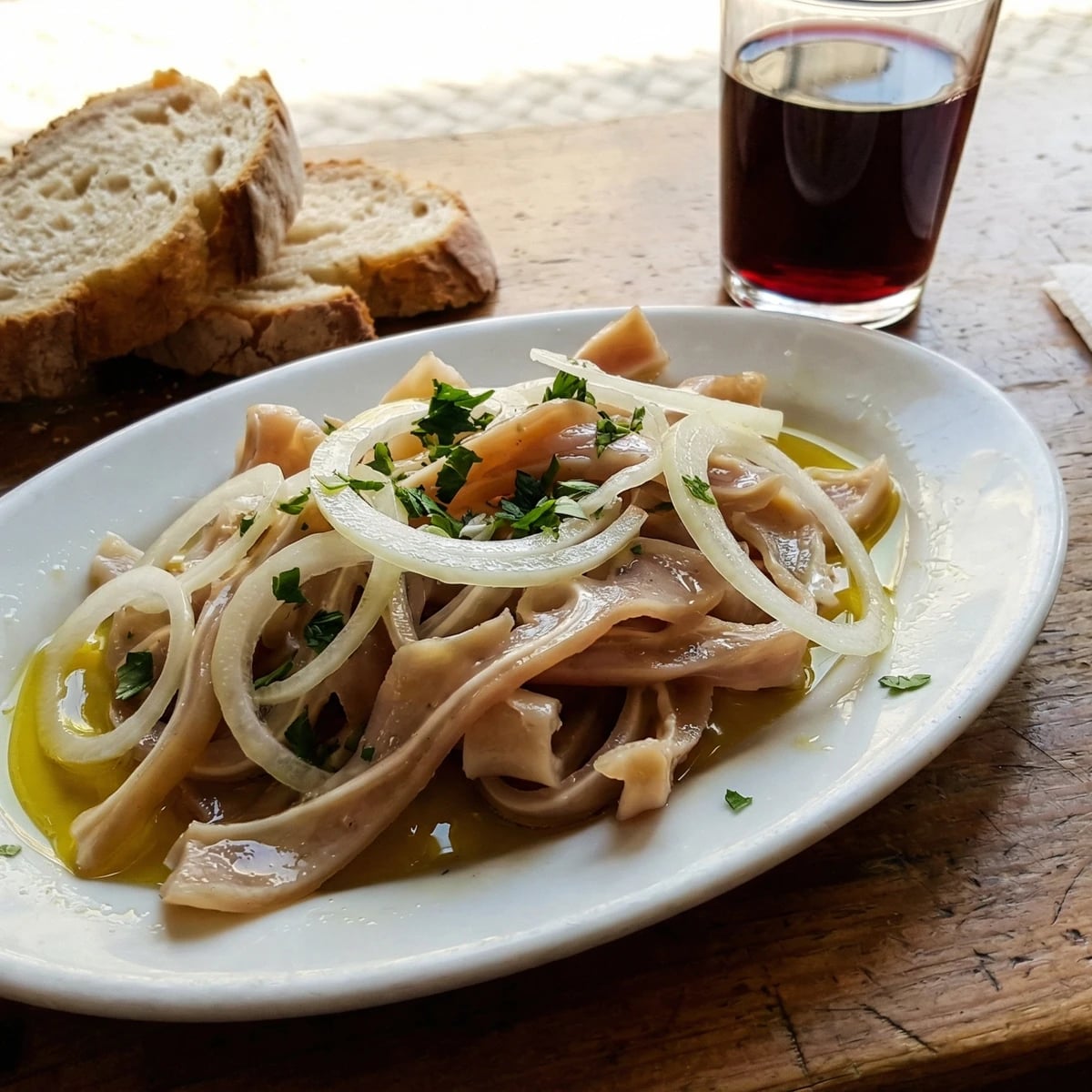
This is the dish that separates the tourists from the locals. Walk into any proper tasca in Lisbon or Porto, and there it is behind the glass counter: pale ribbons of braised pig's ear glistening with olive oil, studded with raw onion and flecked with parsley. Most people walk past. Their loss.

I learned to love orelha de porco at my uncle's house in Portalegre, near the Spanish border. He raised pigs, and at the matança every December, nothing was wasted. The blood became morcela. The fat became banha. And the ears, well, the ears became this. Sliced thin, dressed simply, eaten with bread and wine while the men played cards and argued about football.

This is peasant cooking at its finest. The ears are mostly cartilage, which sounds unappetizing until you braise them for hours and that cartilage turns silky, almost gelatinous, with a texture unlike anything else. The dressing is sharp: raw garlic, good vinegar, your best azeite. It needs that brightness to balance the richness.

At Mesa da Avó, I serve this as a petisco, and I watch people's faces. First the hesitation, then the first bite, then the realization. This is who we are. We use everything. We waste nothing. And somehow, we turn the humble parts into something better than the prized ones.

Salada de orelha belongs to Portugal's deep tradition of nose-to-tail cooking, born from rural communities where the annual matança (pig slaughter) was both survival and celebration. Every part was used: blood for sausages, fat for cooking, ears and trotters for salads and stews. The dish remains a fixture in tascas across Portugal, particularly in Alentejo and Trás-os-Montes, where pig farming has shaped the cuisine for centuries.

The technique, the tradition, and the story behind every dish.

Discover Culinary Explorer

Ingredients

pig's ears

Quantity

4 (about 600g total)

cleaned and singed

onion

Quantity

1 medium

halved

bay leaves

Quantity

2

black peppercorns

Quantity

6

coarse salt

Quantity

1 tablespoon

white onion

Quantity

1 small

sliced paper-thin

garlic

Quantity

4 cloves

minced

extra virgin olive oil (azeite)

Quantity

1/2 cup

white wine vinegar

Quantity

3 tablespoons

flat-leaf parsley

Quantity

1 small bunch

chopped

flaky sea salt

Quantity

to taste

black pepper

Quantity

to taste

freshly ground

piri-piri or crushed red pepper flakes (optional)

Quantity

to taste

Equipment Needed

  • Large heavy pot
  • Sharp knife for slicing
  • Serving bowl or platter

Instructions

  1. 1

    Prepare the ears

    Examine the pig's ears carefully. If there's any remaining hair, singe it off over a gas flame or with a kitchen torch. Scrub them thoroughly under cold running water. They should be completely clean, pale, and smooth. This matters. Nobody wants to find a stray bristle.

    A good butcher will have already cleaned and singed the ears. Ask. Save yourself the work.
  2. 2

    Braise until tender

    Place the ears in a large pot and cover with cold water by about 5 centimeters. Add the halved onion, bay leaves, peppercorns, and coarse salt. Bring to a boil, then reduce to a gentle simmer. Cook uncovered for 2 to 2 1/2 hours, until a knife slides through the thickest part without resistance. The cartilage should be soft, almost gelatinous, but the ear should still hold its shape. Top up with hot water if needed during cooking.

    The ears are done when they bend easily and the cartilage has turned translucent. Undercooked, they'll be chewy. Properly cooked, they have this silky, yielding texture that's impossible to describe until you've tasted it.
  3. 3

    Slice while warm

    Remove the ears from the cooking liquid (save that broth for caldo or beans, there's flavor there). Let them cool just enough to handle, about 10 minutes. While still warm, slice them into very thin strips, about 3mm wide. Work against the natural curl of the ear. The strips should be almost like ribbons. This is easier while the collagen is still warm and supple.

  4. 4

    Make the dressing

    In a small bowl, whisk together the olive oil, white wine vinegar, and minced garlic. Season with salt and pepper. Taste it. The dressing should be bright and assertive. It needs to stand up to the richness of the ears.

  5. 5

    Dress while warm

    Transfer the warm ear strips to a serving bowl. Add the paper-thin onion slices. Pour the dressing over everything and toss gently but thoroughly. The ears will absorb the garlic and vinegar as they cool. This is the moment when the dish comes together. Let it sit at room temperature for at least 30 minutes, tossing occasionally.

  6. 6

    Finish and serve

    Just before serving, scatter the parsley over the top. Taste and adjust the seasoning. Add a pinch of piri-piri if you want heat. Serve at room temperature with plenty of crusty bread to soak up the garlicky dressing. This is tasca food. It's meant to be eaten standing at the counter or sitting at a small table with a glass of red wine in hand.

Chef Tips

  • Buy your ears from a butcher who does their own butchering. Supermarket ears are often poorly cleaned. A good butcher takes pride in proper preparation.
  • The braising liquid is essentially a pork stock. Strain it, refrigerate it, and use it for cooking beans, rice, or greens. Never throw it away.
  • This salad is better the next day. The ears firm up slightly in the fridge and the garlic mellows. Bring to room temperature before serving.
  • Some tascas add a splash of the cooking liquid to the dressing for extra body. Try it. The collagen adds a silkiness that straight olive oil can't match.

Advance Preparation

  • The ears can be braised up to 3 days ahead and refrigerated in their cooking liquid. Slice and dress when ready to serve.
  • The dressed salad keeps refrigerated for up to 4 days. In fact, it improves. Always bring to room temperature before serving; cold dulls the garlic and mutes the olive oil.

Frequently Asked Questions

Nutrition Information

1 serving (about 115g)

Calories
310 calories
Total Fat
25 g
Saturated Fat
5 g
Trans Fat
0 g
Unsaturated Fat
17 g
Cholesterol
70 mg
Sodium
400 mg
Total Carbohydrates
2 g
Dietary Fiber
0 g
Sugars
1 g
Protein
16 g

Note: Chef personas and recipes are created with AI assistance. Cook with care: follow safe food-handling practices, check doneness with a thermometer when needed, and adapt for allergies and your kitchen.

Where cooking meets culture.

Culinary guides, cultural storytelling, and the editorial depth that makes cooking meaningful.

Discover Culinary Explorer

More from Chef Margarida's Salads

Browse the full collection