
Chef Jeong-sun
Agwi-jjim (Braised Monkfish with Bean Sprouts)
Firm monkfish buried under crisp soybean sprouts, minari, and a red gochugaru sauce thickened at the end; Masan's market dish asks for heat, timing, and a steady hand.
A cooking platform built around craft, culture, and the stories behind what we eat.

Created by
Firm white fish sliced thick enough to chew, served cold with chojang, perilla, garlic, and chili, so the clean flavor stays clear and the table reaches in together.
Saengseon-hoe is often explained too quickly: raw fish, like sashimi, but with red sauce. That misses the table. Korean hoe is cut to give you chew, set down with perilla leaves, lettuce, sliced garlic, green chili, chojang (vinegared gochujang sauce), and often a pot of maeuntang waiting after the bones have done their second work. It is not a quiet plate for one person. It gathers hands.
Tonight the dish asks for severity before generosity. Buy fish meant to be eaten raw, handled under proper cold chain, and keep it cold enough that your fingers almost complain. Cut it with one clean pull of the knife. No sauce can correct a careless market choice. No garnish can hide a ragged cut. Technique first, and safe sourcing before technique.
At my teacher's table, Master Seong-nyeo watched the knife more than the platter. The slice should be thick enough to chew, about 6 mm for firm white fish, and even from first piece to last. 정성이 첫째예요. Sincerity comes first, and with hoe sincerity means discipline: clean board, cold fish, measured chojang, and a table ready before the first slice loses its chill.
Hoe (회), the Korean reading of the old character 膾 for sliced raw fish or meat, appears in Joseon-period records and cookbooks as a broad category rather than one court dish. Modern saengseon-hoe is strongly tied to coastal markets and hoe-jip (raw fish restaurants), and it spread inland after the Korean War as refrigeration, live-fish tanks, and aquaculture made flounder, rockfish, and sea bream available in cities. The Korean service is marked by chojang, lettuce or perilla wraps, sliced garlic and chili, and often maeuntang from the remaining bones, a sequence distinct from Japanese sashimi service.
Quantity
600g
skinless, boneless, kept below 4 C / 40 F; olive flounder, halibut, sea bream, or sea bass
Quantity
4 cups
for chilling the tray and holding the fish cold
Quantity
2 cups
finely shredded, rinsed and chilled
Quantity
24 leaves
washed and dried
Quantity
16 leaves
washed and dried
Quantity
4 cloves
thinly sliced
Quantity
2
thinly sliced on the diagonal
Quantity
1/2 cup
Quantity
to serve
Quantity
3 tablespoons
Quantity
2 tablespoons
Quantity
1 tablespoon
or 2 teaspoons sugar dissolved in 1 teaspoon water
Quantity
1 tablespoon
plus more 1 teaspoon at a time if needed
Quantity
1 small clove
finely grated
Quantity
1 teaspoon
Quantity
1/2 teaspoon
Quantity
2 tablespoons soy sauce and 1/2 teaspoon wasabi
| Ingredient | Quantity |
|---|---|
| raw-eating-quality firm white fish filletskinless, boneless, kept below 4 C / 40 F; olive flounder, halibut, sea bream, or sea bass | 600g |
| icefor chilling the tray and holding the fish cold | 4 cups |
| Korean radish or daikon (optional)finely shredded, rinsed and chilled | 2 cups |
| perilla leaves (kkaennip)washed and dried | 24 leaves |
| red leaf lettuce or butter lettucewashed and dried | 16 leaves |
| garlicthinly sliced | 4 cloves |
| Korean green chiliesthinly sliced on the diagonal | 2 |
| ssamjang (seasoned soybean-chili paste) (optional) | 1/2 cup |
| cooked short-grain rice (optional) | to serve |
| gochujang (Korean chili paste) | 3 tablespoons |
| rice vinegar | 2 tablespoons |
| maesil-cheong (green plum syrup)or 2 teaspoons sugar dissolved in 1 teaspoon water | 1 tablespoon |
| cold waterplus more 1 teaspoon at a time if needed | 1 tablespoon |
| garlicfinely grated | 1 small clove |
| toasted sesame seeds | 1 teaspoon |
| toasted sesame oil | 1/2 teaspoon |
| soy sauce and prepared wasabi or yeon-wasabi (optional) | 2 tablespoons soy sauce and 1/2 teaspoon wasabi |
Buy the fish the day you will serve it from a fishmonger who sells fish specifically for raw eating. Ask what species it is, when it was killed or filleted, and whether it was commercially frozen or otherwise handled for raw service. Freshness is not enough for wild finfish; parasite control and cold handling matter. If the fish smells strong, feels soft, has dull edges, or the seller cannot answer plainly, do not serve it raw. Cook it as saengseon-gui (grilled fish) or maeuntang (spicy fish stew) instead.
Put the serving platter in the refrigerator or freezer for 20 minutes. Wash your hands, clean the board, clean the knife, and set a rimmed tray over the ice so the fish can stay cold while you work. Keep the fish wrapped and below 4 C / 40 F until the moment you cut. This is part of the recipe, not housekeeping.
Stir together the gochujang, rice vinegar, maesil-cheong, cold water, grated garlic, sesame seeds, and sesame oil. Let it sit 10 minutes so the garlic settles into the sauce. It should be bright, sharp, and loose enough to dip, not thick and sugary. If it stands stiff on the spoon, add cold water 1 teaspoon at a time. This amount makes about 1/2 cup, enough for four people using 1/2 teaspoon at a bite.
Wash the perilla and lettuce, then dry them well. Wet leaves make the sauce run and the wrap taste thin. Slice the garlic into thin coins and the chilies on a clean diagonal. If using shredded radish, rinse it in very cold water for 5 minutes, drain it hard, and pat it dry so it keeps the platter crisp instead of watery.
Unwrap one piece of fish at a time and keep the rest over ice. Pat it dry, then feel for pin bones and pull them with tweezers. Trim away any dark bloodline, tough membrane, or ragged edges. Cut the fillet into blocks about 2 to 2 1/2 inches wide so each slice can be even from top to bottom.
Set the fish block so you can cut across the grain. Hold the knife at a slight 30-degree angle and draw it from heel to tip in one clean pull, making slices 5 to 7 mm thick for firm white fish. Do not saw. Sawing bruises the surface and makes ragged, watery edges. Korean hoe wants chew, so the slice is thicker than Japanese sashimi, but it must still be clean.
Line the chilled platter with perilla leaves or a loose bed of dried shredded radish. Arrange the fish in slightly overlapping rows, leaving space so each piece can be lifted without tearing the next one. Put chojang, optional soy-wasabi, ssamjang, garlic, chilies, lettuce, perilla, and rice on the table before the platter lands. Serve within 15 minutes of slicing. If the meal will linger, set the platter over ice or bring out smaller platters in rounds.
For one bite, lay a perilla leaf inside lettuce, add one slice of fish, one sliver of garlic, one slice of chili, and 1/2 teaspoon chojang or a pea-size dab of ssamjang. Fold once and eat whole. More sauce is not more care; it just makes every fish taste like gochujang. If you bought a whole fish, the head and bones can become maeuntang after the raw platter is finished.
1 serving (about 315g)
Culinary guides, cultural storytelling, and the editorial depth that makes cooking meaningful.
Discover Culinary ExplorerChef Jeong-sun
Firm monkfish buried under crisp soybean sprouts, minari, and a red gochugaru sauce thickened at the end; Masan's market dish asks for heat, timing, and a steady hand.

Chef Jeong-sun
A quick Korean rice bowl built on contrast: warm rice, cold popping flying-fish roe, chopped vegetables, gim, sesame oil, and the crisp rice bottom a hot stone bowl gives you.
Chef Jeong-sun
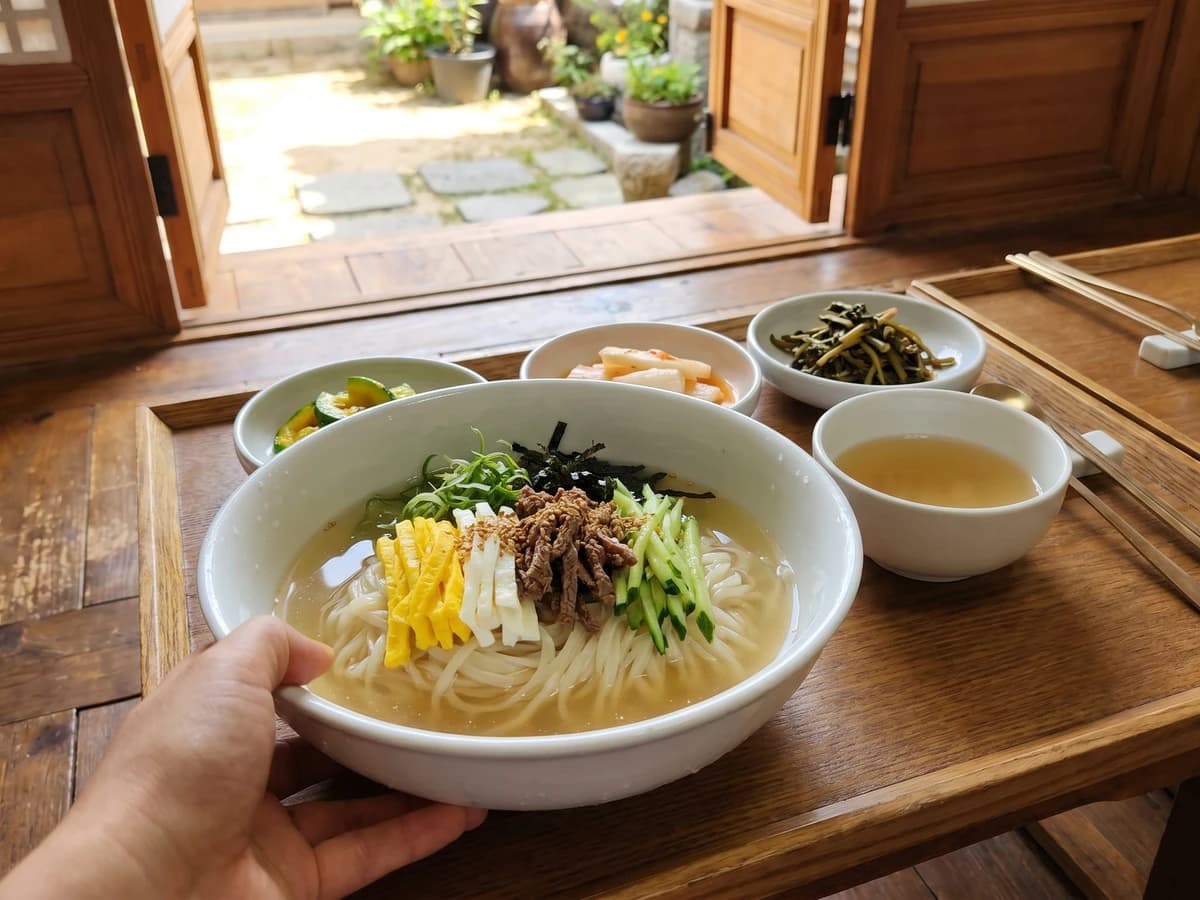
Andong's guest noodles, wheat and roasted soybean flour rolled thin, boiled and rinsed cold, then set in a clear chilled anchovy broth with careful strips of beef, egg, and cucumber.

Chef Jeong-sun
Andong's ritual-table rice served on an ordinary day: separate soy-sesame namul, warm rice, and clear radish soup, mixed without gochujang so every vegetable keeps its own voice.