
Chef Elsa
Apfelkren
Freshly grated horseradish folded with tart apple and lemon, the cold, sharp sauce that belongs beside every plate of Tafelspitz in Vienna and has done for as long as anyone can remember.
A cooking platform built around craft, culture, and the stories behind what we eat.
Created by
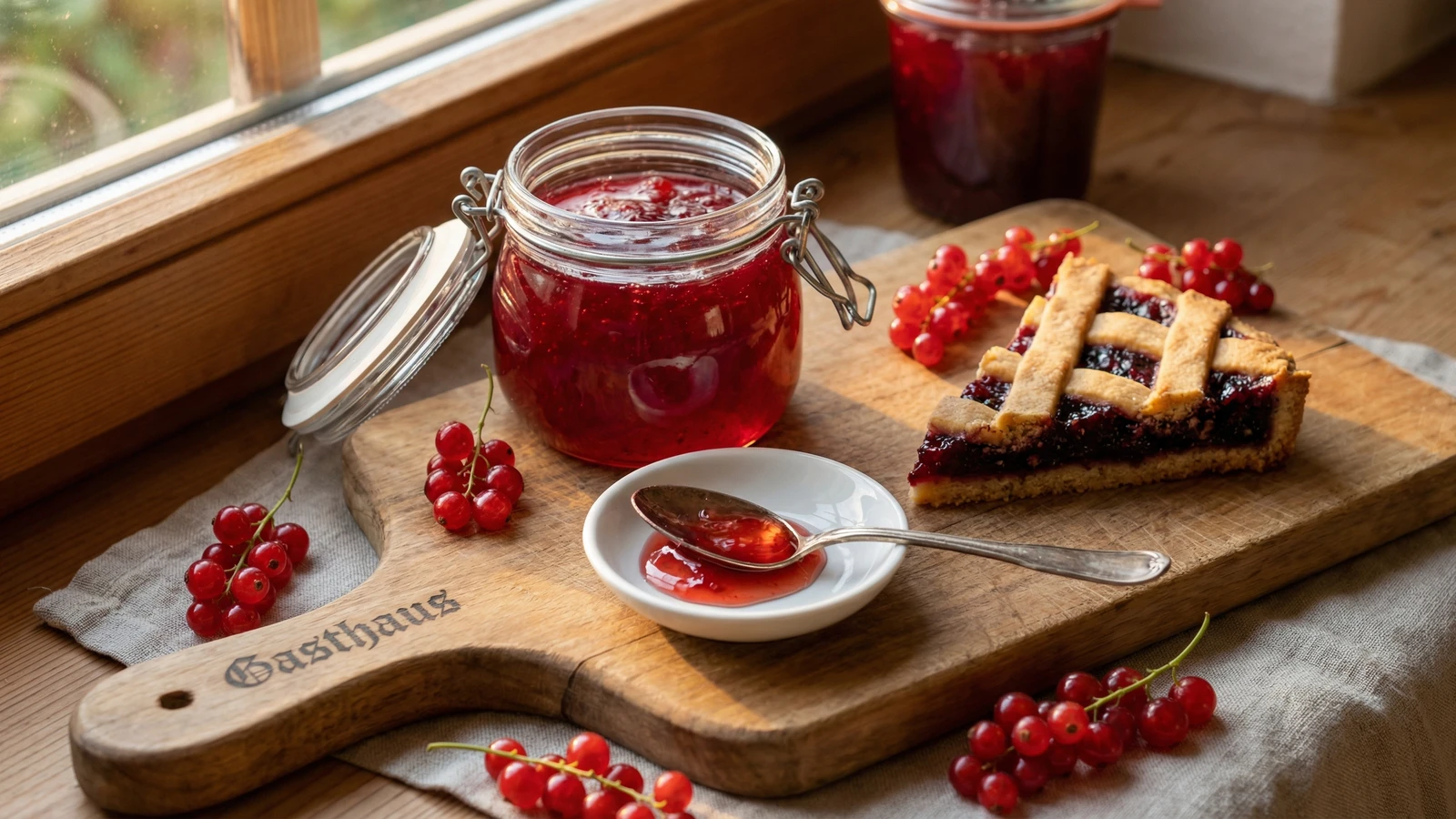
Austria's jewel-red preserve, tart enough to stand up to a buttery Linzer Torte and bright enough to make a spoonful on Topfenknödel sing. This is the jam that fills half the pastry cases in Vienna.
In my grandmother Eva's kitchen in Kent, there was a week every July when the whole house smelled of hot sugar and sharp fruit. Gretel would arrive with a basket of red currants from the garden and the two of them would stand at the stove, stirring and tasting and arguing about when the jam was ready. Gretel always said you know it's set when a drop on a cold plate wrinkles under your fingertip. Eva said you know it's set when Gretel finally stops talking about it. They made this jam every summer for forty years.
Ribisel is the Austrian word for red currants. Not Johannisbeeren, which is what the Germans call them. Ribisel. If you walk through a Viennese Konditorei, this jam is everywhere, even if you don't see it. It's inside the Linzer Torte, sandwiched between Linzer Augen, spooned into Buchteln, stirred through Palatschinken. It's the invisible thread that runs through Austrian baking because its tartness does something no other preserve can: it cuts through butter and sugar and nuts and says, here, taste this, wake up.
The recipe is almost absurdly simple. Red currants. Sugar. Heat. Time. That's it. No added pectin, because red currants are loaded with their own. No lemon juice, because they bring more acidity than most fruits dare. You cook them down, strain out the seeds if you want a smooth jam (and for Linzer Torte, you want a smooth jam), and put it in clean jars. The colour is extraordinary. A deep, translucent ruby that catches the light like stained glass. Gretel used to hold the jars up to the window and admire them before she put them away. I still do the same thing.
Red currant jam's central role in Austrian pastry dates to the Linzer Torte itself, widely considered the oldest known cake recipe in the world, with a version appearing in a Veronese manuscript from 1653. The Torte's lattice crust was always filled with Ribiselmarmelade, never strawberry or raspberry, because the currant's sharp acidity was needed to balance the rich almond and butter dough. In Austria, the word Marmelade is used for all jams regardless of fruit, unlike the British distinction between jam and marmalade. This linguistic difference traces back to the Portuguese marmelo (quince), which entered Austrian German through the Habsburg trade routes long before the EU tried to regulate what could be called what.
Quantity
1 kg
stems removed
Quantity
500g
Quantity
2 tablespoons
| Ingredient | Quantity |
|---|---|
| fresh red currants (Ribisel)stems removed | 1 kg |
| granulated sugar | 500g |
| water | 2 tablespoons |
Run a fork down each stem to pop the berries off. You don't need to be precious about this. A few small stems won't matter because everything gets strained later. Rinse the currants briefly and let them drain. Discard any that are shriveled or moldy. Good fruit is the entire recipe here. There is nowhere for a tired berry to hide.
Wash your jars and lids in hot soapy water and place them in an oven at 120°C for fifteen minutes, or run them through the hottest cycle of your dishwasher. Leave them in the oven or dishwasher until you need them. The jars must be hot when you fill them. Cold glass and hot jam is how you crack a jar and lose an afternoon's work.
Put the currants in a wide, heavy-bottomed pot with two tablespoons of water. The water just prevents sticking in the first minute before the berries burst. Set the heat to medium and stir occasionally. Within five minutes the currants will collapse and release their juice. The kitchen will smell sharp and fruity, almost wine-like. Let them bubble gently for ten minutes, pressing them against the side of the pot with your spoon to break them down completely. You want a loose, pulpy mass with no whole berries left.
Set a fine-mesh sieve over a large bowl and pour the cooked currants through. Press firmly with the back of a ladle or wooden spoon, working the pulp against the mesh to extract every drop of juice. What stays behind is seeds and skin. What passes through is pure, concentrated currant juice, intensely red and slightly thick. For a Linzer Torte filling, you want this smooth. If you prefer a more rustic jam with texture, skip the straining entirely, but know that the seeds are small and crunchy and some people mind.
Return the strained juice to the cleaned pot. Add the sugar and stir over medium heat until it dissolves completely. Then bring the mixture to a rolling boil. This is where the pectin activates. You need a proper boil, not a simmer, not a gentle bubble. The surface should be churning. Stir frequently to prevent scorching on the bottom. Boil for eight to twelve minutes. The jam will deepen in colour and thicken noticeably.
Put a small plate in the freezer before you start cooking. When you think the jam is ready, drop a teaspoon onto the cold plate and push it with your fingertip after thirty seconds. If the surface wrinkles, it's set. If it runs like syrup, boil for another two minutes and test again. Gretel always said the wrinkle test has never lied to anyone who had the patience to actually do it. Most people skip it and end up with syrup.
Ladle the hot jam into your hot sterilized jars, filling them to within a centimeter of the rim. Wipe the rims clean with a damp cloth, because even a thin smear of jam will prevent a proper seal. Screw the lids on firmly and turn the jars upside down. Leave them inverted for five minutes, then flip them right side up and let them cool completely on the counter. You'll hear the lids pop as they seal. That sound is deeply satisfying. Hold one up to the light before you put it away. That colour is worth the whole afternoon.
1 serving (about 20g)
Culinary guides, cultural storytelling, and the editorial depth that makes cooking meaningful.
Discover Culinary ExplorerChef Elsa
Freshly grated horseradish folded with tart apple and lemon, the cold, sharp sauce that belongs beside every plate of Tafelspitz in Vienna and has done for as long as anyone can remember.

Chef Elsa
The clear, caraway-scented pan jus you pour over Schweinsbraten and Knödel, built from nothing but good pork drippings, honest stock, and the patience to let a roasting pan tell you everything it knows.

Chef Elsa
A silky butter roux sauce finished with beef broth, cream, and handfuls of fresh dill, the way every Viennese grandmother serves it alongside Tafelspitz on Sunday.

Chef Elsa
Crisp cauliflower, sweet carrots, and bright peppers in a spiced sweet-sour brine with mustard seeds, the jar you open first when the Brettljause comes out and the last one you put away.