
Chef Lupita
Caldo de Mariscos Campechano
Campeche's chunky seafood chowder from the Gulf coast, built on toasted shrimp shells, charred tomato, recado rojo, and epazote, served family-style from a clay cazuela with lima agria and warm tortillas.
A cooking platform built around craft, culture, and the stories behind what we eat.
Created by
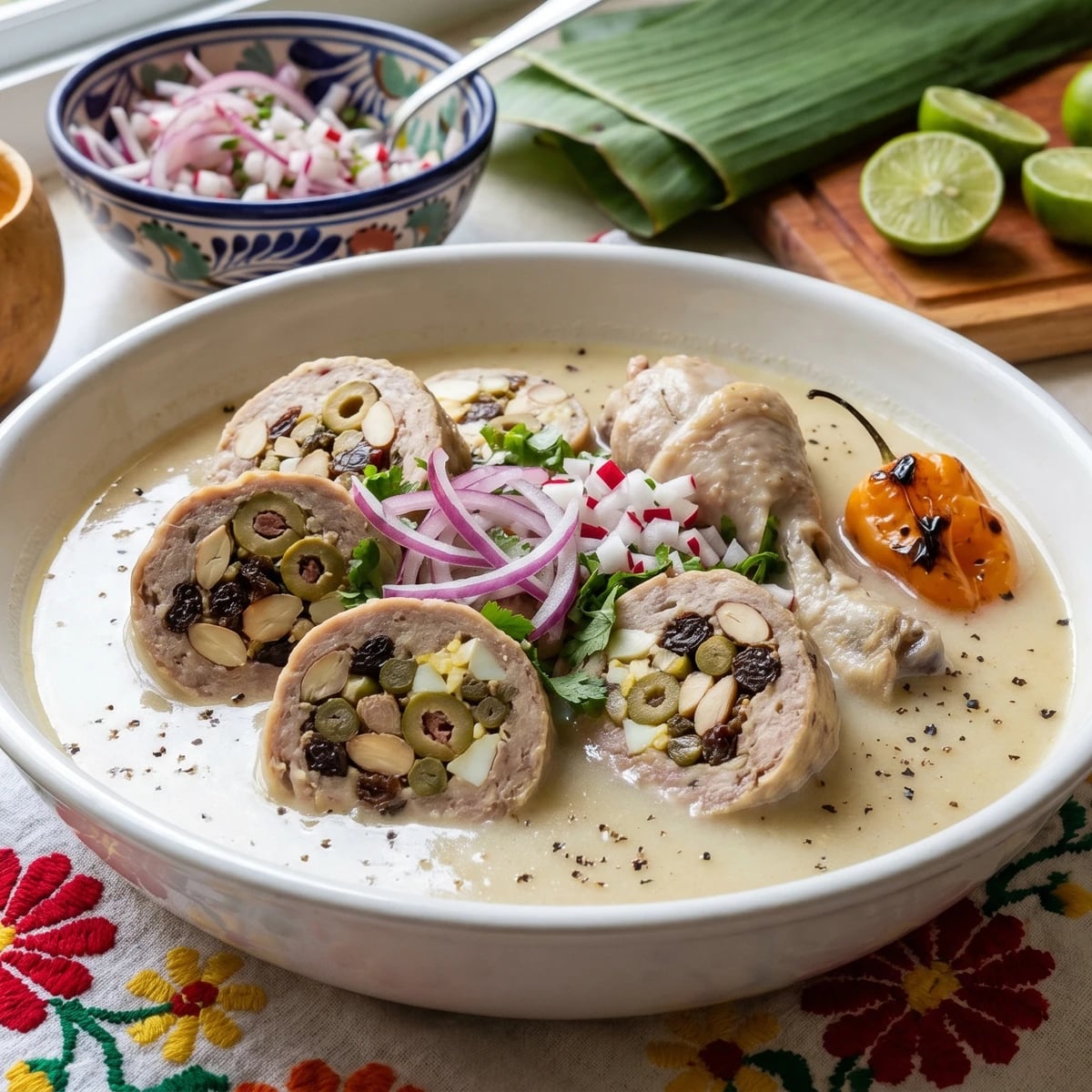
Yucatán's elegant white twin to relleno negro: turkey simmered with epazote and habanero, a pork meatball studded with almonds, raisins, olives, and capers, finished with the masa-thickened k'ool that gives this stew its name.
This is from Yucatán. Specifically from the home kitchens of Mérida and Valladolid, where relleno blanco is the dish that comes out for baptisms, weddings, and the kind of Sunday meal that begins at noon and ends when the last person stops eating. Most of the world knows relleno negro, the dramatic black stew built on burnt chiles and recado negro. Relleno blanco is its elegant twin, paler, more restrained, but in some kitchens more loved.
The color is not white from cream. There is no cream in this dish. The whiteness comes from what is absent: no achiote, no toasted chile, no tomato base. The recado blanco is built on black pepper, clove, cinnamon, cumin, roasted garlic, and toasted oregano. The broth is finished with k'ool, masa harina dissolved in broth and cooked into a pale ivory thickener. K'ool is Maya technique, and you will not understand Yucatecan cooking until you understand that masa is not only for tortillas.
The meatball, the relleno itself, carries the colonial layer. Almonds, raisins, olives, capers, hard-boiled eggs, all woven into ground pork and beef and poached inside the turkey broth. The Mediterranean came to Yucatán on Spanish ships and stayed. The peninsula has always been more itself than Mexican, more Maya than mestizo, and its food is the proof.
I sat in a kitchen in Valladolid in 2014 with a senora named Doña Rosa who showed me how to wrap the meatball in cheesecloth and lower it into the broth. She told me the trick is patience. The turkey gives its flavor to the broth, the broth gives its flavor to the meatball, and the k'ool binds them at the end. Skip a step and the dish stops talking to itself. Esto no es comida de un solo México. Cada estado, su propia cocina, and this one belongs to Yucatán.
Relleno blanco descends from the Maya tradition of stuffed game birds and the Spanish picadillo tradition of meat enriched with dried fruit, nuts, and brine-cured ingredients, a convergence that occurred in Yucatán during the colonial period when the peninsula's relative isolation from central Mexico allowed Maya cooks to absorb Spanish ingredients on their own terms. The recado system itself, recado rojo, negro, blanco, and several others, was codified in Maya household kitchens centuries before it was written down, and the use of naranja agria (Citrus aurantium) as the defining acid of the peninsula reflects the Spanish introduction of the bitter orange in the 16th century. Yucatán's culinary identity remains so distinct that until the railroad connected Mérida to central Mexico in the late 19th century, it was easier to ship goods from the peninsula to Havana or New Orleans than to Mexico City.
Quantity
1 (10 to 12 pounds)
or 6 pounds bone-in turkey legs and thighs
Quantity
2 medium
halved
Quantity
1
halved crosswise
Quantity
6
Quantity
4 sprigs
Quantity
2 sprigs
Quantity
2 tablespoons, plus more to taste
Quantity
1 tablespoon
Quantity
3
charred on a comal
Quantity
2
left whole
Quantity
1/2 cup
or build from peppercorns, cumin, cloves, cinnamon, roasted garlic, toasted oregano (see notes)
Quantity
1/2 cup
or 1/4 cup orange juice with 1/4 cup white vinegar and juice of 1 lime
Quantity
2 pounds
at least 20 percent fat
Quantity
1/2 pound
Quantity
4
finely chopped
Quantity
3
lightly beaten
Quantity
1/2 cup
toasted and roughly chopped
Quantity
1/3 cup
Quantity
1/3 cup
chopped
Quantity
3 tablespoons
drained and chopped
Quantity
1 medium
finely diced
Quantity
1/2 cup, chopped
Quantity
2 tablespoons, plus more as needed
Quantity
1/2 cup
dissolved in 1 cup cold turkey broth
Quantity
2 large
charred on a comal and blended smooth
Quantity
1
thinly sliced
Quantity
4 large
finely diced
Quantity
1/2 cup, chopped
Quantity
for serving
warmed
Quantity
for serving
or extra naranja agria
Quantity
for serving
| Ingredient | Quantity |
|---|---|
| whole turkeyor 6 pounds bone-in turkey legs and thighs | 1 (10 to 12 pounds) |
| white onions (for broth)halved | 2 medium |
| head of garlichalved crosswise | 1 |
| garlic cloves (for meatball) | 6 |
| fresh epazote | 4 sprigs |
| fresh hierbabuena (spearmint) | 2 sprigs |
| kosher salt | 2 tablespoons, plus more to taste |
| black peppercorns | 1 tablespoon |
| fresh chile xkatik (or guero)charred on a comal | 3 |
| fresh chile habaneroleft whole | 2 |
| recado blanco pasteor build from peppercorns, cumin, cloves, cinnamon, roasted garlic, toasted oregano (see notes) | 1/2 cup |
| naranja agria juice (sour orange)or 1/4 cup orange juice with 1/4 cup white vinegar and juice of 1 lime | 1/2 cup |
| ground pork shoulderat least 20 percent fat | 2 pounds |
| ground beef chuck | 1/2 pound |
| hard-boiled eggsfinely chopped | 4 |
| raw eggslightly beaten | 3 |
| blanched almondstoasted and roughly chopped | 1/2 cup |
| raisins | 1/3 cup |
| pitted manzanilla oliveschopped | 1/3 cup |
| capersdrained and chopped | 3 tablespoons |
| white onion (for meatball)finely diced | 1 medium |
| fresh hierbabuena | 1/2 cup, chopped |
| manteca de cerdo (pork lard) | 2 tablespoons, plus more as needed |
| masa harinadissolved in 1 cup cold turkey broth | 1/2 cup |
| tomatoescharred on a comal and blended smooth | 2 large |
| red onion (for salpicon) (optional)thinly sliced | 1 |
| radishes (optional)finely diced | 4 large |
| fresh cilantro (optional) | 1/2 cup, chopped |
| hand-pressed corn tortillas (optional)warmed | for serving |
| lima agria halves (optional)or extra naranja agria | for serving |
| sliced chile habanero (optional) | for serving |
If you have a Yucatecan recado blanco from a Mérida mercado, use it. If not, you build it. Toast the peppercorns, cumin seed, cloves, and cinnamon on a dry comal until fragrant, about two minutes. Grind to a fine powder in a spice mill. Combine with the roasted garlic and toasted oregano in a molcajete or small blender. Add a splash of naranja agria juice and grind to a thick paste. Recado blanco is built on black pepper and cloves, not chile. The whiteness of this stew comes from the absence of color, not from cream.
Place the turkey pieces in a heavy 10-quart stockpot. Cover with cold water by three inches. Add the halved onions, the halved head of garlic, epazote, hierbabuena sprigs, salt, and the tablespoon of peppercorns. Bring to a gentle simmer over medium heat. Skim the gray foam in the first twenty minutes. Reduce heat and cook at a lazy simmer for one and a half hours, until the turkey is tender but not falling apart. Cold start, slow simmer. A rolling boil clouds the broth and toughens the meat.
While the turkey simmers, heat a dry comal over medium-high. Char the xkatik chiles whole, turning, until the skin is blistered and dark in spots, about four minutes. Do the same with the habaneros but only briefly, just to blister. Set them aside. The xkatik gives the broth a yellow chile sweetness without heat. The habanero perfumes the pot without breaking. Do not pierce the habanero unless you want a fire.
In a wide bowl, combine the ground pork, ground beef, chopped hard-boiled eggs, beaten raw eggs, toasted almonds, raisins, chopped olives, capers, diced onion, six minced garlic cloves, chopped hierbabuena, two tablespoons of the recado blanco, two tablespoons of naranja agria juice, and a generous teaspoon of salt. Mix with your hand until it just comes together. Do not overwork it or the meatball turns dense. Pork shoulder ground with its fat is what holds this together. Lean pork makes a dry, sad relleno.
Shape the meat mixture into one large oval loaf, about ten inches long, or into two smaller ovals if your pot is narrow. Wrap each loaf tightly in cheesecloth and tie the ends with kitchen string. Lower the wrapped meatball gently into the simmering turkey broth alongside the turkey. Add the charred xkatik and the whole habaneros. Simmer for one hour, undisturbed. The meatball cooks in the same broth that the turkey gave its flavor to. The exchange goes both ways.
After the meatball has poached for one hour, stir the remaining recado blanco and the naranja agria juice into the broth. Taste. The broth should taste of black pepper, clove, and a sharp citrus that does not read as orange or lime but as something between the two. That is naranja agria. There is no substitute that tastes exactly like it, but the mix of orange juice, vinegar, and lime gets you close. Adjust salt now.
Ladle two cups of the turkey broth into a small saucepan. Whisk in the masa harina slurry. Cook over medium heat, whisking constantly, until the k'ool thickens to the texture of heavy cream, about five minutes. This is the white sauce that gives relleno blanco its name. K'ool is Maya thickening, masa stirred into broth, the same technique used in atole. It binds the dish without flour and without dairy. Asi se hace y punto.
Pour the k'ool back into the main pot, whisking it into the broth. Stir in the charred tomato puree. The broth should now be pale ivory with a faint pink cast from the tomato, glossy from the masa, fragrant with pepper and clove. Simmer five more minutes. Taste one last time. If it tastes flat, more salt. If it tastes sharp, a small pinch of sugar to balance the naranja agria. The senoras in Valladolid keep a sugar bowl next to the salt for exactly this reason.
Lift the meatball out of the broth with a slotted spoon. Cut the string, peel back the cheesecloth, and transfer the loaf to a cutting board. Let it rest five minutes before slicing into thick rounds, about three-quarters of an inch. The cross-section should show the white of the egg, the brown of the meat, the dark of the raisins and olives, the pale almonds. That mosaic is the dish.
Pull the turkey pieces from the pot, shred or leave on the bone, and arrange on a large platter. Lay the meatball rounds alongside. Ladle the hot ivory broth generously over everything. Set bowls of salpicon (sliced red onion, diced radish, chopped cilantro), sliced habanero, lima agria halves, and warm corn tortillas around the table. Each diner builds their own plate. Recetas probadas y garantizadas.
1 serving (about 500g)
Culinary guides, cultural storytelling, and the editorial depth that makes cooking meaningful.
Discover Culinary Explorer
Chef Lupita
Campeche's chunky seafood chowder from the Gulf coast, built on toasted shrimp shells, charred tomato, recado rojo, and epazote, served family-style from a clay cazuela with lima agria and warm tortillas.

Chef Lupita
Yucatán's bright, citrus-driven fish soup, built on a fast fish broth, charred tomato, recado rojo bloomed in lard, and the perfume of a whole unbroken habanero floating in the pot.

Chef Lupita
Tizimín's celebration stew from the cattle country of eastern Yucatán, beef loin and offal simmered in a broth of hierbabuena, recado rojo, and naranja agria, finished at the table with lima agria and habanero.

Chef Lupita
Yucatán's elegant white-tablecloth soup, boiled chaya leaves blended with sweated onion, butter, and evaporated milk, finished with buttered croutons. The soup that opens weddings and feast days in Mérida.