
Chef Lupita
Aguascalientes Beef Tongue Pozole (Pozole de Lengua)
Aguascalientes' Bajio pozole de lengua, built with cacahuazintle hominy, tender beef tongue, chile ancho and guajillo, with xoconostle brightness and table garnishes.
A cooking platform built around craft, culture, and the stories behind what we eat.
Created by
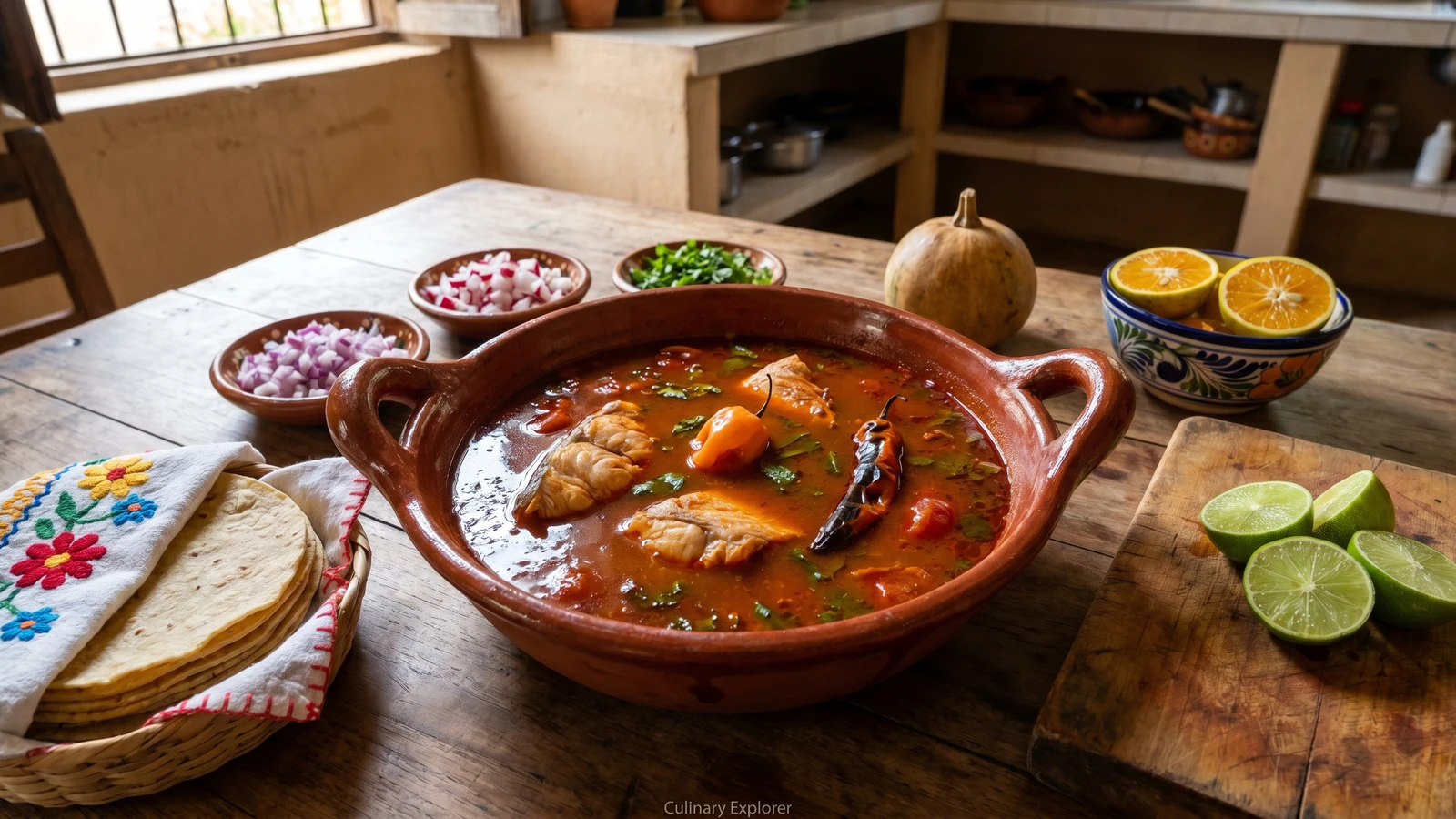
Yucatán's bright, citrus-driven fish soup, built on a fast fish broth, charred tomato, recado rojo bloomed in lard, and the perfume of a whole unbroken habanero floating in the pot.
This is from Yucatán. Not from Mexico. Yucatán. The peninsula has its own cuisine, its own language, its own sense of itself, and its own way of cooking fish that does not look like anything from Veracruz, Sinaloa, or the Pacific coast. Esto no es comida de un solo México.
The caldo is built on three Yucatecan signatures: recado rojo for color and depth, naranja agria for acid, and a whole habanero floating in the pot for perfume. The habanero stays unbroken the entire time. Break it and the soup is finished. The señoras in the Mercado Lucas de Gálvez in Mérida will fish it out with a wooden spoon and set it on the table for whoever wants more heat. The diner adds. The pot does not.
The fish is poached, not boiled. The broth trembles, never rolls. The chile xkatik, a long pale yellow chile native to the peninsula, gets charred on the comal and dropped in whole. The acid comes from lima agria or naranja agria, not from regular lime, because the Yucatán uses bitter citrus the way Jalisco uses lard: as a foundational ingredient, not a garnish.
My mother never made this dish. She was from Jalisco and her sea was a memory. But I learned it in 2008 from Doña Silvia, a cook from Progreso who let me sit in her kitchen for three days during a tormenta when nobody could go fishing. She showed me how to char the tomatoes black and how to talk to the habanero without breaking it. Saber cocinar es saber vivir.
Yucatecan cuisine evolved in geographic and cultural isolation from central Mexico, shaped by the Maya foundation, Spanish colonization, Caribbean trade, and a wave of Lebanese immigration in the late 19th century. The recado rojo at the heart of this soup, achiote ground with sour orange, garlic, oregano brought by the Spanish, and Old World spices including clove and cumin, is a direct material record of those layered histories. Lima agria and naranja agria, both bitter citrus brought by the Spanish from Southeast Asia by way of the Mediterranean, took root in the peninsula's limestone soil and became so integral that Yucatecan cooking is functionally incomprehensible without them; substituting regular lime, while sometimes necessary outside the peninsula, fundamentally changes the flavor architecture of any traditional Yucatecan dish.
Quantity
2 pounds
cut into 3-inch pieces
Quantity
1 pound
rinsed
Quantity
8 cups
Quantity
1 medium
halved, plus 1/2 cup finely diced for serving
Quantity
1
halved crosswise, plus 4 cloves smashed
Quantity
2
Quantity
4
left whole
Quantity
1
left whole and unbroken
Quantity
2 tablespoons
Quantity
1/2 cup
or 1/4 cup orange juice mixed with 1/4 cup lime juice
Quantity
2 large sprigs
Quantity
1 sprig
Quantity
2
Quantity
2 tablespoons
Quantity
1 tablespoon, plus more to taste
Quantity
1 teaspoon
Quantity
for serving
Quantity
for serving
Quantity
for serving
Quantity
for serving
Quantity
for serving
| Ingredient | Quantity |
|---|---|
| firm white fish fillets (mero, huachinango, or robalo)cut into 3-inch pieces | 2 pounds |
| fish heads and bones from the same fishrinsed | 1 pound |
| cold water | 8 cups |
| white onionhalved, plus 1/2 cup finely diced for serving | 1 medium |
| head of garlichalved crosswise, plus 4 cloves smashed | 1 |
| large ripe tomatoes | 2 |
| fresh chile xkatik (or chile guero)left whole | 4 |
| fresh chile habaneroleft whole and unbroken | 1 |
| recado rojo (achiote paste) | 2 tablespoons |
| naranja agria juiceor 1/4 cup orange juice mixed with 1/4 cup lime juice | 1/2 cup |
| fresh epazote | 2 large sprigs |
| fresh hierbabuena | 1 sprig |
| bay leaves | 2 |
| manteca de cerdo (pork lard) | 2 tablespoons |
| kosher salt | 1 tablespoon, plus more to taste |
| black peppercorns | 1 teaspoon |
| lima agria halves (optional) | for serving |
| finely diced red radish (optional) | for serving |
| chopped cilantro (optional) | for serving |
| sliced chile habanero (optional) | for serving |
| warm hand-pressed corn tortillas (optional) | for serving |
Rinse the fish heads and bones under cold water until the water runs clear. Place them in a heavy stockpot with the cold water, the halved onion, the halved head of garlic, the bay leaves, the peppercorns, and one teaspoon of the salt. Bring to a bare simmer over medium heat. Skim the gray foam that rises in the first ten minutes. Cold water draws the flavor out cleanly. A rolling boil clouds the broth and turns it bitter. Simmer gently for 25 minutes, no longer. Fish broth past half an hour tastes like glue.
While the broth simmers, heat a dry comal or heavy skillet over medium-high. Lay the whole tomatoes on the comal and char them on all sides, turning with tongs, until the skins blister black in patches and the flesh softens, about 8 minutes. Move them to a plate. Add the whole xkatik chiles to the comal and char until the skins blister and the chiles soften, about 4 minutes. The smell will turn slightly sweet and grassy. That is the sugar in the chile waking up. This step is not optional. The char is what gives the caldo its depth.
Strain the fish broth through a fine-mesh sieve into a clean pot and discard the solids. In a small skillet, melt the manteca over medium heat. Add the smashed garlic cloves and cook for 30 seconds, until fragrant. Crumble in the recado rojo, breaking up the paste with the back of a spoon. Pour in the naranja agria juice and whisk until you have a smooth, deep red liquid. The recado is not just spice paste. It is achiote, garlic, oregano, cumin, clove, pepper, and bitter orange ground together, the seasoning that defines half of Yucatecan cooking. La manteca es el sabor.
Peel the blistered skins off the charred tomatoes with your fingers. The flesh underneath will be smoky and soft. Roughly chop the tomatoes and add them to the strained broth along with all their juices. Stir in the bloomed recado mixture. Add the charred xkatik chiles whole. Drop in the whole habanero, unbroken. Add the epazote and hierbabuena. Taste for salt and adjust. The broth should be assertive, citrus-bright, and the color of a Mérida sunset.
Bring the broth to a gentle simmer and let it cook for 15 minutes. The habanero must stay whole the entire time. Yucatecan cooks use the habanero for its perfume, not its heat. If the skin breaks, the soup becomes inedible. Pregúntale a las señoras del mercado in Mérida and they will tell you the same thing. If the chile starts to soften too much, fish it out with a slotted spoon and set it aside for the table.
Season the fish pieces lightly with salt. Slide them into the simmering broth in a single layer. Lower the heat so the broth barely trembles. Poach for 6 to 8 minutes, depending on thickness, until the fish turns opaque and flakes when pressed gently with the back of a spoon. Do not stir. Do not boil. Hard simmering breaks the fish into rags. The fish should arrive at the table in whole pieces, not in shreds.
Carefully ladle the caldo into wide bowls, giving each guest a piece of fish, a softened xkatik chile, and plenty of broth. Set the diced onion, radish, cilantro, sliced habanero, and lima agria halves in small dishes around the table. Each person finishes their own bowl with a squeeze of lima agria and whatever salpicón they want. The hot tortillas go in a basket wrapped in a cotton servilleta. Cada estado, su propia cocina, and this one belongs to Yucatán.
1 serving (about 400g)
Culinary guides, cultural storytelling, and the editorial depth that makes cooking meaningful.
Discover Culinary ExplorerChef Lupita
Aguascalientes' Bajio pozole de lengua, built with cacahuazintle hominy, tender beef tongue, chile ancho and guajillo, with xoconostle brightness and table garnishes.

Chef Lupita
Veracruz's Gulf coast rice from Alvarado, built with seafood stock, tomato, chile chipotle, epazote, shrimp, fish, jaiba, and pulpo, served loose and brothy in a clay cazuela.

Chef Lupita
Costa Chica's wet salt-beef stew, built from chile costeño, guajillo, tomato, manteca, yuca, plantain, and masa dumplings, the ranching pot of Cuajinicuilapa and Pinotepa.

Chef Lupita
Michoacán's P'urhépecha atápakua is a masa-thickened sauce and stew at once, built with pork, chile guajillo, and hierbabuena added only at the end.