
Chef Lupita
Aguascalientes Beef Tongue Pozole (Pozole de Lengua)
Aguascalientes' Bajio pozole de lengua, built with cacahuazintle hominy, tender beef tongue, chile ancho and guajillo, with xoconostle brightness and table garnishes.
A cooking platform built around craft, culture, and the stories behind what we eat.
Created by
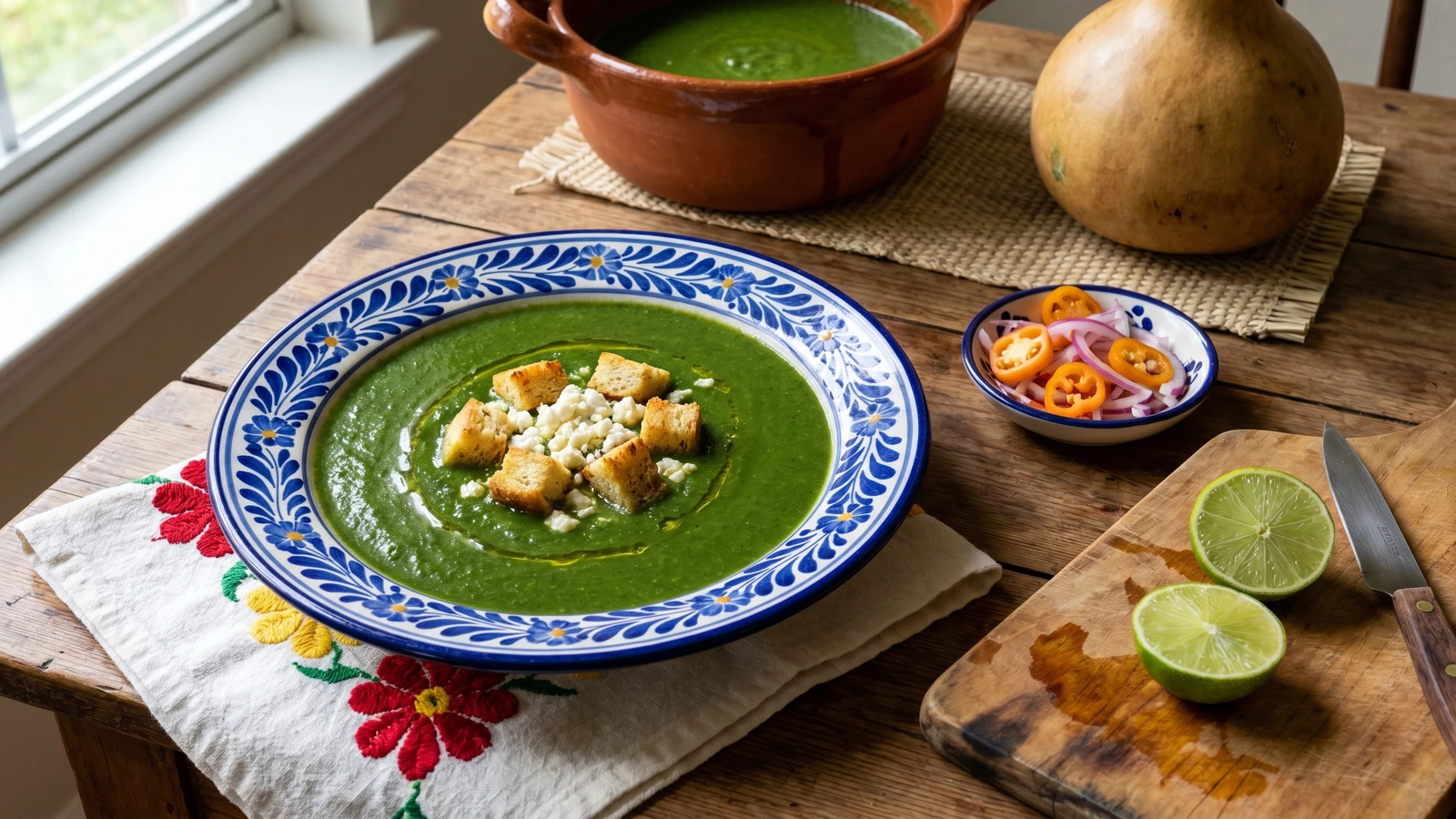
Yucatán's elegant white-tablecloth soup, boiled chaya leaves blended with sweated onion, butter, and evaporated milk, finished with buttered croutons. The soup that opens weddings and feast days in Mérida.
Crema de chaya belongs to Yucatán. Not to the rest of Mexico. The Peninsula has its own kitchen, its own ingredients, its own gravitational pull, and chaya is one of the plants that anchors it. You will not find chaya in a market in Guadalajara or Oaxaca. You will find it in Mérida, in Valladolid, in the small Maya towns where it grows in almost every solar, the household garden behind the house.
This is a special-occasion soup. The senoras in Mérida bring it out for weddings, baptisms, the comida after a graduation. The white tablecloth comes out and the crema de chaya comes out with it. It looks elegant, almost European, but the plant in the bowl is Mesoamerican to its core. The Maya have been growing and cooking chaya for over a thousand years, calling it chay or chaay, and they knew long before any nutritionist measured it that the leaves are denser in protein, calcium, and iron than spinach.
The rule that matters: chaya must be boiled. Raw chaya is toxic. Twenty minutes in salted water, and the leaves become one of the most generous greens in the Maya kitchen. No me vengas con atajos. And never use an aluminum pot. The Maya cooks I learned this from will stop you mid-motion if they see aluminum near the chaya. The leaves react and turn the soup bitter. Stainless steel or enameled clay, nothing else.
The technique is simple, the sourcing is everything. If you cannot find fresh chaya, fresh spinach with a handful of arugula leaves will give you the closest approximation. It will not be crema de chaya. It will be a green soup. The difference is the plant, and the plant is Yucatán. Saber cocinar es saber vivir.
Chaya (Cnidoscolus aconitifolius) is a domesticated shrub native to the Yucatán Peninsula and was a staple cultivated by the ancient Maya, with evidence of its use stretching back to the Late Preclassic period. The Maya cultivated chaya in household solares rather than open fields, a horticultural practice that survived the Spanish conquest precisely because chaya did not register as an agricultural crop to colonial administrators and was therefore never subject to tribute or replacement. The transformation of chaya into a soup finished with butter and evaporated milk reflects the late 19th and early 20th century henequen-era cuisine of Mérida, when the Yucatecan elite layered French and Lebanese influences onto Maya foundations, producing a regional kitchen that is unmistakably Peninsular and unlike anything else in Mexico.
Quantity
1 pound
thick stems removed (about 6 packed cups)
Quantity
6 cups
for boiling the chaya
Quantity
1 teaspoon
for the boiling water
Quantity
4 tablespoons
Quantity
1 medium
finely diced
Quantity
3
finely chopped
Quantity
4 cups
preferably homemade
Quantity
1 can (12 ounces)
Quantity
1 teaspoon, plus more to taste
Quantity
1/2 teaspoon
Quantity
1/4 teaspoon
Quantity
4 thick slices
cut into 1/2-inch cubes, for croutons
Quantity
2 tablespoons
for the croutons
Quantity
1/4 cup
crumbled, for serving
Quantity
1
finely sliced, for serving
Quantity
for serving
halved
| Ingredient | Quantity |
|---|---|
| fresh chaya leavesthick stems removed (about 6 packed cups) | 1 pound |
| waterfor boiling the chaya | 6 cups |
| kosher saltfor the boiling water | 1 teaspoon |
| unsalted butter | 4 tablespoons |
| white onionfinely diced | 1 medium |
| garlic clovesfinely chopped | 3 |
| chicken brothpreferably homemade | 4 cups |
| evaporated milk | 1 can (12 ounces) |
| kosher salt | 1 teaspoon, plus more to taste |
| freshly ground white pepper | 1/2 teaspoon |
| freshly grated nutmeg | 1/4 teaspoon |
| crusty breadcut into 1/2-inch cubes, for croutons | 4 thick slices |
| unsalted butterfor the croutons | 2 tablespoons |
| queso fresco (optional)crumbled, for serving | 1/4 cup |
| chile habanero (optional)finely sliced, for serving | 1 |
| lima agria (optional)halved | for serving |
Pull the leaves off the thick central stems. Discard the stems. Rinse the leaves under cold running water and shake them dry. Handle the chaya with the back of a wooden spoon or with gloves if your skin is sensitive. The raw leaves carry stinging hairs that disappear the moment they hit boiling water. This is one of those plants where the instruction is non-negotiable: chaya must be boiled before eating. Raw chaya contains hydrocyanic compounds. Boil it and it becomes one of the most nutritious greens in Mesoamerica. Skip the boil and it makes you sick. Así se hace y punto.
Bring the 6 cups of water to a hard boil in a stainless steel pot. Add the teaspoon of salt. Drop in all the chaya leaves and submerge them with the back of a spoon. Boil for 20 minutes. Twenty. Not five. The long boil neutralizes the compounds and softens the leaves enough to blend smooth. The water will turn dark green. Drain the chaya in a colander and reserve one cup of the cooking liquid. Press lightly to release excess water but do not squeeze the chaya dry.
In a wide pot or cazuela, melt the 4 tablespoons of butter over medium-low heat. Add the diced onion with a pinch of salt. Cook gently for 8 to 10 minutes until the onion is fully translucent and soft, never browned. This is a white soup. Color on the onion changes the final hue. Add the garlic and cook one more minute, until you can smell it but it has not taken on color.
Transfer the cooked chaya and the sweated onion-garlic mixture to a blender. Add 2 cups of the chicken broth and the reserved chaya cooking liquid. Blend on high for a full two minutes until completely smooth and velvety. The color should be a deep, vivid green. Work in batches if your blender is small. A rough blend gives you a rough soup. Cada estado, su propia cocina, and Yucateca elegance demands a smooth puree.
Return the blended puree to the pot over medium heat. Pour in the remaining 2 cups of chicken broth and the evaporated milk. Stir to combine. Add the salt, white pepper, and nutmeg. Bring to a gentle simmer, never a hard boil. A hard boil will break the evaporated milk and curdle the soup. Cook for 10 minutes, stirring often, until the flavors marry and the soup tightens to a light cream consistency. Taste for salt. The broth should taste of chaya first, butter second, the milk in the background.
While the soup simmers, melt the 2 tablespoons of butter in a wide skillet over medium heat. Add the bread cubes and toss to coat. Toast, turning often, for 6 to 8 minutes until the croutons are deep gold on every side and crisp through. These are not soft bread cubes. They are crackling croutons that hold their crunch in the hot soup. The toast garnish is part of the recipe, not a decoration.
Ladle the soup into shallow bowls or footed talavera plates. Float a generous handful of buttered croutons in the center of each bowl. Crumble a little queso fresco over the top if using. Set the sliced habanero and the halved lima agria in small dishes on the table for diners to add as they like. Recetas probadas y garantizadas. Serve immediately, before the croutons soften.
1 serving (about 320g)
Culinary guides, cultural storytelling, and the editorial depth that makes cooking meaningful.
Discover Culinary ExplorerChef Lupita
Aguascalientes' Bajio pozole de lengua, built with cacahuazintle hominy, tender beef tongue, chile ancho and guajillo, with xoconostle brightness and table garnishes.

Chef Lupita
Veracruz's Gulf coast rice from Alvarado, built with seafood stock, tomato, chile chipotle, epazote, shrimp, fish, jaiba, and pulpo, served loose and brothy in a clay cazuela.

Chef Lupita
Costa Chica's wet salt-beef stew, built from chile costeño, guajillo, tomato, manteca, yuca, plantain, and masa dumplings, the ranching pot of Cuajinicuilapa and Pinotepa.

Chef Lupita
Michoacán's P'urhépecha atápakua is a masa-thickened sauce and stew at once, built with pork, chile guajillo, and hierbabuena added only at the end.