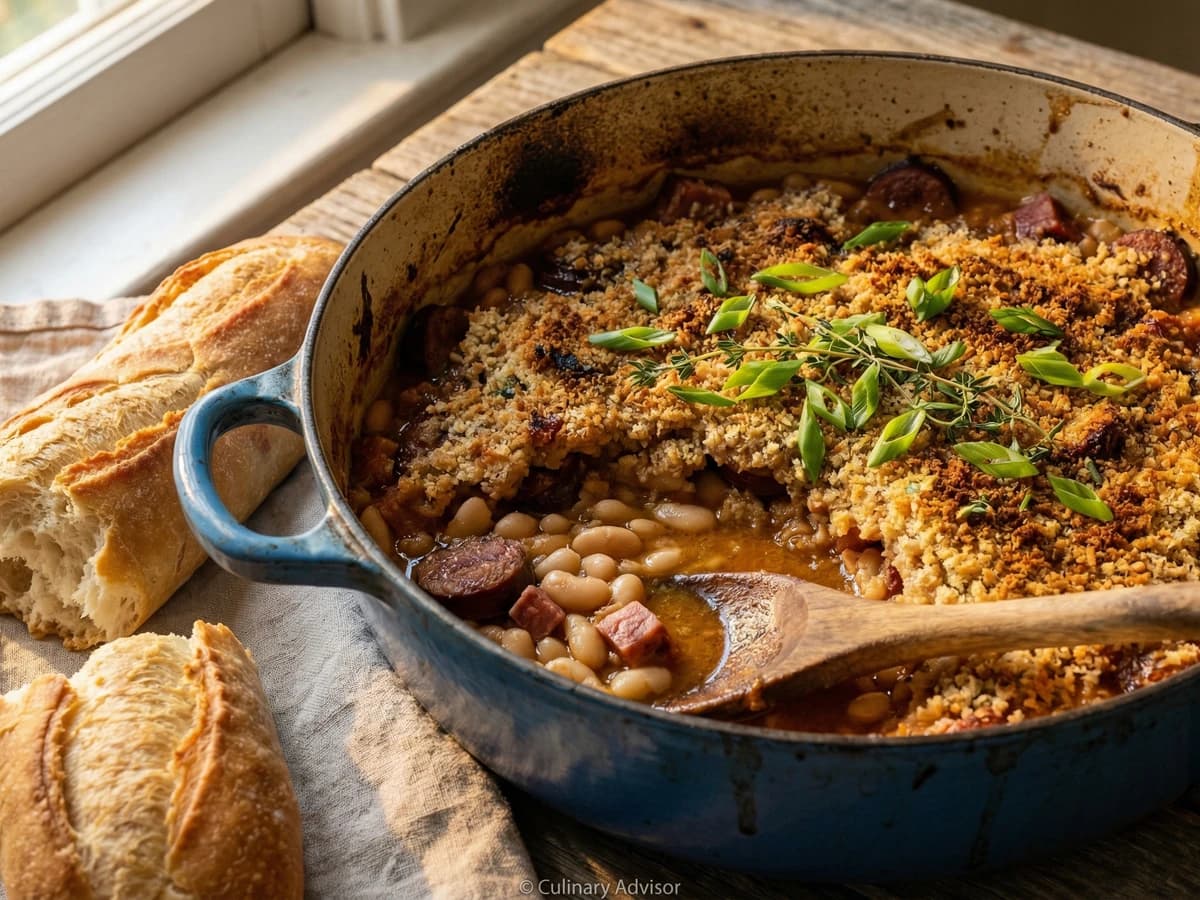
Gulf redfish simmered in a brick-red tomato gravy built on dark roux and the holy trinity, the kind of one-pot supper that warms you from the inside out and tastes even better the next day.
Main Dishes
Cajun
Comfort Food
Weeknight
Make Ahead
30 min
Active Time
1 hr 15 min cook•1 hr 45 min total
Yield6 servings
Court-bouillon is one of the oldest dishes in the Louisiana repertoire. Say it 'coo-bee-yon' and you sound like you belong here. This is not the French poaching liquid of the same name. This is something different entirely: a rich, spicy tomato gravy that braids fish into submission until it flakes at the touch of a fork.
My grandmother Evangeline made this every Friday during Lent, and plenty of other Fridays besides. She started with whatever fish my grandfather pulled from the bayou that morning. Redfish was her favorite because it holds together in the sauce without falling apart into mush. The flesh stays firm but tender, soaking up all that tomato and spice.
The secret lives in the roux. You want it darker than you might think, somewhere between peanut butter and milk chocolate. That color brings a nutty depth that balances the acidity of the tomatoes. Then you build flavor in layers: season the fish, season the vegetables, season the sauce, taste and adjust at the end. At Lagniappe, we serve this over fluffy white rice with crusty French bread on the side for sopping. That bread is not optional. You will want every drop of that gravy.
The technique, the tradition, and the story behind every dish.
green onionssliced thin, whites and greens separated
4
fresh parsleychopped
1/4 cup
cooked white rice
for serving
crusty French bread
for serving
Equipment Needed
•Large Dutch oven or heavy-bottomed pot (5-quart minimum)
•Flat-bottomed wooden spoon for stirring roux
•Tight-fitting lid
Instructions
1
Season the fish
Pat the redfish fillets completely dry with paper towels. Season both sides generously with about 2 tablespoons of the Cajun seasoning, pressing it into the flesh. Set aside at room temperature while you build the gravy. This gives the seasoning time to penetrate and brings the fish closer to room temperature for even cooking.
If you cannot find redfish, drum, snapper, or any firm white fish will work. Avoid delicate fish like tilapia that will fall apart in the sauce.
2
Build the roux
Heat the vegetable oil in a large Dutch oven or heavy-bottomed pot over medium heat. When the oil shimmers, whisk in the flour all at once. Now you stir. Constantly. Use a flat-bottomed wooden spoon and scrape every corner of the pot. The roux will foam, then settle, then begin to darken. You are looking for a color somewhere between peanut butter and milk chocolate, about 20 to 25 minutes. The smell should be nutty and toasty, not burned.
If you see black specks or smell anything acrid, start over. Burned roux tastes bitter and will ruin the entire dish. That is the bayou way: better to waste ten minutes than an hour of cooking.
3
Cook the holy trinity
The moment your roux reaches the right color, add the onion, celery, and bell pepper all at once. The mixture will sizzle and steam aggressively. This is good. Stir continuously for the first minute to prevent the roux from burning on the bottom, then reduce heat to medium-low. Cook until the vegetables soften and the onions turn translucent and sweet, about 8 to 10 minutes. Add the white parts of the green onions and the garlic, cooking another minute until fragrant.
4
Add tomatoes and liquids
Pour in the crushed tomatoes and diced tomatoes with their juices. Stir well to incorporate with the roux, scraping up any fond from the bottom. Add the fish stock and white wine, stirring until the sauce is smooth and uniform. The color should be a deep brick red. Bring to a simmer.
5
Season the gravy
Add the bay leaves, thyme, oregano, cayenne, salt, black pepper, Worcestershire sauce, hot sauce, and the remaining tablespoon of Cajun seasoning. Stir everything together and let the sauce simmer uncovered for 25 to 30 minutes, stirring occasionally. The gravy will thicken slightly and the flavors will marry. Taste it. Adjust the salt and cayenne. The sauce should have a gentle heat that builds, not a punch that overwhelms.
Heat tolerance is personal. Start with less cayenne and add more in small increments. You can always add heat, but you cannot take it away.
6
Nestle in the fish
Reduce heat to low so the sauce barely bubbles. Gently nestle the seasoned redfish portions into the gravy, spooning some sauce over the top of each fillet. Do not stir or move the fish once it is in place. Cover the pot with a tight-fitting lid.
7
Braise until tender
Let the fish braise undisturbed for 15 to 20 minutes. The fish is done when it flakes easily with a fork and is opaque throughout. Resist the urge to poke or prod. The covered pot creates steam that cooks the fish gently from all sides. Remove the bay leaves.
Thicker fillets need closer to 20 minutes. Thinner pieces may be done in 12 to 15. When in doubt, check the thickest part of the largest fillet.
8
Finish and serve
Remove the pot from heat. Scatter the green onion tops and most of the parsley over the surface. Let rest for 5 minutes with the lid off. This allows the fish to firm up slightly and the flavors to settle. Serve each portion of fish over a generous mound of white rice, spooning plenty of that brick-red gravy over everything. Garnish with remaining parsley and serve with crusty French bread for sopping. When the last bite is as good as the first, you have done it right.
Chef Tips
•Make this dish a day ahead if you can. The flavors deepen overnight in the refrigerator. Reheat gently over low heat, adding a splash of stock if the gravy has thickened too much. The fish will be even more tender and flavorful.
•If you cannot find good fish stock, clam juice mixed with equal parts water works in a pinch. Chicken stock is acceptable but changes the character of the dish. At Lagniappe, we make our own fish stock from Gulf fish bones, but home cooks should not feel bad about using what they can find.
•The wine is not optional. It adds acidity that brightens the tomatoes and cuts through the richness of the roux. If you prefer not to cook with alcohol, substitute an equal amount of stock plus a tablespoon of white wine vinegar.
•Serve this with a cold beer or a crisp white wine. Something with enough acidity to stand up to the tomatoes and enough body to match the richness of the gravy.
Advance Preparation
•The gravy can be made up to 2 days ahead and refrigerated before adding fish. Bring to a simmer before nestling in the fish portions.
•The complete dish refrigerates beautifully for up to 3 days. Reheat gently over low heat. The fish will become even more tender as it sits.
•This dish does not freeze well. The fish texture suffers from freezing and thawing.
Frequently Asked Questions
Nutrition Information
1 serving (about 500g)
Calories
490 calories
Total Fat
22 g
Saturated Fat
3 g
Trans Fat
0 g
Unsaturated Fat
18 g
Cholesterol
70 mg
Sodium
990 mg
Total Carbohydrates
33 g
Dietary Fiber
5 g
Sugars
12 g
Protein
36 g
Where cooking meets culture.
Culinary guides, cultural storytelling, and the editorial depth that makes cooking meaningful.