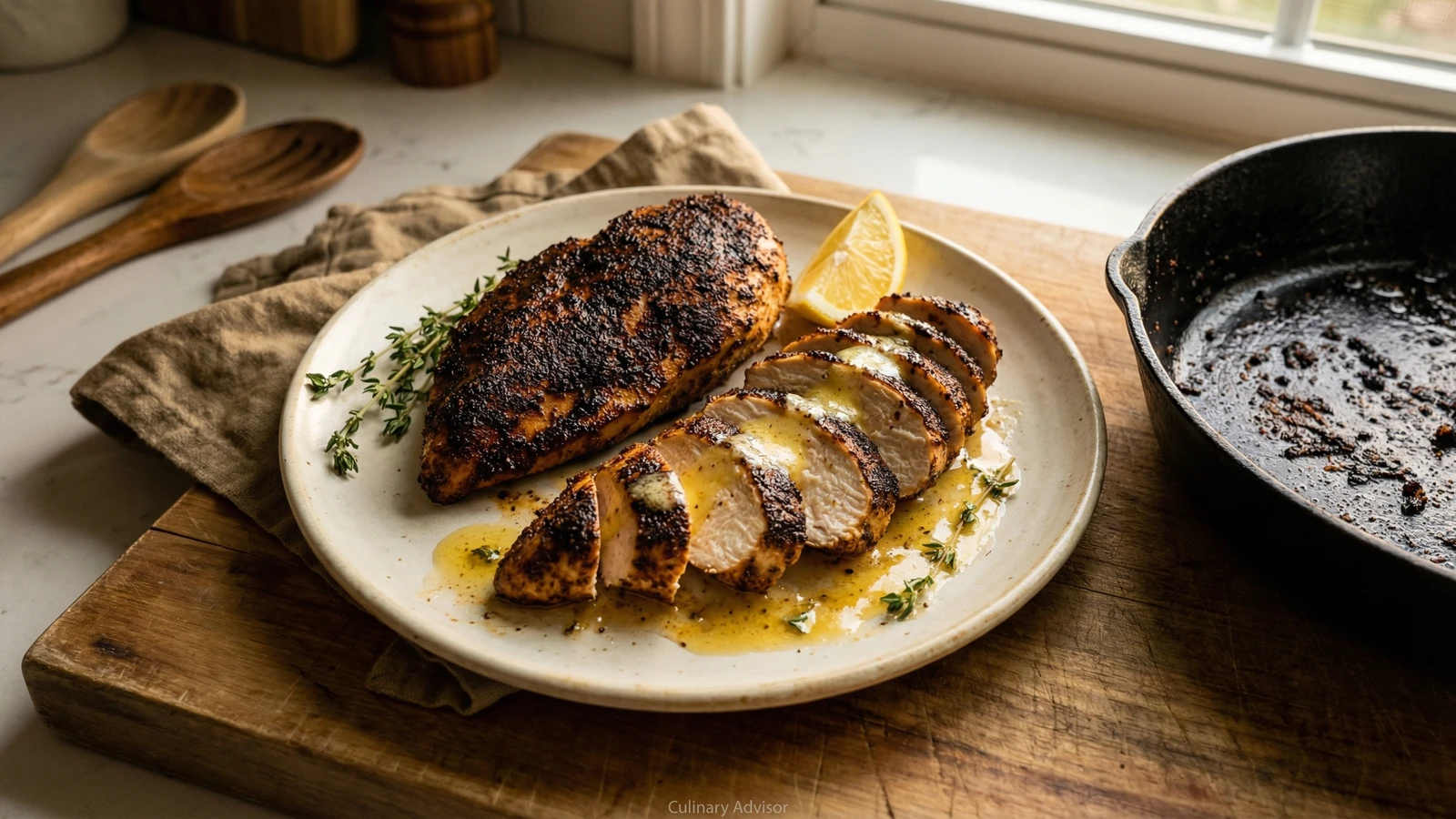
Boneless chicken breasts dredged in homemade Cajun spices and seared in a screaming-hot cast iron skillet until the crust turns dark and complex, the meat stays juicy inside, and your kitchen smells like a Friday night at Lagniappe.
Main Dishes
Cajun
Weeknight
Quick Meal
Meal Prep
10 min
Active Time
10 min cook•20 min total
Yield4 servings
The blackening technique is pure Louisiana magic. You take a simple piece of chicken, coat it in spices, and press it into a cast iron skillet so hot the seasoning blooms and caramelizes in seconds. The result is a crust that looks almost burned but tastes like something entirely different: smoky, complex, a little bitter at the edges but sweet underneath.
I learned this technique watching the masters work in New Orleans kitchens back in the eighties. The secret isn't the heat alone, though you need plenty of that. It's the butter. You dip the chicken in melted butter before the spice coating, and you add more butter to the pan as it cooks. That butter carries the spices, helps them bloom, and keeps the meat from drying out while the outside develops that signature char.
At Lagniappe, we go through cases of chicken breasts every week making this dish. Home cooks shy away because they think it's complicated or too smoky. It's neither. You need a good cast iron skillet, proper ventilation, and about fifteen minutes. That's it. The spice blend comes together in two minutes, the chicken cooks in eight. This is weeknight food that tastes like you spent all day in the kitchen.
The technique, the tradition, and the story behind every dish.
Place chicken breasts between two sheets of plastic wrap. Using a meat mallet or the bottom of a heavy skillet, pound to an even thickness of about half an inch. This is not optional. Uneven chicken means the thin parts burn while the thick parts stay raw. You want uniform thickness so everything cooks at the same rate.
If your chicken breasts are very thick, butterfly them first by slicing horizontally, then pound gently. This gets you to half-inch thickness without destroying the meat.
2
Mix the blackening spice
Combine the paprika, garlic powder, onion powder, thyme, oregano, cayenne, black pepper, salt, and white pepper in a wide shallow bowl. Whisk until completely blended. The color should be a deep rusty red with flecks of green herbs throughout. This makes more than you need for one batch. That's intentional. Store the extra in a jar for next time.
3
Heat your cast iron
Set your cast iron skillet over high heat for a full five minutes. Do not rush this. The pan needs to be screaming hot, the kind of hot where a drop of water vaporizes instantly. If you have a thermometer, you're looking for 500 degrees or higher. Open windows and turn on your exhaust fan now. This will smoke.
A properly seasoned cast iron skillet is essential. If yours is sticky or poorly maintained, the spice crust will adhere to the pan instead of the chicken.
4
Coat the chicken
Pour about three tablespoons of melted butter into a shallow dish. Working one breast at a time, dip the chicken in butter, turning to coat both sides completely. Let excess drip off, then press both sides firmly into the spice mixture. The coating should be generous and even. Set aside on a plate and repeat with remaining breasts.
5
Blacken the chicken
Add one tablespoon of butter to the hot skillet. It will smoke immediately and may brown. That's fine. Lay two chicken breasts in the pan, leaving space between them. Do not crowd the skillet. You'll hear an aggressive sizzle and see smoke billowing up. This is correct. Cook without moving for three to four minutes until the bottom develops a dark, almost black crust.
The crust should look nearly burnt but smell aromatic, not acrid. If you smell burning rather than toasting spices, your heat is too high.
6
Flip and finish
Add another tablespoon of butter to the pan and flip the breasts. The cooked side should be deeply charred with patches of dark brown and black. Cook the second side for three to four minutes until the internal temperature reaches 165 degrees. Transfer to a cutting board and tent loosely with foil. Repeat with remaining two breasts, adding fresh butter before each batch.
7
Rest and serve
Let the chicken rest for five minutes before slicing. This allows the juices to redistribute so they stay in the meat rather than flooding your cutting board. Slice against the grain if serving over rice or salad, or serve the breasts whole. Drizzle any remaining melted butter over the top. The char should crackle slightly under your knife, revealing juicy white meat beneath.
Chef Tips
•The cayenne level here gives moderate heat. If you're spice-shy, start with one teaspoon and build up next time. If you like it hot, go to two tablespoons. That's how we do it at Lagniappe for guests who ask for extra fire.
•This technique works beautifully on fish (redfish, catfish, drum), pork chops, and even firm tofu. Adjust cooking times accordingly. Fish needs only two to three minutes per side.
•Make a double or triple batch of the spice blend and store it in a glass jar. It keeps for six months and makes weeknight blackened anything possible in minutes.
•If your smoke alarm is particularly sensitive, do this outside on a propane burner. Many serious cooks keep a dedicated outdoor setup for blackening.
Advance Preparation
•The spice blend can be made weeks ahead and stored in an airtight container at room temperature.
•Chicken can be pounded and refrigerated up to 24 hours ahead. Bring to room temperature for 20 minutes before coating and cooking.
•Cooked blackened chicken refrigerates well for up to 4 days. Reheat gently in a 350 degree oven to preserve the crust. It's excellent sliced cold over salads.
Frequently Asked Questions
Nutrition Information
1 serving (about 180g)
Calories
420 calories
Total Fat
24 g
Saturated Fat
13 g
Trans Fat
0 g
Unsaturated Fat
10 g
Cholesterol
195 mg
Sodium
550 mg
Total Carbohydrates
5 g
Dietary Fiber
1 g
Sugars
1 g
Protein
46 g
Where cooking meets culture.
Culinary guides, cultural storytelling, and the editorial depth that makes cooking meaningful.