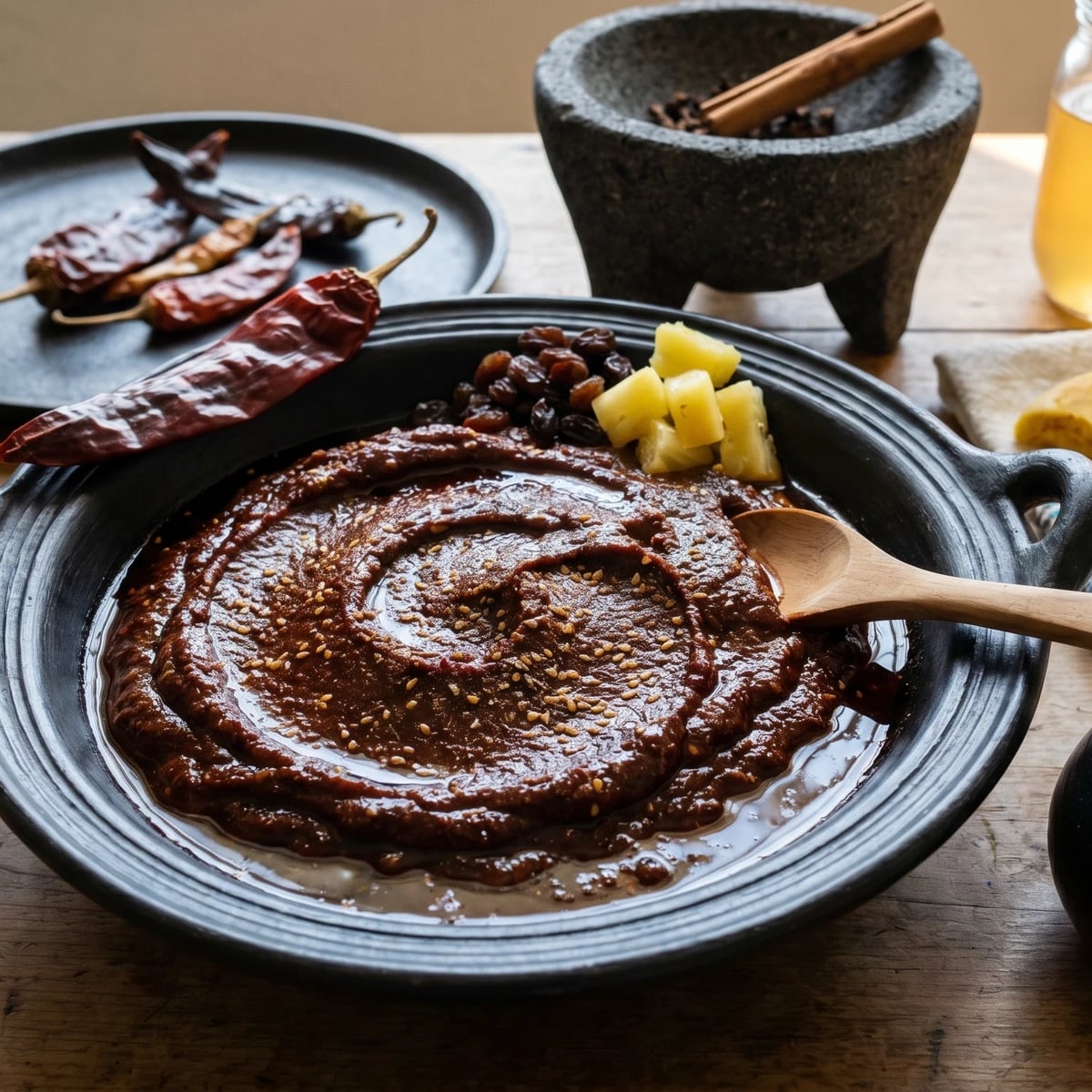
The wedding paste of the Istmo de Tehuantepec, where Zapotec cooks grind toasted chiles with cinnamon, cloves, raisins, pineapple, and pan resobado bread for the ceremonial beef estofado that anchors a Oaxacan wedding feast.
Sauces & Condiments
Mexican
Special Occasion
Celebration
Holiday
35 min
Active Time
35 min cook•1 hr 10 min total
YieldAbout 3 cups paste, enough to season 6 to 8 pounds of beef for estofado
This recado does not come from Oaxaca city. It comes from the Istmo de Tehuantepec, which is its own world inside Oaxaca state. The Zapotec women of Juchitan, Tehuantepec, and Salina Cruz, the same women who run the markets and the velas and the household economies of the entire region, keep this paste on the shelf in glass jars, ready for the wedding that announces every fall and spring on the social calendar of the Istmo.
This is wedding food. Estofado de bodas. The bride's family cooks it for the groom's family on the day of the rezo. The beef simmers for hours in the recado until the meat falls apart and the sauce turns the color of dark amber. What carries the ceremony is the paste itself, not the meat. Get the paste right and the rest of the dish does what it has always done.
The pan resobado is the ingredient that tells you this comes from the Istmo and nowhere else. It is the yellow, egg-and-lard enriched bread of Tehuantepec, kneaded over and over (resobado, re-kneaded) until it carries enough body to thicken a wedding-scale pot of stew. Outside the Istmo, almost nobody knows what it is. Inside the Istmo, no estofado de bodas exists without it. Pair the bread with chile ancho, chile costeño rojo, chile guajillo, fresh pineapple from the tierra caliente, raisins, canela mexicana, clavo, and pimienta gorda, and you have the recado the Zapotec abuelas have been grinding on metates for generations.
My mother never made this. She was from Jalisco. The recipe in my notebook came from Na Berta, an octogenaria from Juchitan who walked me through the paste in her cocina de humo over two afternoons in 2014. She told me the proportions by feel and corrected me twice when I weighed things instead of looking at them. I weighed them anyway. You can blame me for that. Cada estado, su propia cocina, and within Oaxaca, the Istmo has its own.
The estofado tradition of the Istmo de Tehuantepec emerged from the convergence of pre-Columbian Zapotec sauce-making, which used native chiles ground on metate, with the Spanish enriched-bread tradition (pan resobado) and the spices that arrived through the Manila galleon trade at Acapulco beginning in the 16th century. Cinnamon, cloves, and black pepper traveled across the Pacific from Asia and were absorbed into the cooking of the Istmo earlier and more deeply than into many other Mexican regional cuisines, partly because the Camino Real to the Gulf passed directly through Tehuantepec. The matriarchal Zapotec social structure of the Istmo, in which women control the markets, the household economy, and the ritual calendar of the velas, is the reason these wedding recados were preserved in such fierce detail; the recipes pass mother to daughter as a form of inheritance that no man has ever been allowed to interrupt.
The technique, the tradition, and the story behind every dish.
•Cast iron comal or heavy 12-inch skillet for toasting
•Wide clay cazuela or heavy skillet for frying the paste
•Spice grinder or volcanic stone molcajete
•High-powered blender
•Medium-mesh strainer
•Wooden spoon worn smooth from years of use
Instructions
1
Toast the chiles
Heat a dry comal or heavy cast iron skillet over medium. Toast the ancho, costeño rojo, and guajillo chiles separately, about 20 to 30 seconds per side. The skin should puff and the kitchen should smell like the chile vendors at the Mercado 20 de Noviembre. Pull each one off the comal the moment it shifts from raw and dusty to alive and fragrant. Burned chile is bitter chile and there is no fixing it later. Move the toasted chiles to a heatproof bowl as you go.
Chile costeño rojo is not the same as chile costeño from the coast of Guerrero. The Oaxacan version is shorter, darker, and more pungent. If you cannot find it, the closest substitute is a mix of chile puya and an extra ancho. It is a compromise, not an upgrade.
2
Soak the chiles
Cover the toasted chiles with hot tap water, not boiling. Boiling water cooks the skin and pulls bitterness into the soak. Press a small plate on top to keep them submerged. Let them soften for 25 minutes while you work on the rest of the recado.
3
Toast the spices, seeds, and almonds
On the same comal, toast the cinnamon stick, cloves, peppercorns, allspice, and cumin together over medium-low heat for two minutes, shaking the pan, until the spices release their aroma. Move them to a small bowl. Toast the sesame seeds until golden, about two minutes, watching closely. They go from pale to gold to burned in seconds. Toast the almonds last, about three minutes, until the skins darken and the nuts smell like roasted nuts and not raw ones.
4
Char the garlic and onion
Place the garlic cloves and onion quarters directly on the comal. Let them blacken in patches, turning every minute or two, for about eight minutes total. The onion should soften and develop dark scorch marks. The garlic should turn from white to a deep amber with black freckles. This dry-charring on the comal is how Zapotec cooks build the smoky base of every serious recado. No oil, no oven, just the hot iron and patience.
5
Fry the pan resobado and pineapple
In a heavy skillet, melt 1 tablespoon of the lard over medium heat. Add the torn pan resobado and toast it in the lard, stirring, until the bread turns deep gold and absorbs the fat, about four minutes. Move the bread to a plate. Add the pineapple chunks to the same skillet and let them caramelize on each side, about two minutes per side, until the edges turn dark and the sugars concentrate. La manteca es el sabor and this is where the recado earns its weight.
If you cannot find pan resobado outside Oaxaca, the closest substitute is pan de yema or a stale bolillo enriched with a beaten egg yolk and a pinch of anise. It is not the same. It is the closest you will get north of the border.
6
Grind the spices and aromatics
Grind the toasted whole spices in a spice grinder or molcajete to a fine powder. The cinnamon will resist. Keep grinding until it surrenders. Combine the ground spices with the charred garlic and onion, the toasted sesame and almonds, the raisins, the toasted pan resobado, and the caramelized pineapple in a high-powered blender.
7
Blend with the chiles
Drain the soaked chiles, reserving the soaking liquid. Add the chiles to the blender along with the pineapple vinegar, the salt, and 1 cup of the chile soaking liquid. Blend on high for two full minutes, stopping to scrape the sides, until the paste is completely smooth. Add a little more soaking liquid only if the blender struggles. The recado should be thick enough to hold a line drawn through it with a spoon. Pass the paste through a medium-mesh strainer, pressing on the solids with a wooden spoon. Discard whatever skin and grit remains in the strainer.
Vinagre de piña casero, the homemade pineapple vinegar that ferments in jars on Istmo kitchen counters, is what the recipe wants. If you do not have it, a good white wine vinegar with a teaspoon of pineapple juice stirred in will hold the line. No me vengas con vinagre destilado. Distilled white vinegar will flatten everything you just built.
8
Fry the paste
Heat the remaining 2 tablespoons of lard in a wide cazuela or heavy skillet over medium heat until the fat shimmers. Pour in the strained paste. It will sputter aggressively, so stand back. Stir constantly with a wooden spoon for eight to ten minutes. The paste will deepen from rust to mahogany and the lard will start to bead at the edges of the cazuela. That fat separation is your signal. The recado is finished. Taste for salt and adjust. It should taste concentrated, slightly sweet from the pineapple and raisins, dark from the spices, and assertive from the chile. Asi se hace y punto.
To use the recado for estofado de bodas, brown 6 to 8 pounds of beef chuck or short rib in lard, add the entire batch of recado plus enough beef broth to cover, and braise covered for 3 hours over low heat. The meat should fall apart with a spoon and the sauce should coat the back of it heavily.
Chef Tips
•If you can travel to Mercado de Abastos in Oaxaca city or, better, the Mercado 5 de Septiembre in Juchitan, buy your pan resobado, your chile costeño rojo, and your vinagre de piña there in one trip. The vendors who sell these things know what you are making the moment you put them on the counter together. Outside Mexico, you are working with substitutes and the recado will be 80 percent of itself. Asi son las cosas.
•Do not skip the strainer step. The pan resobado and the almond skins leave a fine grit in the paste, and a wedding recado has to be smooth on the tongue. The Zapotec abuelas in Tehuantepec used to push the paste through a clean cotton cloth. A medium-mesh strainer with a wooden spoon does the same job and saves your wrist.
•The recado will keep refrigerated in a glass jar with a film of lard on top for three weeks. It freezes well for up to four months. Make a double batch when you can. The work is the same and a jar of finished recado is the kind of thing that turns a Tuesday into a special occasion.
Advance Preparation
•The recado can be made up to three days ahead and refrigerated. The flavor only deepens as it sits and the spices marry the chile.
•For a full estofado de bodas, make the recado one day ahead, then braise the beef in it the day of the meal. The Zapotec cooks of the Istmo will tell you the recado has to rest at least overnight before it meets the meat. They are right.
•The paste freezes well for up to four months in a tight-sealed glass jar with a thumb of lard floated on top to keep the air out.
Frequently Asked Questions
Nutrition Information
1 serving (about 45g)
Calories
130 calories
Total Fat
6 g
Saturated Fat
1 g
Trans Fat
0 g
Unsaturated Fat
4 g
Cholesterol
3 mg
Sodium
290 mg
Total Carbohydrates
17 g
Dietary Fiber
3 g
Sugars
5 g
Protein
3 g
Where cooking meets culture.
Culinary guides, cultural storytelling, and the editorial depth that makes cooking meaningful.