Culinary Explorer

A cooking platform built around craft, culture, and the stories behind what we eat.
Discover Culinary Explorer
Pulpo al Tikinxic Holbox

Pulpo al Tikinxic Holbox

Created by

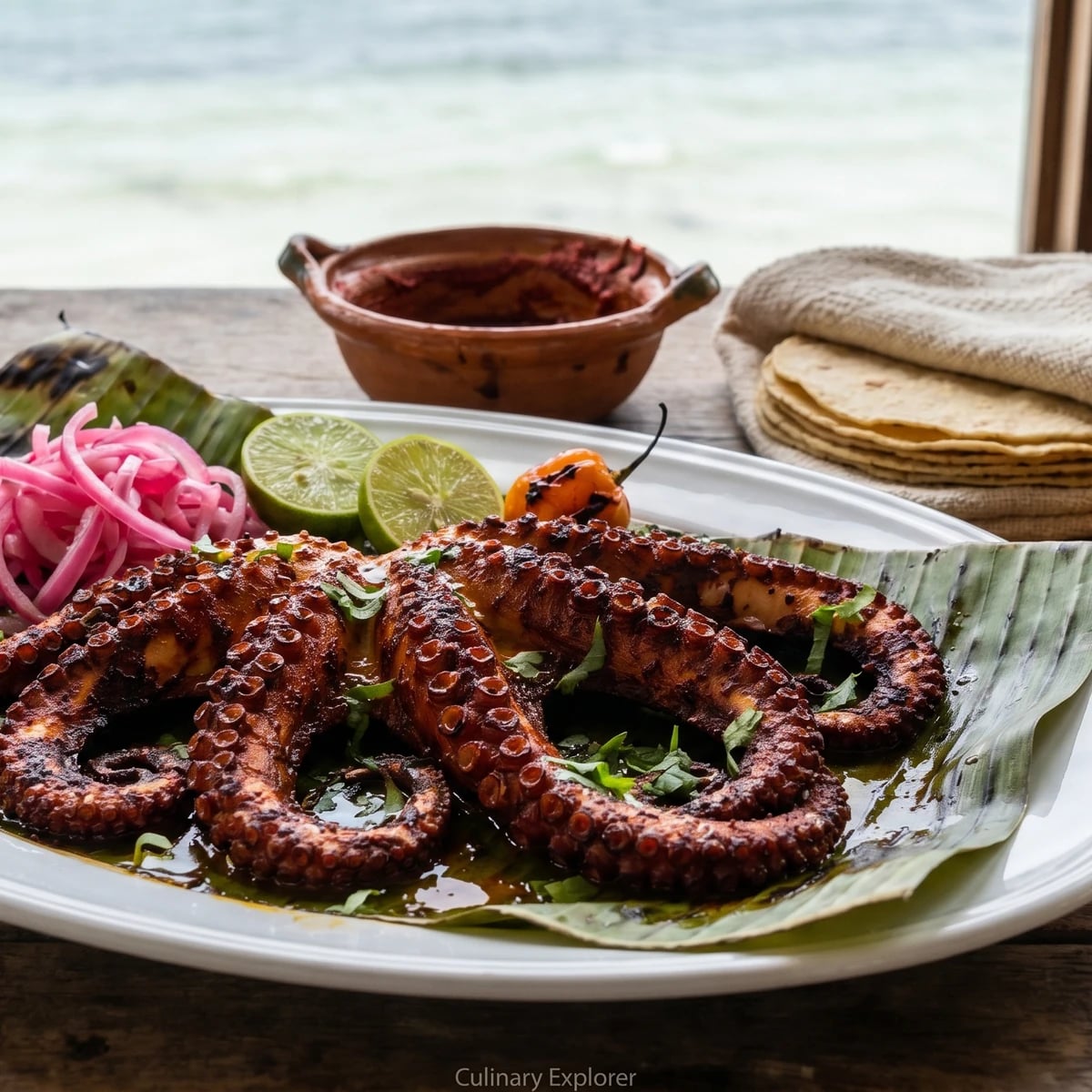
Quintana Roo's coastal tikinxic, octopus marinated in achiote and sour orange, grilled over banana leaves until the tentacles curl, the suckers crisp, and the red crust turns to char at the edges.

Main Dishes
Mexican
BBQ
Outdoor Dining
Dinner Party
40 min
Active Time
1 hr 30 min cook2 hr 10 min total
Yield6 servings

Tikinxic is a Yucatecan technique. The word is Mayan: tikin means dry, xic means wing or fin, the dish of a fish dried and rubbed with recado rojo and grilled over an open fire wrapped in banana leaf. In Merida and along the coast of Yucatan state, tikinxic is grouper or snapper. In Quintana Roo, on the island of Holbox where the small-boat fishermen pull octopus from the Gulf and the Caribbean meets the Gulf at a sandbar you can walk across, the technique gets put on pulpo. Same recado. Same banana leaf. Different animal. This is what the peninsula does: it takes one principle and adapts it to whatever the sea is giving that week.

The recado rojo is the spine of the dish. Achiote, sour orange, garlic, oregano, allspice, black pepper, cumin, salt, and lard. Eight ingredients and a blender. Do not bring me a marinade with lemon juice and paprika and call it tikinxic. Naranja agria is the sour orange of the peninsula and you can substitute, the formula is in the ingredients, but understand that you are substituting. A substitution is a compromise, not an upgrade. The achiote paste has to be the real Yucatecan kind, sold in red bricks at the mercados in Merida, Valladolid, and Chetumal, made by women who have been blending the same recado for forty years.

The octopus has to be poached first. This is not optional. You cannot grill a raw octopus and get tender meat; you will get rubber. The pescadores in Holbox poach it in seawater with onion and bay leaf until a knife slides into the tentacle, then it goes onto the marinade, then onto the grill over a banana leaf, where the achiote caramelizes into a dark red crust and the suckers go crisp at the edges. The smoke from the banana leaf below and the fire above are doing two different jobs and you need both. La cocina no es decoracion, es trabajo. This is dinner-party food in Holbox the way pozole is Sunday food in Jalisco: a coastal cuisine showing off what its own water makes possible. Cada estado, su propia cocina.

Tikinxic, also written tik-in-xic, derives from the Yucatec Mayan terms 'tikin' (dry) and 'xic' (wing or fin), describing a pre-Hispanic technique in which fish were rubbed with achiote and aromatic herbs, wrapped in banana or henequen leaves, and cooked over coals or in the underground pib oven. The achiote seed (Bixa orellana) was used by the Maya for centuries as both a colorant for ceremonial body paint and a culinary ingredient, and it predates Spanish contact by more than a thousand years; the addition of sour orange, garlic, and cumin to the modern recado rojo came after the conquest, when Spanish and later Lebanese traders introduced citrus and Old World spices to the peninsula. The application of tikinxic to octopus is a 20th-century coastal variation centered on Quintana Roo's small fishing communities, particularly the island of Holbox in the Yum Balam reserve, where the octopus fishery operates seasonally between August and December.

The technique, the tradition, and the story behind every dish.

Discover Culinary Explorer

Ingredients

whole octopus, cleaned

Quantity

1 (3 to 4 pounds)

white onion

Quantity

1 medium

halved

head of garlic

Quantity

1

halved crosswise

bay leaves

Quantity

2

kosher salt (for poaching)

Quantity

1 tablespoon

achiote paste (recado rojo)

Quantity

1 block (3.5 ounces)

fresh sour orange juice (naranja agria)

Quantity

1 cup

or 2/3 cup orange juice mixed with 1/3 cup lime juice and 2 tablespoons white vinegar

garlic cloves

Quantity

6

peeled

dried Mexican oregano, preferably Yucatecan

Quantity

1 teaspoon

ground allspice (pimienta gorda)

Quantity

1 teaspoon

ground black pepper

Quantity

1/2 teaspoon

ground cumin

Quantity

1/2 teaspoon

kosher salt (for marinade)

Quantity

1 teaspoon

manteca de cerdo

Quantity

3 tablespoons

melted

banana leaves

Quantity

2

passed over an open flame until pliable

red onion

Quantity

1 medium

sliced into thin half-moons

fresh sour orange juice (for pickled onion)

Quantity

1/2 cup

kosher salt (for pickled onion)

Quantity

1 tablespoon

chile habanero

Quantity

2

stemmed

hand-pressed corn tortillas (optional)

Quantity

for serving

warmed

lime halves (optional)

Quantity

for serving

Equipment Needed

  • Large stockpot, 8 quarts or more, for poaching the octopus
  • Charcoal or gas grill capable of high direct heat
  • Long-handled tongs for working over the fire
  • High-powered blender for the recado rojo
  • Wide ceramic or glass dish for marinating
  • Glass jar for the pickled red onion

Instructions

  1. 1

    Poach the octopus

    Bring a large pot of water to a simmer with the halved white onion, halved garlic head, bay leaves, and tablespoon of salt. Grasp the octopus by the head and lower it into the water three times, dipping for a few seconds each time. The tentacles will curl. This is the old Mediterranean trick the pescadores in Holbox borrowed long ago because it works. Lower the whole octopus in and simmer gently for 45 minutes to one hour, until a knife slips into the thickest part of a tentacle without resistance. Do not boil hard. A rolling boil makes the flesh rubbery and there is no recovering from it later.

    Fresh or frozen, it does not matter for tenderness. Frozen-then-thawed octopus is actually easier to work with because the freezing breaks down the muscle fibers. The pescadores in Holbox will tell you the same.
  2. 2

    Cool and portion

    Lift the octopus out with tongs and let it cool on a sheet pan until you can handle it, about 20 minutes. Reserve the cooking liquid. Cut the tentacles from the head where they meet. Separate each tentacle. You will grill the tentacles whole; chop the head and the body into large pieces for the grill basket.

  3. 3

    Build the recado rojo

    Crumble the achiote paste into a blender. Add the sour orange juice, the six peeled garlic cloves, the oregano, the allspice, the black pepper, the cumin, the teaspoon of salt, and the melted lard. Blend until completely smooth. The marinade should be the color of a Quintana Roo sunset and the texture of heavy cream. La manteca es el sabor: the lard carries the achiote into the flesh of the octopus and helps it grill without sticking. Skip it and the marinade will not cling.

    Use a real Yucatecan achiote paste. The brands sold at the mercados in Merida and Valladolid have the right balance of achiote, garlic, vinegar, and spice. Anything labeled 'annatto seasoning' from the supermarket is a different product.
  4. 4

    Marinate the octopus

    Place the octopus pieces in a wide ceramic or glass dish. Pour the recado rojo over them and turn each piece until they are completely coated, red from end to end. Cover and refrigerate for at least one hour, up to four. Any longer and the acid in the sour orange will start to break the flesh down. This is not a cold-cure dish like aguachile. The fire finishes it.

  5. 5

    Quick-pickle the red onion

    While the octopus marinates, place the sliced red onion in a heatproof bowl and cover with boiling water for 10 seconds. Drain immediately. Return to the bowl with the half cup of sour orange juice, the tablespoon of salt, and one stemmed habanero left whole for perfume without full heat. Let it sit at room temperature for at least 30 minutes. The onion will turn bright pink. This is the cebolla morada that goes on every peninsular dish from Campeche to Chetumal. No me vengas con atajos: do not skip it and do not use vinegar in its place.

  6. 6

    Prepare the grill and banana leaves

    Build a hot fire in a charcoal grill or heat a gas grill to high. Pass the banana leaves directly over an open flame for a few seconds per side until they turn deep glossy green and become pliable. This step releases the leaf's oils and is non-negotiable for tikinxic. The leaf is not just a wrapper; it is a flavor. Lay one banana leaf on the work surface for transferring the octopus.

  7. 7

    Grill the tentacles over the leaf

    Lay the second banana leaf directly on the grill grates over the hottest part of the fire. Arrange the marinated octopus pieces on top of the leaf in a single layer. The leaf chars and smokes underneath, perfuming the octopus from below while the fire kisses it from above. Grill for 4 to 5 minutes, then turn each piece. Grill another 3 to 4 minutes. The edges of the tentacles should curl and crisp, the achiote should darken into a deep red-black crust, and the suckers should turn into little crackling bites. This is the moment tikinxic earns its name.

    If you do not have a grill, a heavy cast iron pan ripping hot over a gas burner will get you most of the way there. You lose the leaf-smoke, but the char on the tentacles will still happen. A nonstick pan will not work. The achiote needs heavy iron to caramelize properly.
  8. 8

    Char the second habanero

    While the octopus finishes, throw the remaining whole habanero directly onto the grill grates. Let it blister and blacken in spots, about two minutes total. This is tamulado-style: a charred habanero crushed coarsely with a little salt and lime, the way they do it in the cocinas economicas across the peninsula. It is not a sauce. It is heat with smoke.

  9. 9

    Plate and serve at the table

    Transfer the octopus to a fresh banana leaf laid over a wide platter. Pile the tentacles in the center, suckers up, so the charred edges show. Mound the bright pink cebolla morada along one side. Set the charred habanero next to it. Hand the table warm corn tortillas and lime halves. This is eaten with your hands, on a tortilla, with onion and habanero and a squeeze of lime, looking at the Caribbean if you are lucky. Recetas probadas y garantizadas. Saber cocinar es saber vivir.

Chef Tips

  • Frozen octopus is not a compromise. Most octopus sold in Mexico City and across the United States has been frozen at sea and that freezing tenderizes the flesh. Buy it cleaned from a fishmonger you trust. A whole 3-to-4-pound octopus serves six generously.
  • If you cannot find naranja agria, the formula of orange juice, lime juice, and white vinegar is the standard substitution that cooks across the peninsula use when they are away from the Yucatan. It is not identical but it works. Recado rojo made with bottled lime juice from a plastic bottle is not a compromise. It is a different dish.
  • Cebolla morada en escabeche is non-negotiable. It is the acid and the crunch that cuts the richness of the octopus and the heat of the habanero. Make extra and keep it in a glass jar in the refrigerator; it lasts a week and goes on everything from cochinita to panuchos.
  • Banana leaves are sold frozen in most Latin grocery stores. Thaw them, rinse them, and pass them over an open flame before using. The flame step is what releases the leaf's oils.

Advance Preparation

  • The octopus can be poached one day ahead. Cool, cover, and refrigerate in a little of its poaching liquid so the flesh does not dry out.
  • The recado rojo can be blended up to three days ahead and refrigerated in a glass jar. The flavor only deepens.
  • The cebolla morada en escabeche can be made up to one week ahead and improves after the first day.

Frequently Asked Questions

Nutrition Information

1 serving (about 280g)

Calories
520 calories
Total Fat
13 g
Saturated Fat
4 g
Trans Fat
0 g
Unsaturated Fat
8 g
Cholesterol
165 mg
Sodium
1600 mg
Total Carbohydrates
47 g
Dietary Fiber
5 g
Sugars
3 g
Protein
54 g

Note: Chef personas and recipes are created with AI assistance. Cook with care: follow safe food-handling practices, check doneness with a thermometer when needed, and adapt for allergies and your kitchen.

Where cooking meets culture.

Culinary guides, cultural storytelling, and the editorial depth that makes cooking meaningful.

Discover Culinary Explorer

More from Yucatecan Main Dishes

Browse the full collection