Culinary Explorer

A cooking platform built around craft, culture, and the stories behind what we eat.
Discover Culinary Explorer
Pudim Abade de Priscos

Pudim Abade de Priscos

Created by

The most decadent pudim in all of Portugal, born from an abbot's kitchen in Braga. Fifteen egg yolks, bacon fat, port wine. This is convent dessert tradition taken to its glorious extreme.

Desserts
Portuguese
Special Occasion
Dinner Party
45 min
Active Time
1 hr 15 min cook2 hr total
Yield8 servings

There are desserts, and then there is Pudim Abade de Priscos. This is the one that makes people go quiet when they taste it, that makes them set down their spoon and ask, "What is in this?"

Fifteen egg yolks. Bacon fat. Port wine. Yes, bacon fat. The abbot who created this in the 1800s understood something profound: that rendered pork fat creates a texture no butter or cream can replicate. Silky. Dense. Almost impossibly smooth. The kind of richness that coats your tongue and stays with you.

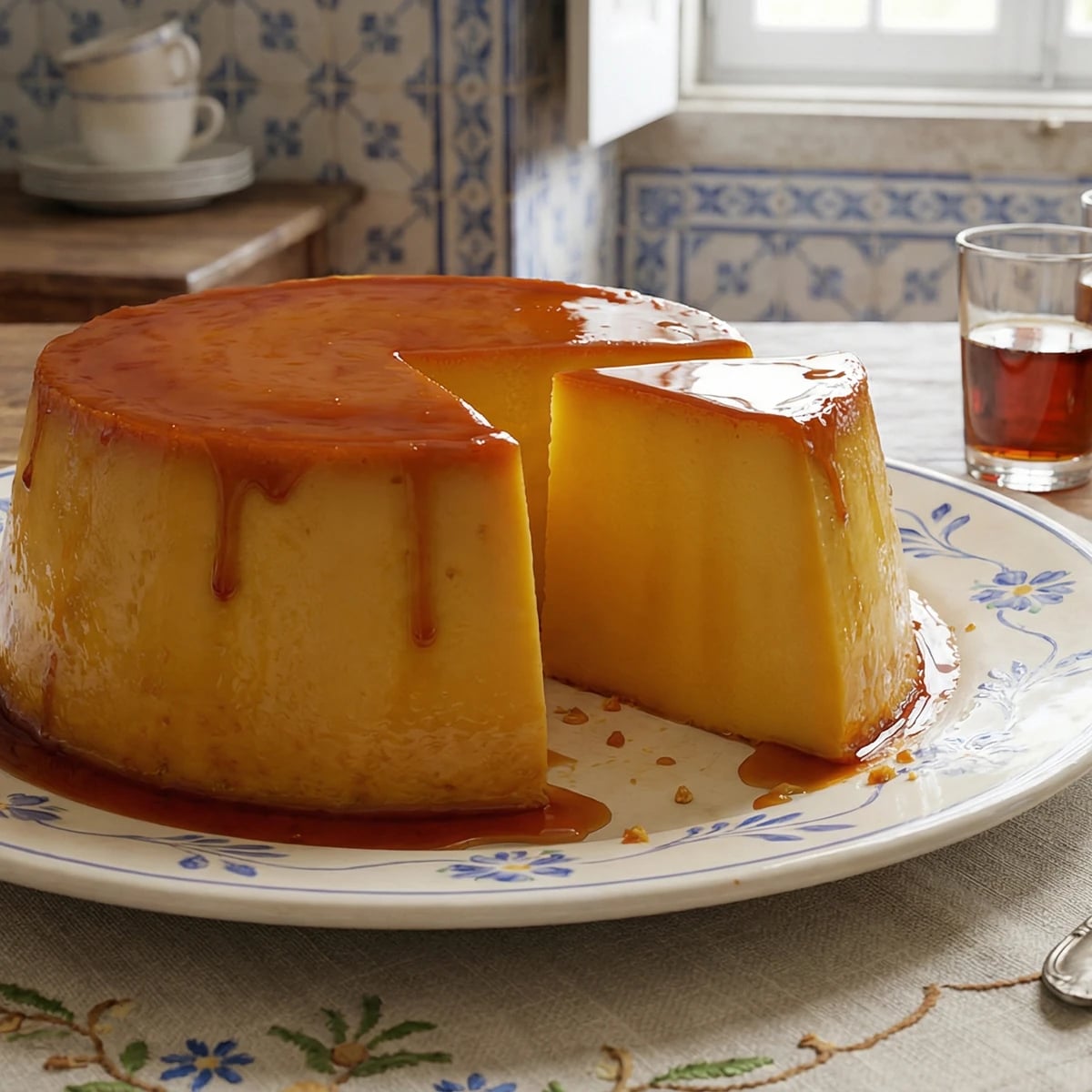
I first tasted this pudim in Braga, at the home of a woman whose grandmother had learned the recipe from the abbot's own household. She served it on her wedding china, the way her family had served it for four generations. "Este não é para todos os dias," she told me. This is not for every day. She was right. This is a celebration dessert, a special occasion dessert, the kind of thing you make when you want people to remember a meal forever.

The technique requires patience. The sugar must reach the right point. The egg yolks must be incorporated slowly. The bacon fat must be rendered properly, clean and neutral. Rush any step and you'll know. But follow the process with care, and you'll create something extraordinary. A cozinha é memória, and this pudim carries the memory of an abbot who knew that sometimes, more is more.

This pudim was created by Father Manuel Joaquim Machado Rebelo, the Abbot of Priscos parish near Braga, in the mid-19th century. The abbot was known for his culinary experiments, and this creation became his legacy. The use of bacon fat was revolutionary, transforming a traditional egg custard into something unprecedented. The recipe was kept secret during his lifetime but eventually spread throughout the Minho region after his death in 1866.

The technique, the tradition, and the story behind every dish.

Discover Culinary Explorer

Ingredients

sugar

Quantity

400g, plus 100g for the caramel

water

Quantity

250ml

egg yolks

Quantity

15 (from large eggs)

rendered bacon fat (banha de toucinho)

Quantity

100g

strained and cooled

ruby port wine

Quantity

100ml

lemon zest

Quantity

from 1 lemon

in strips, no white pith

cinnamon stick

Quantity

1

Equipment Needed

  • 1.5-liter pudim mold or flan tin
  • Heavy-bottomed saucepan for caramel
  • Medium saucepan for sugar syrup
  • Candy thermometer (optional but helpful)
  • Fine-mesh sieve
  • Deep roasting pan for water bath

Instructions

  1. 1

    Prepare the caramel

    Place 100g of sugar in a heavy-bottomed pan over medium heat. Do not stir. Let it melt slowly, swirling the pan occasionally to distribute the heat. Watch it carefully. The moment it turns deep amber, pour it immediately into a 1.5-liter pudim mold, tilting to coat the bottom and sides. Work quickly because caramel waits for no one. Set aside to harden.

    The caramel should be dark amber, almost the color of strong tea. Too light and it won't have enough bitterness to balance the richness. Too dark and it turns bitter.
  2. 2

    Make the sugar syrup

    In a medium saucepan, combine the 400g sugar with the water, lemon zest strips, and cinnamon stick. Bring to a boil over medium-high heat, stirring only until the sugar dissolves. Then stop stirring. Let it boil undisturbed until it reaches ponto de estrada (thread stage), about 110°C on a candy thermometer. To test without a thermometer: dip a slotted spoon into the syrup and lift it. When thin threads form between the holes, you're there. Remove from heat.

  3. 3

    Prepare the egg yolks

    While the syrup cools slightly (5 minutes), place the 15 egg yolks in a large bowl. Beat them gently with a fork until combined but not frothy. You're not incorporating air here. You're just breaking them down.

    The yolks must be at room temperature. Cold yolks will seize when they meet the warm syrup. Take them out of the refrigerator at least an hour before you begin.
  4. 4

    Combine syrup and yolks

    Remove the lemon zest and cinnamon stick from the syrup. Slowly, in a thin stream, pour the warm syrup into the egg yolks while stirring constantly. Go slowly. You're tempering the eggs, bringing them up to temperature without cooking them. If you rush, you'll have sweet scrambled eggs. Once all the syrup is incorporated, the mixture should be smooth and golden.

  5. 5

    Add the bacon fat and port

    The bacon fat should be at room temperature, soft but not liquid. Add it to the egg mixture in small pieces, stirring continuously until each piece is fully incorporated before adding the next. The mixture will become incredibly silky. Finally, stir in the port wine. Pass everything through a fine-mesh sieve into a clean bowl. This removes any bits that would mar the texture.

    The bacon fat must be properly rendered and strained. Any meat bits or impurities will affect both flavor and texture. Good banha should be clean, white, and neutral-smelling when cooled.
  6. 6

    Fill the mold and prepare the bath

    Pour the custard mixture into the caramel-lined mold. Tap gently to release any air bubbles. Cover tightly with aluminum foil. Place the mold in a deep roasting pan. Fill the pan with hot water until it reaches halfway up the sides of the mold. This banho-maria is essential for gentle, even cooking.

  7. 7

    Bake low and slow

    Bake in a preheated oven at 160°C (320°F) for 1 hour to 1 hour 15 minutes. The pudim is done when it's set around the edges but still has a slight wobble in the very center when you tap the pan. It will continue to set as it cools. Better to undercook slightly than to overcook. An overdone pudim loses its silky texture.

    Every oven is different. Start checking at 50 minutes. The wobble should be gentle, like a firm gelatin. If it moves like liquid, it needs more time.
  8. 8

    Cool and chill

    Remove the mold from the water bath and let it cool to room temperature on a wire rack. This takes at least 2 hours. Then refrigerate overnight, or at least 6 hours. The pudim must be completely cold before unmolding. Patience is not optional here.

  9. 9

    Unmold and serve

    Run a thin knife around the edge of the pudim. Place your serving plate on top of the mold and flip decisively. The pudim should release with a satisfying sound, the caramel pooling around it like liquid amber. If it sticks, set the bottom of the mold briefly in warm water and try again. Slice at the table, showing your guests the dense, golden interior. Serve cold, in thin slices. This pudim is rich. A little goes a long way.

Chef Tips

  • The bacon fat is the soul of this pudim. Render it yourself from quality toucinho (pork belly fat) for the best results. Slowly melt the fat over low heat, strain through cheesecloth, and refrigerate until solid and white. Store-bought lard can work but lacks the subtle depth of home-rendered banha.
  • Use a proper pudim mold if you have one. The traditional shape is tall and narrow, which gives the classic presentation. A metal mold conducts heat better than ceramic and helps the caramel release cleanly.
  • This pudim is even better on the second day. The flavors deepen and the texture becomes more cohesive. Make it two days before you plan to serve it if you can.
  • Save those egg whites. Freeze them for suspiros (meringues), claras de ovos for Sericaia, or an egg white omelet. Portuguese cooking wastes nothing.

Advance Preparation

  • The bacon fat must be rendered and strained ahead of time. This can be done days or even weeks in advance; refrigerate until needed.
  • The pudim must be refrigerated at least 6 hours, preferably overnight, before unmolding.
  • Once unmolded, the pudim keeps refrigerated for up to 4 days. Keep covered to prevent the surface from drying.

Frequently Asked Questions

Nutrition Information

1 serving (about 140g)

Calories
480 calories
Total Fat
21 g
Saturated Fat
8 g
Trans Fat
0 g
Unsaturated Fat
12 g
Cholesterol
355 mg
Sodium
5 mg
Total Carbohydrates
65 g
Dietary Fiber
0 g
Sugars
64 g
Protein
5 g

Note: Chef personas and recipes are created with AI assistance. Cook with care: follow safe food-handling practices, check doneness with a thermometer when needed, and adapt for allergies and your kitchen.

Where cooking meets culture.

Culinary guides, cultural storytelling, and the editorial depth that makes cooking meaningful.

Discover Culinary Explorer

More from Chef Margarida's Desserts

Browse the full collection