
Chef Elsa
Apfelkren
Freshly grated horseradish folded with tart apple and lemon, the cold, sharp sauce that belongs beside every plate of Tafelspitz in Vienna and has done for as long as anyone can remember.
A cooking platform built around craft, culture, and the stories behind what we eat.
Created by
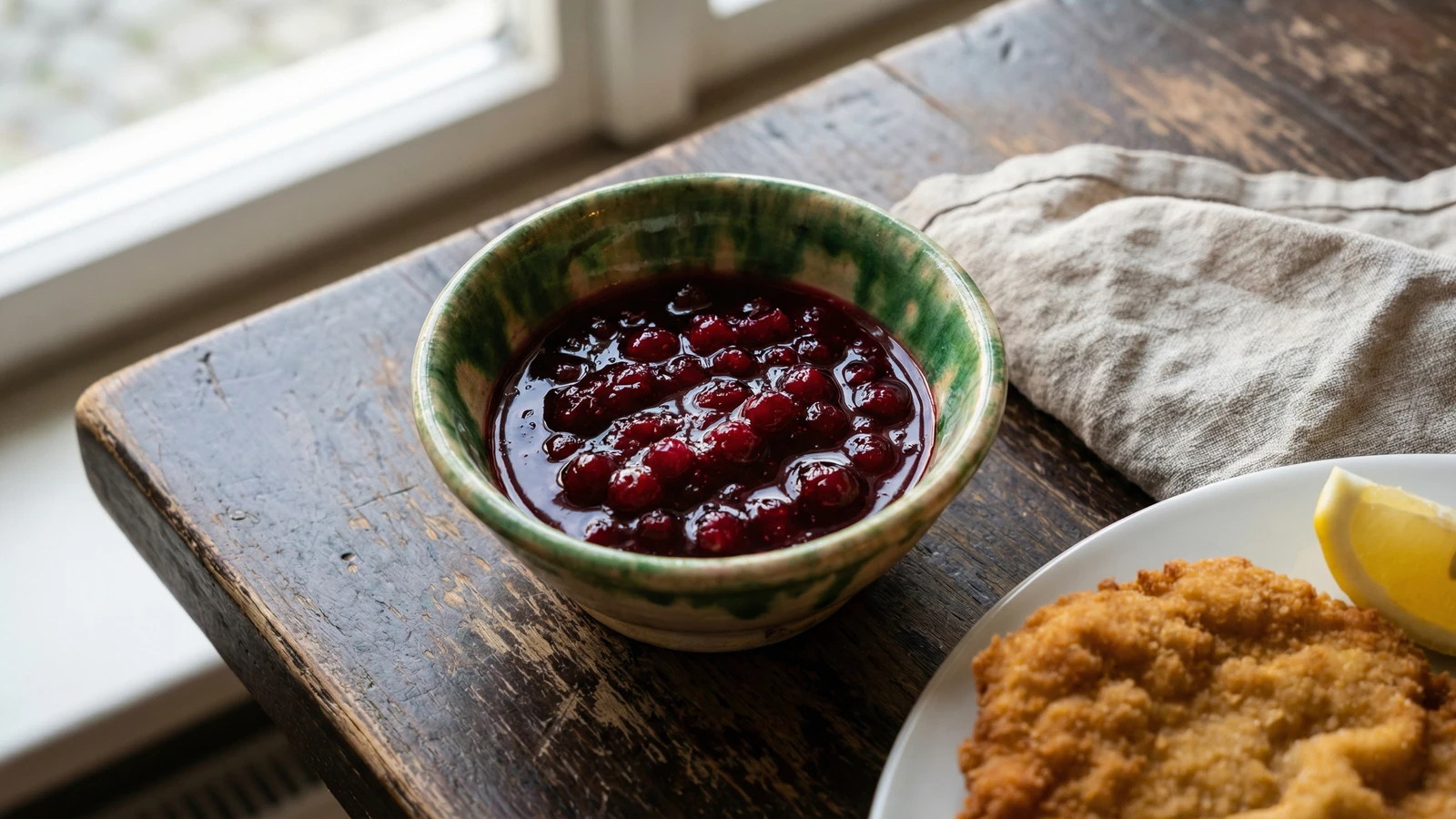
Tart, jewel-red lingonberry compote simmered with just enough sugar to let the berries speak for themselves. The condiment no Austrian table can do without.
In my grandmother Eva's kitchen in Kent, there was always a jar of Preiselbeeren in the fridge. Always. It sat on the second shelf in a glass jar with a metal clasp, dark red and glossy, and it came out for Schnitzel, for roast pork, for Palatschinken, for cold cuts on Sunday evening. Gretel always said that a kitchen without Preiselbeeren is a kitchen that isn't finished.
Preiselbeeren are wild lingonberries, small and deeply tart, and they grow across the mountain meadows of Austria and Scandinavia. The compote you make from them is one of the simplest things in all of Austrian cooking: berries, sugar, water, a little heat, ten minutes of your time. That's it. But the result is something no jar from a supermarket shelf can touch. When you cook them yourself, you control the sugar. You keep the tartness. You get that sharp, bright, almost cranberry-like bite that cuts through rich meat and fried breadcrumbs like nothing else can.
This is the condiment that sits beside every Wiener Schnitzel in every Gasthaus in Austria. It's spooned alongside roast venison and Wildschweingulasch in autumn. It appears next to Kaiserschmarrn and Palatschinken because Austrians understand that tart fruit and sweet things belong together. If you've ever wondered what's in that little dish of dark red compote that arrives unbidden with your meal in Salzburg, this is it. And once you've made it yourself, you'll keep a jar in your fridge too.
Preiselbeeren have been foraged in the Austrian Alps for centuries, gathered wild from mountain pastures above 1,000 meters where the berries grow low to the ground in acidic soil. The tradition of preserving them as a compote predates refined sugar; early versions used honey or simply dried the berries for winter. Their role as the mandatory accompaniment to Wiener Schnitzel became codified in Viennese Bürgerlich cooking during the 19th century, when the classic Schnitzel plate, with its potato salad, lemon wedge, and small dish of Preiselbeeren, achieved the form it still holds today.
Quantity
400g
fresh or frozen
Quantity
100g
Quantity
100ml
Quantity
1 strip (about 5cm)
pith removed
Quantity
1 tablespoon
| Ingredient | Quantity |
|---|---|
| lingonberries (Preiselbeeren)fresh or frozen | 400g |
| granulated sugar | 100g |
| water | 100ml |
| lemon zestpith removed | 1 strip (about 5cm) |
| fresh lemon juice | 1 tablespoon |
If using fresh lingonberries, pick through them and discard any that are soft, shriveled, or still green. Rinse them briefly in cold water and drain. If using frozen berries, don't bother thawing them. They go straight into the pot from the bag. Frozen lingonberries actually release their juice faster as the ice crystals break down the cell walls, which gives you a head start on the compote.
Combine the sugar and water in a medium saucepan over medium heat. Stir until the sugar dissolves completely. This takes about two minutes. You want a clear, thin syrup before the berries go in. If you dump the sugar on top of the berries dry, it scorches on the bottom of the pan before the fruit has a chance to release its juice.
Add the lingonberries and the strip of lemon zest to the syrup. Bring to a gentle simmer over medium-low heat. You'll hear the berries start to pop. That's exactly what you want. Some will burst and thicken the liquid. Others will stay whole and give the compote its texture. Stir gently a few times but don't mash them. Let the heat do the work. Simmer for eight to ten minutes until the compote looks glossy, deep red, and has thickened slightly.
Remove from the heat. Fish out the lemon zest. Stir in the lemon juice. Taste it. The compote should be tart first, sweet second. If it tastes like jam, you've added too much sugar and lost the point of the dish. Preiselbeeren exist to cut through richness, and they can only do that if they keep their edge. Let the compote cool to room temperature. It will thicken and deepen in color as it sits, turning from bright red to a dark, jewel-like garnet.
Transfer the cooled compote to a clean glass jar. It keeps in the fridge for up to three weeks. Serve it cold or at room temperature, spooned into a small dish alongside Wiener Schnitzel, roast pork, game, or anything that needs a bright, tart counterpoint. A tablespoon or two per person is enough. This is a condiment, not a side dish.
1 serving (about 55g)
Culinary guides, cultural storytelling, and the editorial depth that makes cooking meaningful.
Discover Culinary ExplorerChef Elsa
Freshly grated horseradish folded with tart apple and lemon, the cold, sharp sauce that belongs beside every plate of Tafelspitz in Vienna and has done for as long as anyone can remember.

Chef Elsa
The clear, caraway-scented pan jus you pour over Schweinsbraten and Knödel, built from nothing but good pork drippings, honest stock, and the patience to let a roasting pan tell you everything it knows.

Chef Elsa
A silky butter roux sauce finished with beef broth, cream, and handfuls of fresh dill, the way every Viennese grandmother serves it alongside Tafelspitz on Sunday.

Chef Elsa
Crisp cauliflower, sweet carrots, and bright peppers in a spiced sweet-sour brine with mustard seeds, the jar you open first when the Brettljause comes out and the last one you put away.