Culinary Explorer

A cooking platform built around craft, culture, and the stories behind what we eat.
Discover Culinary Explorer
Potaje de Millo de Lanzarote

Potaje de Millo de Lanzarote

Created by

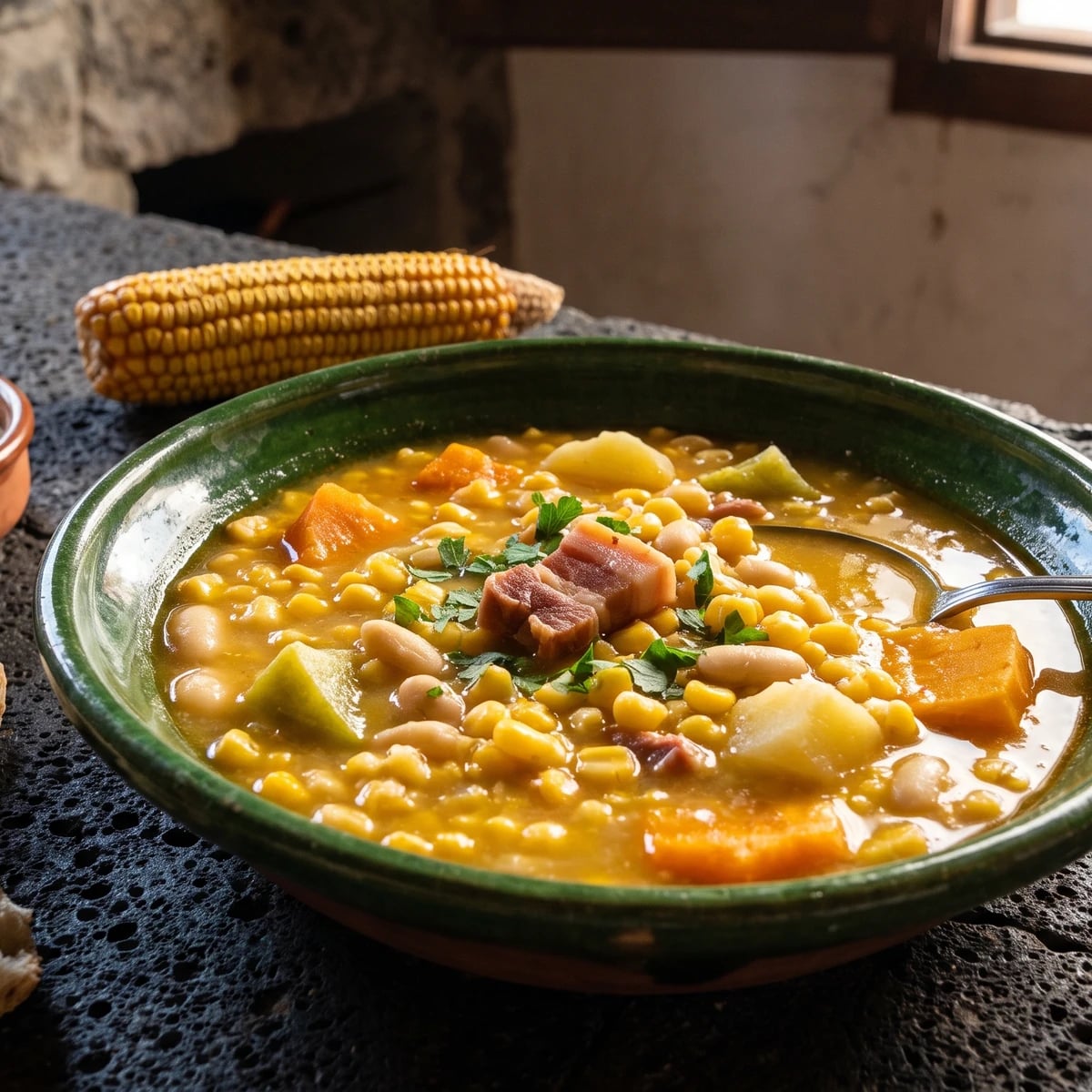
Potaje de Millo is Lanzarote's corn stew: soaked millo, beans, garden vegetables and salted pork, cooked slow until the kernels give and the pot feeds the table for days.

Soups & Stews
Spanish
Comfort Food
Budget Friendly
Batch Cooking
30 min
Active Time
3 hr cook3 hr 30 min total
Yield6 to 8 servings

Potaje de Millo is Lanzarote's corn stew, a Canarian potaje built around millo, whole corn, with beans, garden vegetables and a piece of salted pork doing quiet work in the pot. It is not a rich meat stew pretending to be humble. The corn is the point: chewy, plain-sweet, and able to feed a full table when the pantry was not showing off.

The method that decides it is the order. Soak the millo and beans, desalinate the pork, then give the corn its long simmer before the vegetables go in. Add the pumpkin, potato and bubango too early and they disappear before the kernels are ready; add them late and they keep their shape and sweeten the broth. The sofrito, the slow onion base, goes in dark gold and jammy, not pale, because that is where the sweetness is built.

If you are far from the islands, look for dried maiz mote or dried hominy in a Latin American shop. It is not exactly millo del pais, but it has the right long-cooked chew; canned hominy will do only if it goes in near the end, and the stew will taste softer and less of grain. No hace falta haber pisado España. You don't need to have set foot in Spain. Weigh it, soak it, keep the pot at a gentle murmur. Siempre sale, si lo sigues.

The Margin for this one says, "verdura tarde," vegetables late. It looks too practical to be poetry, which is exactly why it saves the dish.

Potaje de Millo belongs to Lanzarote and the wider Canarian cocina de cuchara, where millo is the island word for maize, the same grain ground into gofio and boiled whole in everyday pots. After maize came from the Americas into the islands' larder, Lanzarote's dry fields and volcanic ash mulches made grain, legumes and preserved pork practical food for day labourers and households watching the pantry. The pork was seasoning as much as meat: a small salted piece gave body to a pot meant to last several days.

The technique, the tradition, and the story behind every dish.

Discover Culinary Explorer

Ingredients

dried whole yellow corn kernels (millo en grano, maiz mote, or dried hominy)

Quantity

250g

soaked overnight

dried pinto or small white beans

Quantity

220g

soaked overnight

salted pork ribs (costillas saladas) or salt pork

Quantity

350g

soaked overnight and rinsed

olive oil

Quantity

60ml

onion

Quantity

1 large (about 200g)

finely chopped

green pepper

Quantity

1 (about 120g)

finely chopped

garlic

Quantity

4 cloves

finely chopped

ripe tomatoes

Quantity

300g

grated

sweet pimenton

Quantity

1 teaspoon

ground cumin

Quantity

1/2 teaspoon

bay leaf

Quantity

1

cold water

Quantity

2 litres, plus more as needed

waxy potatoes

Quantity

400g

peeled and cut into 3cm chunks

pumpkin or firm winter squash

Quantity

300g

peeled and cut into 3cm chunks

cabbage

Quantity

180g

roughly shredded

bubango or zucchini

Quantity

250g

cut into thick half-moons

fresh coriander or parsley (optional)

Quantity

10g

chopped

salt

Quantity

only if needed

Equipment Needed

  • Tall heavy pot or olla, 5 to 6 litres
  • Wide frying pan for the sofrito
  • Skimming spoon
  • Sharp knife for cutting the pork and vegetables

Instructions

  1. 1

    Soak the staples

    The night before, put the millo and the beans in separate bowls and cover each with plenty of cold water. Put the salted pork in a third bowl of cold water and change that water once if you remember. In the morning, drain everything and rinse the pork well. Do not salt anything yet; the pork has to speak first.

    Use food-grade dried whole corn, maiz mote, or dried hominy. Do not use popcorn, polenta, or cornmeal; they belong to other pots.
  2. 2

    Start the millo

    Put the drained millo, the rinsed pork, the bay leaf and 2 litres cold water in a tall heavy pot. Bring it up slowly, skim the foam, then lower the heat until the surface barely trembles. Cook for 45 minutes, giving the corn its head start. Millo is stubborn in the right way; hurry it and it stays hard at the centre.

  3. 3

    Add the beans

    Add the drained beans to the pot and keep the simmer low and steady for 1 hour to 1 hour 15 minutes, until the beans are nearly tender and the corn has begun to swell and open at the edges. Add a splash of hot water if the level drops below the ingredients. Stir gently from the bottom now and then, not so roughly that the beans break.

    If the beans soften before the corn is ready, lower the heat and keep going. In this pot the millo sets the clock.
  4. 4

    Cook the sofrito

    While the beans simmer, heat the olive oil in a frying pan over low heat. Add the onion and green pepper with a small pinch of salt and cook 15 to 18 minutes, until soft, dark gold and sweet. Add the garlic for 1 minute, then the grated tomato. Cook another 12 to 15 minutes, until the tomato has lost its water and the sofrito looks thick and jammy. Take it off the heat and stir in the pimenton and cumin so they bloom without burning.

  5. 5

    Join the pot

    Scrape the sofrito into the pot and stir gently. Simmer 20 to 30 minutes more, until the beans are tender and the broth has taken on a warm golden-red colour from the tomato and pimenton. Taste the liquid now before adding salt. If the pork has done its work, you may need none.

  6. 6

    Add vegetables late

    Add the potatoes, pumpkin and cabbage. Simmer 18 to 20 minutes, until the potatoes are nearly tender, then add the bubango or zucchini and cook another 8 to 10 minutes. This late addition is what keeps the vegetables from vanishing into the broth before the millo is ready. The stew should be thick but still spoonable; loosen it with hot water if it sits too heavily.

  7. 7

    Rest and serve

    Lift out the pork, cut the meat from any bones, and return bite-size pieces to the pot. Turn off the heat and let the potaje rest 20 minutes so the broth settles around the corn and beans. Taste once more for salt. Serve deep bowls with millo, beans, vegetables and pork in every spoonful, and scatter a little coriander or parsley only if you like it there. Tal como se hace allí, plain and enough.

Chef Tips

  • For the millo, dried maiz mote or dried hominy is the best substitute outside the Canaries. It gives the same patient chew, though the flavour is a little rounder and less earthy than millo del pais.
  • Canned hominy is a last useful shortcut, not the same dish from the start. Use two drained 425g cans and add them with the potatoes, after the beans are tender; the stew will cook faster but taste softer and less of grain.
  • Salted pork ribs, costillas saladas, are the Canarian choice. If you can't find them, use salt pork or a small unsmoked ham hock. Smoked bacon takes over the pot and pulls it toward another place.
  • Add the vegetables late. The corn and beans need time, but pumpkin, potato and bubango do not. Put them in too early and you get a thick mash instead of a potaje with pieces you can recognize.
  • This is better the next day. Chill it covered, then reheat gently with a splash of water. The corn keeps drinking, so loosen the pot before you correct the salt.
  • A dry Malvasia Volcanica from Lanzarote sits well with the sweet corn and salted pork. Bread and water are just as proper. This was household food before it was anything else.

Advance Preparation

  • Soak the millo and beans overnight in separate bowls of cold water so each cooks evenly.
  • Desalt the pork overnight in its own bowl of cold water; change the water once for a cleaner broth.
  • The sofrito can be cooked a day ahead and refrigerated. Add it once the beans and millo are nearly tender.
  • The finished potaje keeps 3 days in the refrigerator and reheats gently. Add water, not stock, if it thickens too much.

Frequently Asked Questions

Nutrition Information

1 serving (about 560g)

Calories
530 calories
Total Fat
19 g
Saturated Fat
5 g
Trans Fat
0 g
Unsaturated Fat
14 g
Cholesterol
35 mg
Sodium
700 mg
Total Carbohydrates
69 g
Dietary Fiber
12 g
Sugars
7 g
Protein
21 g

Note: Chef personas and recipes are created with AI assistance. Cook with care: follow safe food-handling practices, check doneness with a thermometer when needed, and adapt for allergies and your kitchen.

Where cooking meets culture.

Culinary guides, cultural storytelling, and the editorial depth that makes cooking meaningful.

Discover Culinary Explorer

More from Cocina de Cuchara Canaria

Browse the full collection