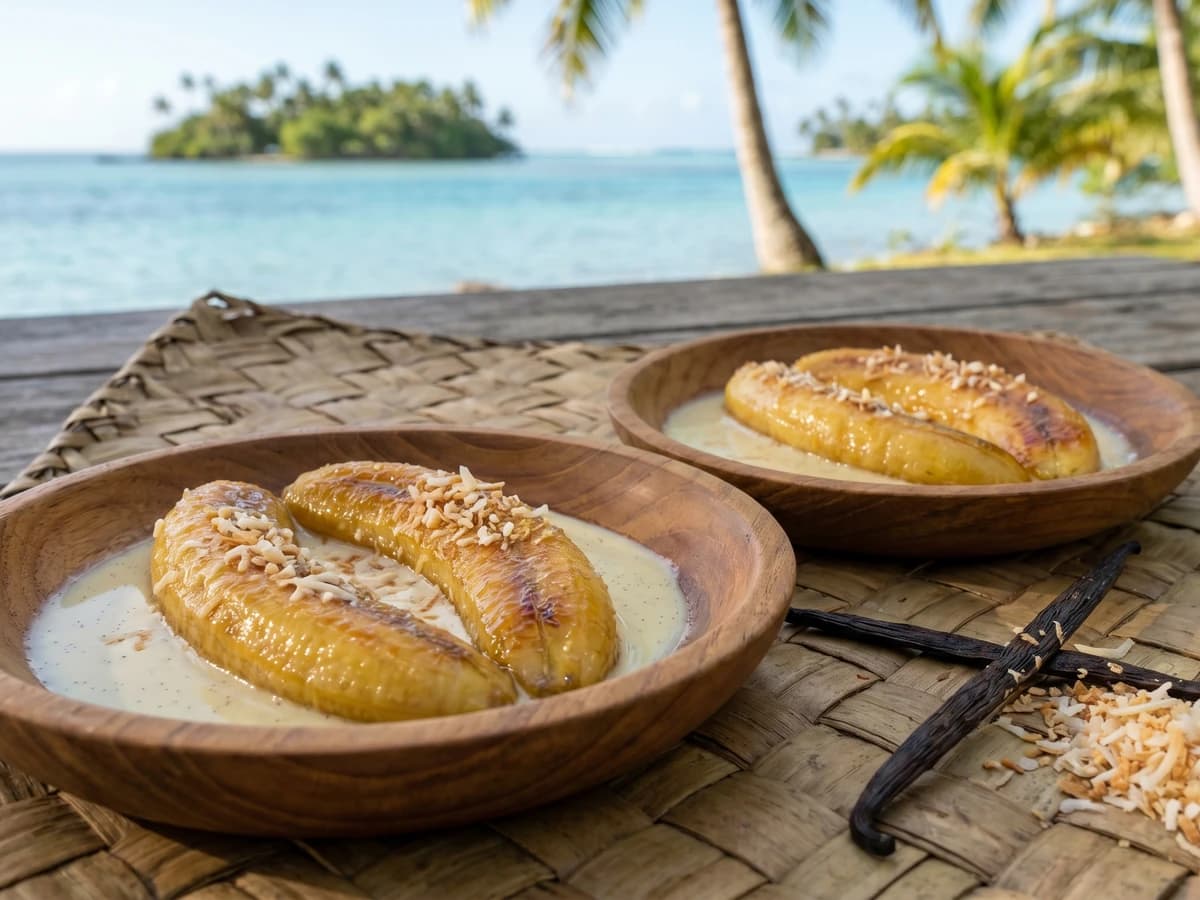
Poʻe Mautini (Tahitian Pumpkin Pudding with Coconut Milk)
Created by
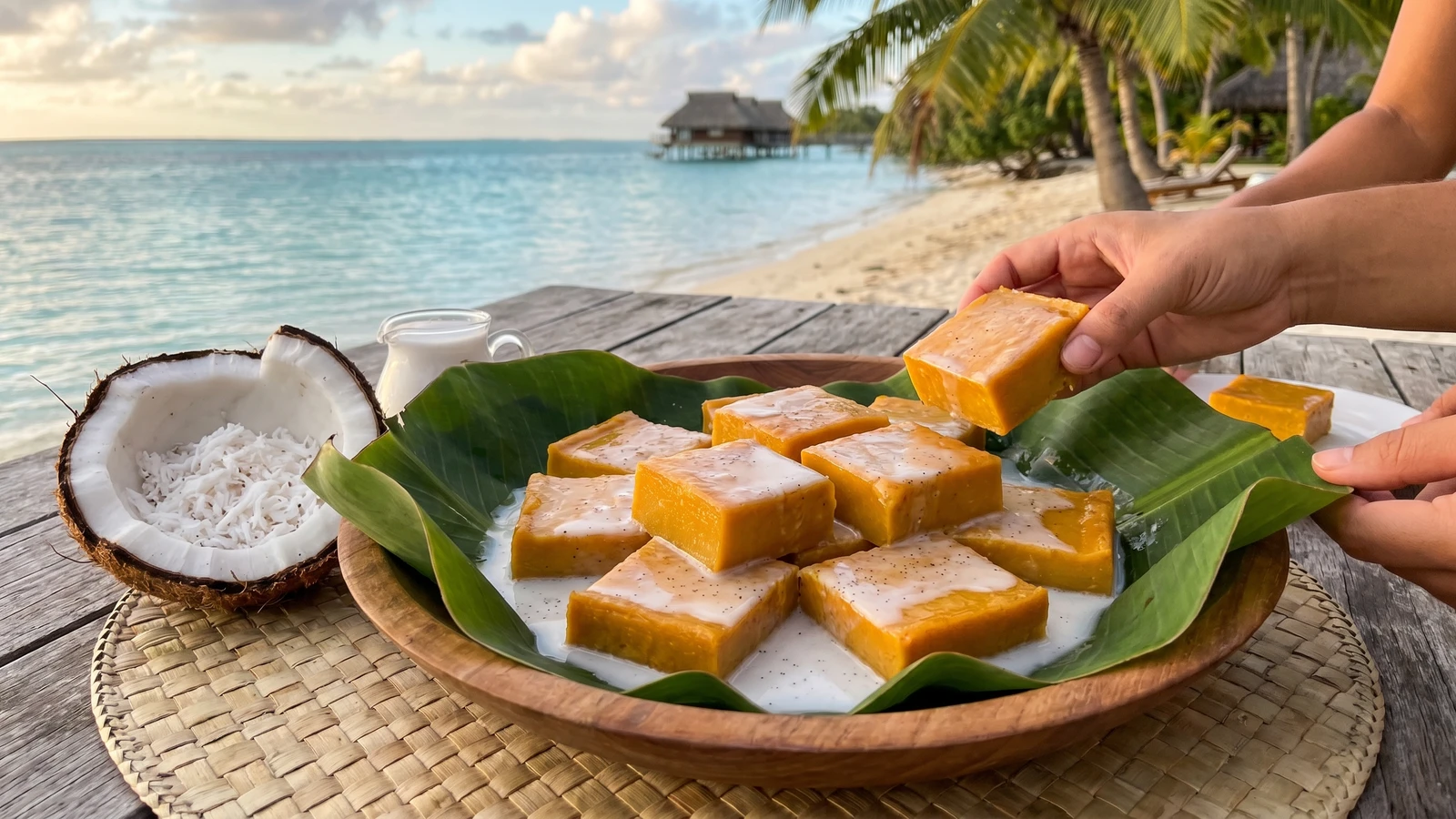
Deep-gold Tahitian poʻe mautini, orange squash mashed with starch and vanilla, baked until firm and tender, then cooled and spooned with fresh coconut milk at the table.
Desserts
Polynesian, Tahitian
Celebration
Special Occasion
Comfort Food
30 min
Active Time
1 hr 20 min cook•2 hr 50 min total
Yield8 to 10 servings
At a Tahitian table, even the sweet pan keeps genealogy. Poʻe mautini, Tahitian pumpkin pudding, belongs to Tahiti and its maʻa, food, from the fenua, the land, where squash went into the same wise old pudding grammar as banana, breadfruit, and taro: cook the plant soft, fold in starch, let heat set it, then cool it under miti haʻari, fresh coconut milk. I first ate it from a cousin's auntie by the lagoon, cut in plain squares, no decoration, just deep gold pudding and coconut poured right before we ate.
The cousins have their own hands. In the Cook Islands, poke is a banana or pumpkin pudding thickened with starch and served with coconut. Back home in Hawaiʻi, kūlolo is kalo and coconut cooked slow until chewy and dark. Same family feeling, not the same dish. One ocean, one canoe, one root, and every island keeps its own bowl.
For this one, don't chase fancy. Use a dense, sweet squash, mash it while it is warm, and let the starch do its quiet work until the pan sets firm enough to cut but still tender under the spoon. Serve it cool or room temperature, with coconut milk poured over at the table. Eat what you have, yeah, but don't rush the cooling. The pudding needs time to settle into itself.
Poʻe is a Tahitian family of starch-set puddings, made from mashed banana, breadfruit, papaya, or mautini, then cooled and served with miti haʻari, coconut milk. The starch line reaches before contact through pia, Polynesian arrowroot processed across the Triangle, while pumpkin, sugar, cornstarch, and the famous Tahitian vanilla came later through mission, trade, and colonial routes; Edmond Albius's 1841 hand-pollination method on Reunion is part of how vanilla became a workable crop across French island colonies. That is the honest history in the pan today: deep food meeting newer food without losing the Tahitian hand.
The technique, the tradition, and the story behind every dish.
peeled, seeded, and cut into 1-inch chunks, about 4 cups cooked mash
light brown sugar
Quantity
3/4 cup packed
plus more to taste
tapioca starch, pia (Polynesian arrowroot starch), or cornstarch
Quantity
3/4 cup
vanilla bean or pure vanilla extract
Quantity
1 bean or 2 teaspoons
seeds scraped if using bean
sea salt
Quantity
1/2 teaspoon
coconut oil
Quantity
1 tablespoon
melted, plus more for the pan
banana leaf or parchment (optional)
Quantity
enough to line an 8-inch square pan
banana leaf softened
grated mature coconut plus warm water, or full-fat canned coconut milk
Quantity
3 cups coconut plus 1 1/2 cups water, or 2 cups canned
for miti haʻari, coconut milk
sugar (optional)
Quantity
1 to 2 teaspoons
for the coconut milk
Ingredient
Quantity
dense pumpkin or kabocha squash (mautini)peeled, seeded, and cut into 1-inch chunks, about 4 cups cooked mash
3 pounds
light brown sugarplus more to taste
3/4 cup packed
tapioca starch, pia (Polynesian arrowroot starch), or cornstarch
3/4 cup
vanilla bean or pure vanilla extractseeds scraped if using bean
1 bean or 2 teaspoons
sea salt
1/2 teaspoon
coconut oilmelted, plus more for the pan
1 tablespoon
banana leaf or parchment (optional)banana leaf softened
enough to line an 8-inch square pan
grated mature coconut plus warm water, or full-fat canned coconut milkfor miti haʻari, coconut milk
3 cups coconut plus 1 1/2 cups water, or 2 cups canned
sugar (optional)for the coconut milk
1 to 2 teaspoons
Equipment Needed
•8-inch square baking pan
•Steamer basket set inside a large pot
•Potato masher or food mill
•Nut milk bag or clean kitchen cloth for pressing coconut milk
Instructions
1
Line the pan
Heat the oven to 350F. Oil an 8-inch square pan lightly, then line it with softened banana leaf, shiny side up, or with parchment if that is what your kitchen has. This is a home pan, not an ahimaʻa, the Tahitian earth oven, but the leaf still gives the pudding a little memory of where it belongs.
2
Cook the mautini
Set the pumpkin or kabocha chunks in a steamer basket over simmering water and cook 20 to 25 minutes, until a fork slides through with no fight. Let the squash drain in the basket for 10 minutes after cooking, so the extra water leaves and the mash stays sweet and thick.
Use a dense squash, not a watery carving pumpkin. Source first, always. A sweet, heavy squash does half the cooking for you before you touch the spoon.
3
Mash it smooth
Mash the warm squash with a potato masher or pass it through a food mill until it is mostly smooth and deep orange. Measure out 4 cups of mash. If you have a little extra, save it for rice or soup; we no waste good food.
4
Mix the poʻe
Stir the sugar, starch, and salt together first so the starch does not clump. Fold that dry mix into the warm mautini, then add the vanilla and melted coconut oil. The batter should be thick, glossy, and heavy on the spoon, like it wants to sit down and stay there.
5
Bake until set
Spread the batter into the lined pan and smooth the top with wet hands or a wet spatula. Bake 45 to 55 minutes, until the top turns deep gold, the edges pull slightly from the leaf, and the center feels set with a gentle bounce. A thin knife should come out with sticky crumbs, not wet paste.
6
Press the coconut
While the pudding bakes, make the miti haʻari, the coconut milk. Pour the warm water over the grated coconut, knead it with your hands until the liquid turns rich and white, then squeeze it through a clean cloth or nut milk bag. Stir in a small pinch of salt and a little sugar only if the coconut needs help. A good full-fat can is fine on a weeknight; just stir it smooth.
7
Cool and serve
Let the poʻe cool at least 1 hour, or until it firms enough to cut clean squares. Serve it cool or at room temperature, with the coconut milk poured over each piece at the table. The pudding should be tender, lightly chewy, and sweet in a quiet way, with the coconut carrying it home.
Chef Tips
•Kabocha, kuri, butternut, or a dense local pumpkin all work. Eat what you have. Just avoid watery squash, because the pudding will taste thin and need too much starch to stand up.
•Pia gives the clean old-style set if you can find it. Tapioca starch gives more chew. Cornstarch makes a softer, gentler square. All three belong in a real kitchen, so use the one you can get.
•Fresh coconut milk is worth the hand work when coconut is available. If not, a full-fat can is no shame. Stir it well and keep it plain, because the poʻe is the sweet part.
•The pudding cuts best after it cools fully. Warm poʻe slumps and looks like it lost confidence. Give it the hour, or chill it overnight for a firmer, cleaner square.
•Leftovers keep covered in the fridge for 3 to 4 days. Spoon fresh coconut milk over only when serving, so the squares do not sit in liquid and soften too far.
Advance Preparation
•Cook and mash the squash up to 1 day ahead. Keep it covered in the fridge, then bring it close to room temperature before mixing in the starch.
•Bake the poʻe the day before a celebration and chill it covered. Cut it cold, then let it sit out 20 to 30 minutes before serving.
•Press fresh coconut milk the morning of the meal and keep it chilled. Stir before serving, because the cream naturally rises.
Frequently Asked Questions
Nutrition Information
1 serving (about 185g)
Calories
275 calories
Total Fat
14 g
Saturated Fat
12 g
Trans Fat
0 g
Unsaturated Fat
2 g
Cholesterol
0 mg
Sodium
150 mg
Total Carbohydrates
39 g
Dietary Fiber
3 g
Sugars
23 g
Protein
2 g
Where cooking meets culture.
Culinary guides, cultural storytelling, and the editorial depth that makes cooking meaningful.