
Chef Lupita
Arroz Amarillo Yucateco con Achiote
Yucatán's everyday yellow rice, toasted in achiote-stained lard with onion and garlic, perfumed by a whole habanero on top. The bright plate that lives beside every cochinita on the Mérida table.
A cooking platform built around craft, culture, and the stories behind what we eat.
Created by
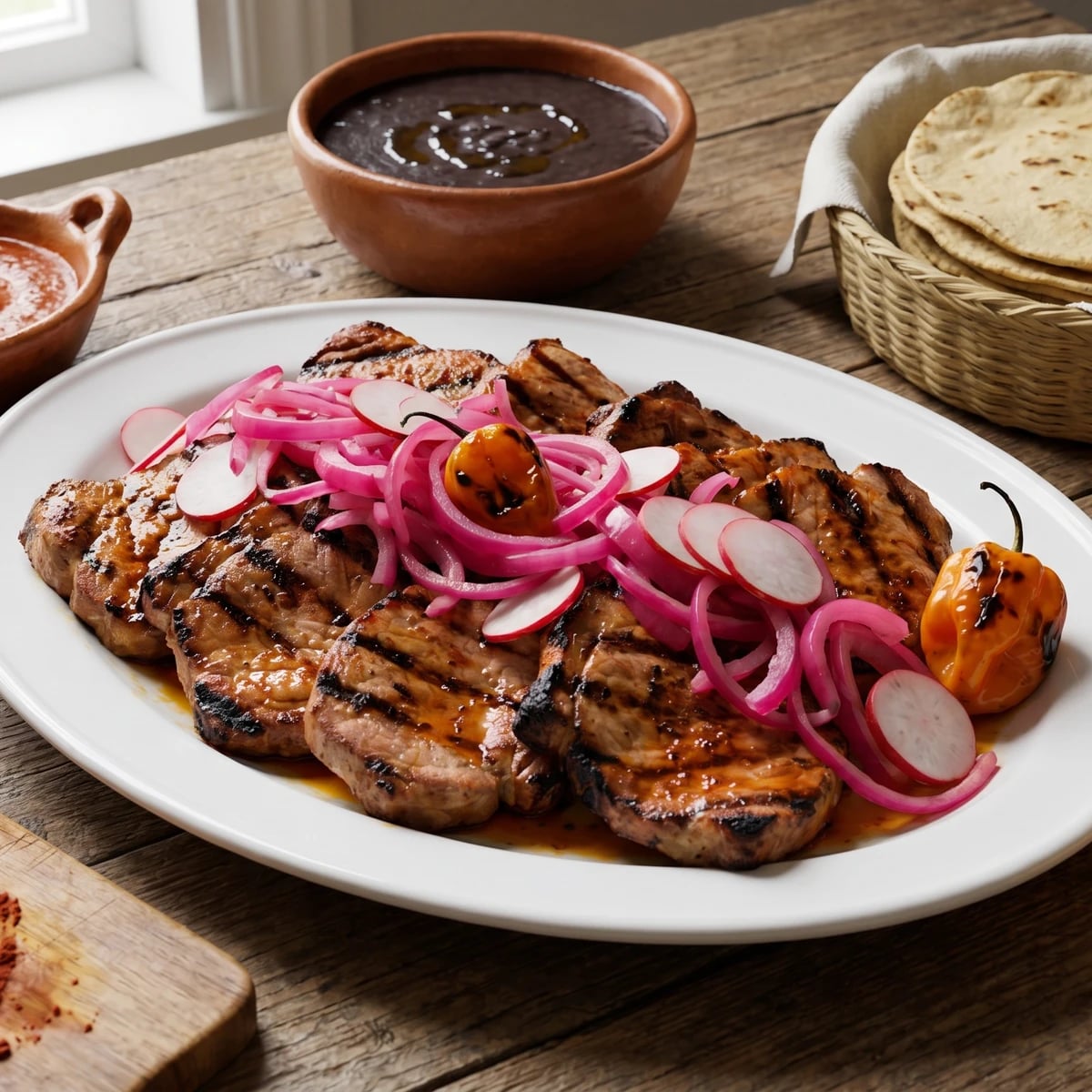
Mérida's daily grilled pork, thin loin marinated in sour orange and charred garlic, seared fast over screaming charcoal, and served with chiltomate, pickled red onions, and frijol colado.
Poc chuc is from Yucatán. Not from generic Mexico, not from the north, not from the central plateau. From Yucatán, the peninsula with its own chiles, its own citrus, its own Mayan vocabulary still alive in the kitchen. The name itself, poc chuc, is Maya. Poc means to toast or sear. Chuc means charcoal. The name is the recipe.
This is daily food in Mérida. Not Sunday food. Not celebration food. Daily food. Lunch at a wooden table under a slow ceiling fan, the platter passed around, everybody building their own taco. Thin pork loin, sour orange and charred garlic, a hot charcoal fire, and the three things that always sit at the table of a Yucatecan cook: chiltomate, cebolla morada encurtida, and frijol colado. Take any one of them away and the meal limps.
The sour orange is the heart of it. Naranja agria, the bitter Seville orange the Spanish brought to the peninsula in the 16th century, which the Mayan cooks folded into their existing tradition of citrus-cured meats. If you live somewhere you cannot find sour orange, mix regular orange with lime in a two-to-one ratio. The señoras of Valladolid who taught me this recipe will not love that you had to do it, but they understand. They have daughters in Houston and Los Angeles. They have made the same compromise.
One more thing. The pork must be thin and the fire must be hot. Thick pork on a weak fire gives you something that is not poc chuc, no matter what you call it. Pound the steaks. Build the fire properly. Cook them ninety seconds a side. Saber cocinar es saber vivir, and in Yucatán, saber cocinar is also saber leer el fuego.
Poc chuc is a relatively recent dish in the Yucatecan canon, generally credited to the Los Almendros restaurant in Ticul, which formalized the recipe on its menu in the 1960s and brought it to Mérida as a signature peninsular plate. The technique itself, however, drew on much older Mayan practices of marinating game meats in citrus juice (originally from native fruits like the chaya berry and later from Spanish-introduced sour orange) before searing them over open coals, a method documented in colonial-era accounts of Mayan kitchens. The chiltomate that accompanies it is one of the oldest sauces in the peninsular repertoire, a pre-Columbian preparation of fire-roasted tomatoes and chile that predates the arrival of Europeans by centuries.
Quantity
2 pounds
sliced into 1/4-inch thick steaks and pounded thin
Quantity
1 cup
or 2/3 cup fresh orange juice mixed with 1/3 cup fresh lime juice
Quantity
8
roasted on a comal until charred and soft
Quantity
1 teaspoon
toasted
Quantity
1/2 teaspoon
toasted
Quantity
1 tablespoon
Quantity
2 large
sliced into thin half-moons
Quantity
1 cup
or 2/3 cup orange juice mixed with 1/3 cup lime juice
Quantity
1
charred whole on the comal
Quantity
1 teaspoon
preferably Yucatecan oregano, crumbled
Quantity
1 teaspoon
Quantity
6
Quantity
1
halved
Quantity
3
unpeeled
Quantity
1
whole
Quantity
1 tablespoon
Quantity
to taste
Quantity
1 pound
picked over and rinsed
Quantity
1 sprig
Quantity
1
halved
Quantity
2 tablespoons
Quantity
for serving
warmed
Quantity
for serving
Quantity
for serving
sliced
Quantity
for serving
| Ingredient | Quantity |
|---|---|
| boneless pork loinsliced into 1/4-inch thick steaks and pounded thin | 2 pounds |
| fresh sour orange juice (naranja agria)or 2/3 cup fresh orange juice mixed with 1/3 cup fresh lime juice | 1 cup |
| garlic clovesroasted on a comal until charred and soft | 8 |
| whole black peppercornstoasted | 1 teaspoon |
| whole allspice berriestoasted | 1/2 teaspoon |
| kosher salt | 1 tablespoon |
| red onionssliced into thin half-moons | 2 large |
| fresh sour orange juice for pickled onionsor 2/3 cup orange juice mixed with 1/3 cup lime juice | 1 cup |
| chile habanerocharred whole on the comal | 1 |
| dried Mexican oreganopreferably Yucatecan oregano, crumbled | 1 teaspoon |
| kosher salt (for pickled onions) | 1 teaspoon |
| ripe Roma tomatoes | 6 |
| small white onion (for chiltomate)halved | 1 |
| garlic cloves (for chiltomate)unpeeled | 3 |
| chile habanero (for chiltomate)whole | 1 |
| manteca de cerdo (pork lard) | 1 tablespoon |
| salt | to taste |
| dried black beans (frijol negro)picked over and rinsed | 1 pound |
| epazote | 1 sprig |
| small white onion (for beans)halved | 1 |
| manteca de cerdo (for beans) | 2 tablespoons |
| hand-pressed corn tortillas (optional)warmed | for serving |
| lime wedges (optional) | for serving |
| fresh radishes (optional)sliced | for serving |
| fresh cilantro (optional) | for serving |
Rinse the black beans and place them in a heavy pot with the halved white onion and the sprig of epazote. Cover with cold water by three inches. Bring to a gentle simmer and cook uncovered for about two hours, until the beans are completely soft and the broth has turned a deep purple-black. Salt only in the last twenty minutes. Frijol colado is what Yucatecans serve with everything. It is not refried. It is strained.
While the beans cook, bring a small pot of water to a boil. Drop the sliced red onions in for exactly ten seconds, then drain immediately. This takes the raw bite off without cooking them. Transfer to a glass jar with the charred habanero, the crumbled Yucatecan oregano, and the salt. Pour the sour orange juice over the top, press the onions down so they are submerged, and let them sit at room temperature for at least an hour. They will turn that bright magenta pink that signals the dish is from the peninsula and nowhere else.
Heat a dry comal over medium and char the eight garlic cloves in their skins until the skins blacken and the cloves underneath turn soft and sweet, about eight minutes. Peel them. Toast the peppercorns and allspice in the same comal for thirty seconds until fragrant, then crush in a molcajete with the salt. Add the roasted garlic and grind to a paste. Stir in the sour orange juice. This is the Yucatecan recado for poc chuc. Simple, three ingredients, and the fight is in the proportions.
Pound the pork loin steaks to a generous quarter-inch thickness. Thin is the whole point. Thick pork does not work for poc chuc and turns the dish into something else. Lay the steaks in a shallow dish and pour the marinade over them, turning to coat every piece. Marinate for thirty minutes at room temperature, no longer than an hour. The sour orange will start to cook the meat if you leave it too long, and you want the lime to flavor it, not cure it.
On the same comal, char the Roma tomatoes, the halved white onion, the unpeeled garlic, and the whole habanero until the skins blacken in spots, turning often. About ten minutes. Peel the garlic. Transfer everything to a molcajete or blender and grind to a coarse, chunky sauce. Heat the lard in a small clay cazuela, pour in the sauce, and simmer for five minutes until it tightens and the color deepens to brick red. Salt to taste. Chiltomate is the table sauce of Yucatán, and the habanero gets ground in whole, not seeded. This is how it is done.
When the beans are tender, pass them through a fine-mesh sieve or a food mill, pressing the beans and broth through and discarding the skins. You want a smooth, thick pourable bean puree. Return to the pot, melt the manteca in, and simmer five more minutes. Taste for salt. Frijol colado is the strained one. La manteca es el sabor, even in the beans.
Light a generous bed of natural lump charcoal and let it burn down to glowing embers covered with gray ash. The grill should be hot enough that you cannot hold your hand over the grate for more than two seconds. Poc chuc means burnt or seared meat in Maya. The name is the instruction. If your fire is weak, your poc chuc is not poc chuc, it is grilled pork.
Lift the steaks from the marinade and let the excess drip off. Lay them on the hot grate. Cook for ninety seconds to two minutes per side, no more. The edges should char and the surface should pick up dark grill marks. Thin pork over high heat cooks fast. Pull it the second it is opaque through the center. Overcooked poc chuc is tough poc chuc and there is no recovering it.
Pile the grilled pork on a white Mérida-style platter. Spoon the chiltomate alongside, mound the pickled red onions on top of the pork, and ladle the frijol colado into small bowls for each guest. Serve with warm corn tortillas, lime wedges, and sliced radishes. Each person builds their own taco at the table: tortilla, a slice of pork, a forkful of pickled onion, a spoon of chiltomate, a swipe of beans. This is lunch in Mérida. Así se hace y punto.
1 serving (about 450g)
Culinary guides, cultural storytelling, and the editorial depth that makes cooking meaningful.
Discover Culinary Explorer
Chef Lupita
Yucatán's everyday yellow rice, toasted in achiote-stained lard with onion and garlic, perfumed by a whole habanero on top. The bright plate that lives beside every cochinita on the Mérida table.

Chef Lupita
Yucatán's one-pot Sunday lunch. Chicken seared in achiote recado rojo, then rice, sour orange, and broth added with peas, carrots, olives, and capers. Spanish bones, Mayan soul.

Chef Lupita
Yucatán's ash-dark rice, fried in lard and cooked in pork stock with recado negro, the burnt-chile and tortilla paste that gives the peninsula its smokiest pot.

Chef Lupita
Campeche's Thursday plate, beef strips marinated in recado de bistek and sour orange, then braised low and slow with charred tomato, chile xcatic, and potatoes in a clay cazuela. Always served over white rice.