Chef Fai
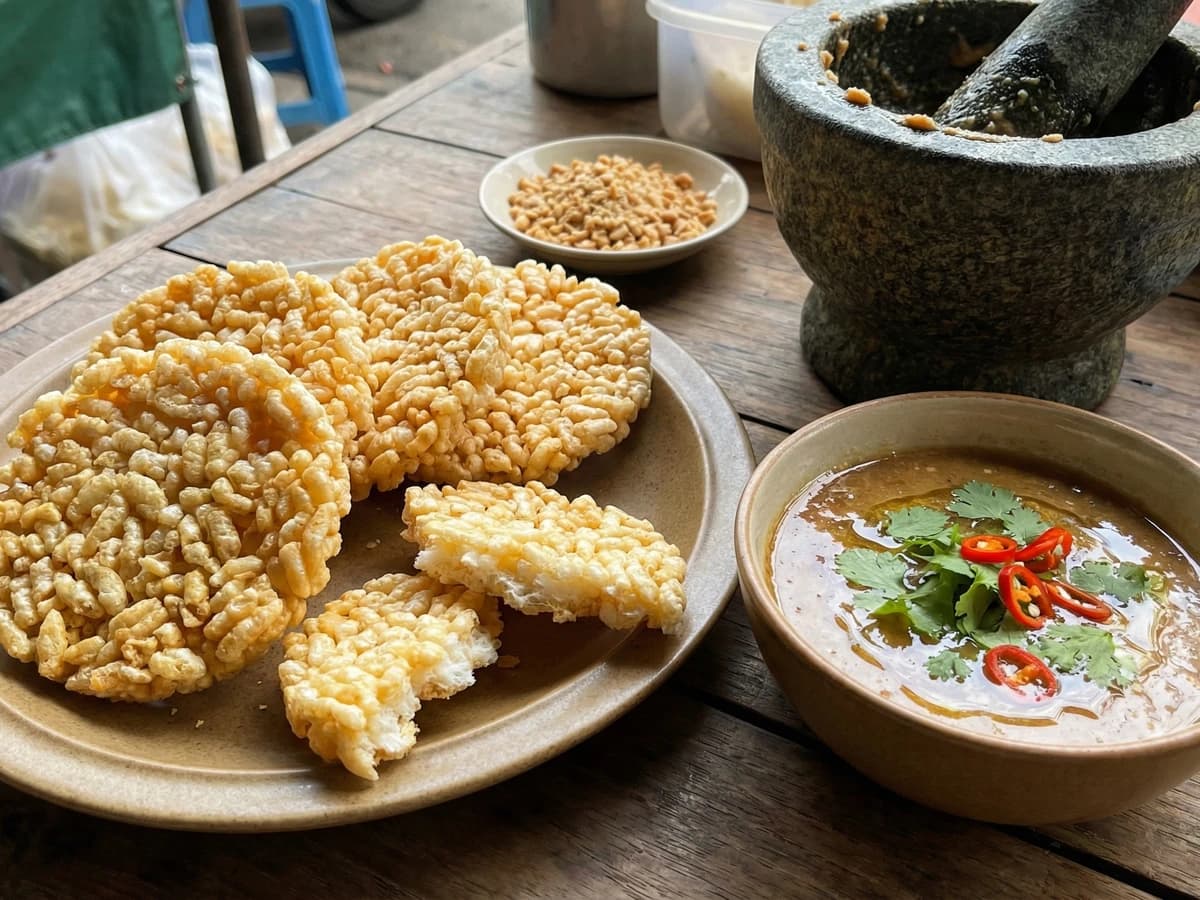
Crispy Rice with Coconut Dip (Khao Tang Na Tang)
The kreung tam doesn't rest, not even for a snack. Pounded paste cracked into coconut cream, spooned over golden rice that shatters on contact. Four pillars in every bite.
A cooking platform built around craft, culture, and the stories behind what we eat.

Created by
Isan fermentation at its most direct: whole fish packed with garlic and cooked rice, left for lactic acid bacteria to create sourness, then fried until the skin shatters golden. The acid isn't from lime. It's from time and biology.
Fermentation is the Isan answer to the third pillar. Ajarn McDang's framework gives us four governing forces in Thai cooking: fish sauce for salt, palm sugar for sweet, tropical acids for sour, chili for heat. Most people hear "tropical acids" and think lime juice. Sure. Lime is one path. But in Isan, the oldest source of sourness is lactic acid fermentation. Bacteria eating rice starches, producing acid, transforming raw protein into something entirely new. That's pla som. That's the principle before the recipe.
The science is clean. Take a whole freshwater fish, rub it with coarse salt, stuff it with crushed garlic and cooked rice, seal it up, and wait. Three to five days at room temperature. The lactic acid bacteria already living on the fish and the rice go to work, consuming sugars and producing acid. That acid does two things simultaneously: it drops the pH low enough to shut out harmful bacteria (preservation), and it creates a tangy sourness that no squeeze of lime can replicate. This is the exact same biochemistry behind naem (fermented pork), sai krok Isan (fermented sausage), and pla ra (fermented fish paste). Different products, same governing science. Fermentation is the deep toolkit of Isan cuisine.
Then you fry it. The whole fermented fish goes into hot oil until the skin turns golden and cracks when you press it. Inside: sour, funky, tender flesh that tastes like it has been transformed by something patient and ancient. Outside: crispy, golden armor. The contrast between that shattering crust and the tangy, soft interior is the entire point. You tear it apart with your hands over sticky rice and raw vegetables. No fork. No ceremony.
My mother kept pla som in a jar at the back of our stall in Khlong Toei. She made a batch every week, mostly for family dinner. Fried pla som with khao niew and a handful of raw cabbage on a weeknight. No performance. Just the food Isan people have been eating for generations, preserved by a process older than any cookbook. If you understand what the bacteria are doing and why the rice is there, you can ferment any fish, anywhere. Principles, not recipes.
Pla som (ปลาส้ม, literally "sour fish") belongs to a family of lactic acid-fermented protein traditions across Isan and mainland Southeast Asia, alongside naem, sai krok Isan, and pla ra. The technique predates refrigeration and reflects a riverine agricultural society's need to preserve the abundant freshwater fish of the Mekong basin and Khorat Plateau. Silver barb (pla tapian) is the traditional fish of choice, prized for its firm flesh and clean flavor after fermentation, though tilapia and snakehead (pla chon) have become common modern substitutions as wild freshwater catches decline.
Quantity
4 fish, about 800g-1kg total
cleaned, gutted, scaled
Quantity
3 tablespoons
Quantity
1 head (10-12 cloves)
peeled and lightly crushed
Quantity
1 cup
cooled to room temperature
Quantity
2
beaten
Quantity
enough to submerge the fish
Quantity
for serving
Quantity
wedges, for serving
Quantity
sliced, for serving
Quantity
for serving
| Ingredient | Quantity |
|---|---|
| small whole freshwater fish (silver barb/pla tapian, tilapia, or snakehead/pla chon)cleaned, gutted, scaled | 4 fish, about 800g-1kg total |
| coarse salt | 3 tablespoons |
| garlicpeeled and lightly crushed | 1 head (10-12 cloves) |
| cooked jasmine rice or sticky rice (khao niew)cooled to room temperature | 1 cup |
| eggsbeaten | 2 |
| vegetable oil | enough to submerge the fish |
| sticky rice (khao niew) | for serving |
| raw cabbage | wedges, for serving |
| cucumber | sliced, for serving |
| bird's eye chilies (prik khi nu) | for serving |
Rinse each fish under cold water and pat completely dry. Score both sides with deep diagonal cuts, about an inch apart, cutting almost to the bone. These scores aren't decorative. They let salt penetrate the flesh and give bacteria access during fermentation. Rub the coarse salt generously over the entire fish: inside the cavity, into every score mark, across the skin. Use all three tablespoons across the four fish. Set them on a plate and let them sit for 15 minutes while you prepare the fermentation base. The salt starts drawing moisture immediately. That's what you want.
In a bowl, mix the crushed garlic cloves with the cooled cooked rice. Use your hands. Squeeze the garlic into the rice so the juices distribute through the grains. This mixture is the fuel for your fermentation: the rice provides carbohydrates for lactic acid bacteria to eat, and the garlic provides both flavor and mild antimicrobial properties that favor the right bacteria over the wrong ones. Stuff each fish cavity with the garlic-rice mixture, pressing it in firmly. Pack the remaining mixture into the score marks and over the surface of the fish. Layer the fish tightly into a glass jar or food-safe container. Press down to eliminate air pockets. Seal the container tightly. Leave at room temperature (ideally 28-32°C, which is normal Thai room temperature) for 3 to 5 days.
After 3 days, open the container and check. The fish should smell distinctly sour and tangy, with a funky edge that's sharp but not rotten. The flesh should feel firmer than raw but still yielding. The rice will have broken down and turned slightly translucent. If it smells cleanly sour, like yogurt crossed with something briny, you're there. If it smells putrid or like decay, something went wrong: discard it. Trust your nose. Once the fermentation is right, remove the fish and gently rinse off the excess rice and garlic under running water. Pat the fish bone-dry with paper towels. Dip each fish in beaten egg, coating all surfaces. Heat vegetable oil in a deep pot or wok to 170°C (340°F). The oil should be deep enough to submerge the fish. Fry 2 fish at a time, turning once, until the skin is deeply golden and crispy, about 4 to 5 minutes per batch. The egg coating will puff and turn golden. When you tap the skin with a spatula, it should sound hollow. Drain on a wire rack, not paper towels. Paper towels trap moisture underneath and kill the crispness you just worked for.
Plate the fried pla som whole. Serve immediately alongside sticky rice (khao niew), raw cabbage wedges, sliced cucumber, and fresh bird's eye chilies (prik khi nu). This is Isan eating. You tear the fish apart with your hands, pinch some sticky rice, grab a piece of cabbage, bite a chili if you want heat. No utensils, no plating rules. The sour tang of the fermented fish against the neutral sweetness of sticky rice is the combination. The raw vegetables are palate cleansers between bites. Every element has a job. Eat it the way it was designed to be eaten.
1 serving (about 210g)
Culinary guides, cultural storytelling, and the editorial depth that makes cooking meaningful.
Discover Culinary ExplorerChef Fai
The kreung tam doesn't rest, not even for a snack. Pounded paste cracked into coconut cream, spooned over golden rice that shatters on contact. Four pillars in every bite.
Chef Fai
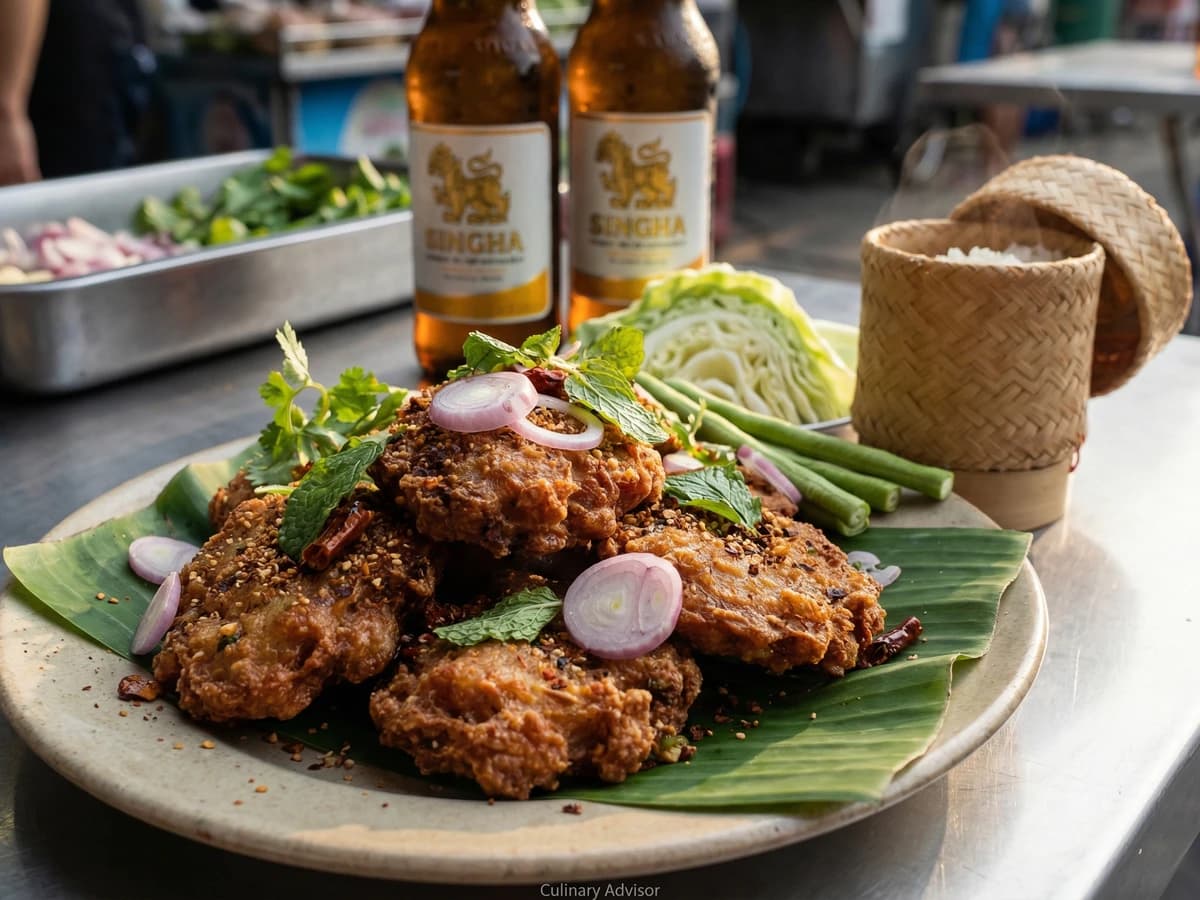
Isan's larb principles pressed into patties and fried golden: fish sauce for salt, lime for sour, khao khua for structure and crunch, prik pon for heat. No sugar. That's the rule that separates Isan from everything else.
Chef Fai
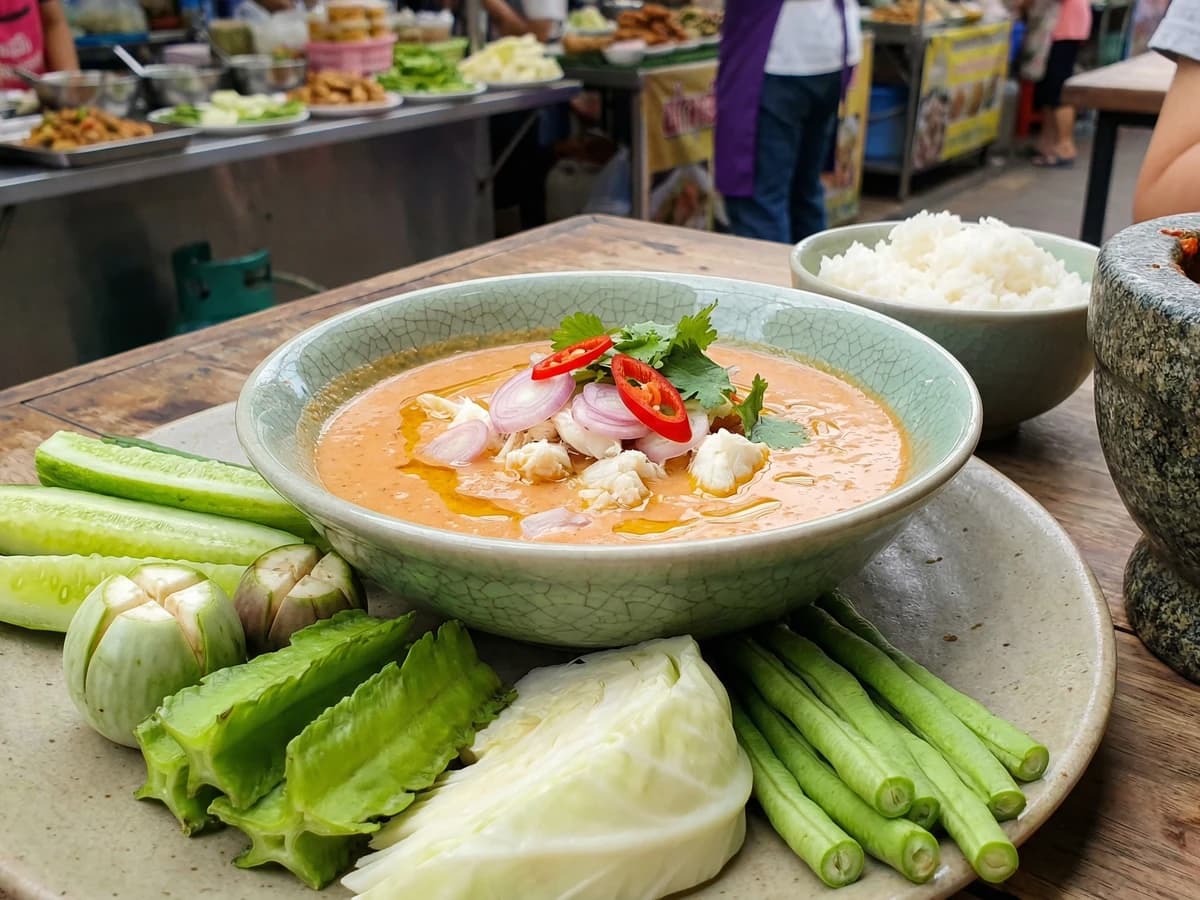
A kreung tam pounded in the krok, dissolved into cracked coconut cream, sweet crab folded through at the end. All four pillars balanced in a dip so silky you'll forget it started in a granite mortar. Central Thai home cooking at its most principled.

Chef Fai
Twenty-four meatballs, eight bamboo skewers, a charcoal grill the size of a shoebox, and one pot of nam jim built on the four pillars. The simplest vendor setup in Thailand proves the system works everywhere.