
Chef Fai
Southern Cucumber Relish (Ajad)
The one Thai condiment where vinegar replaces lime as the sour pillar, and the system still holds. Palm sugar for sweet, nam pla for salt, prik for heat. Ajad is the four pillars in a jar.
A cooking platform built around craft, culture, and the stories behind what we eat.
Created by
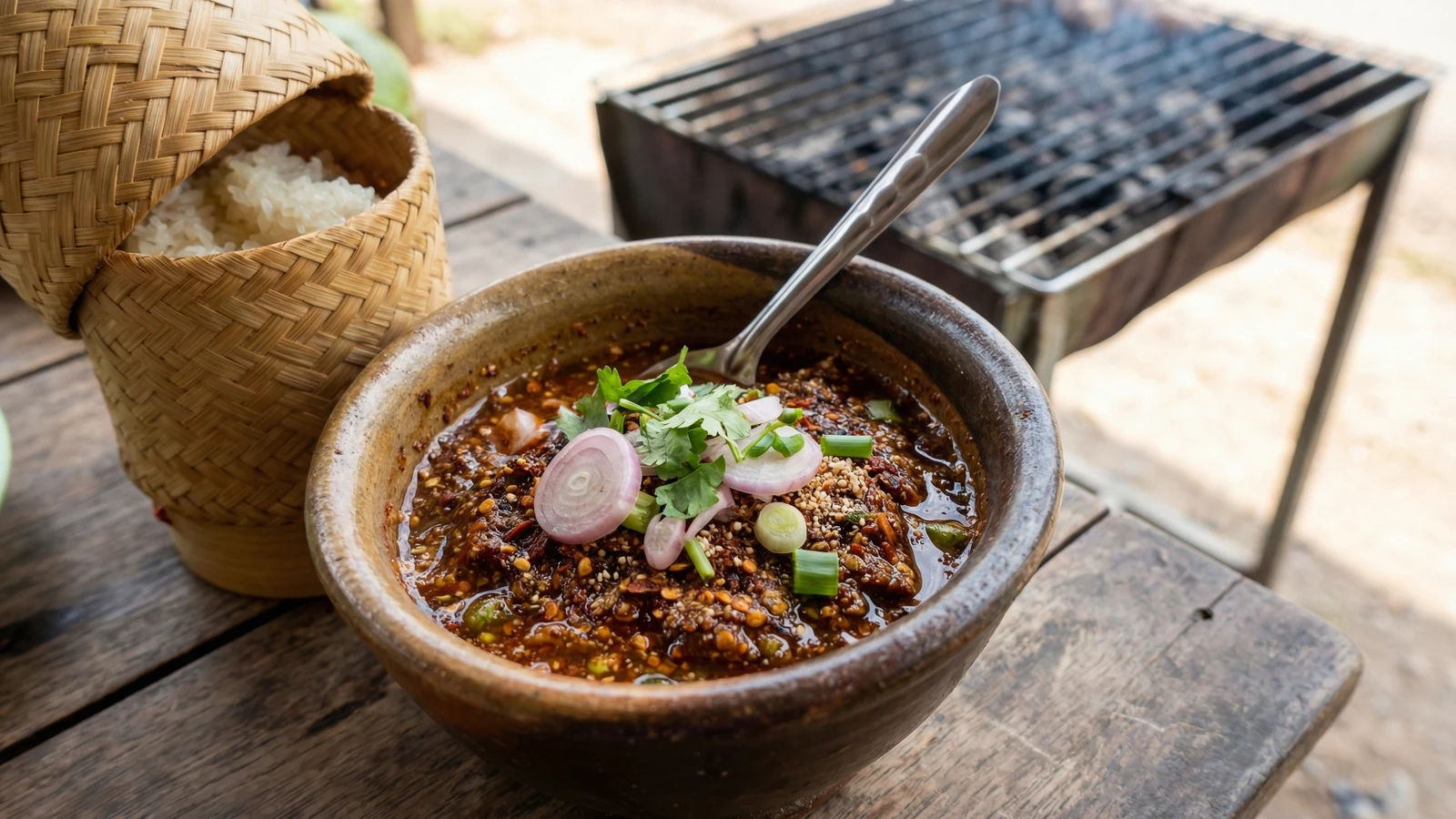
Every grilled dish in Isan answers to this dip. Roasted dried chilies, nam pla, manao, khao khua, and shallots: the four pillars in a condiment that's structural, not optional.
Jaew is not a condiment. It's the other half of every grilled dish in Isan. Without jaew, gai yang is just grilled chicken. Kor moo yang is just grilled pork. The sauce completes the equation. It's structural. You don't ask "do you want jaew with that?" in Isan. That's like asking if you want salt on the table.
Ajarn always said the four pillars govern everything: fish sauce for salt, palm sugar for sweet, tropical fruit acids for sour, chili for spice. Jaew strips this down to the bare frame. Nam pla for salt. Manao for sour. Roasted prik haeng for heat and smoke. Sweetness is almost absent, maybe a half-teaspoon of sugar to round the edges, or none at all. This is Isan. The food is leaner, sharper, more direct than Central Thai cooking. No coconut cream softening things. No palm sugar balancing everything into harmony. Jaew hits you: sour, salty, smoky, hot. That's the Isan palate.
The khao khua (toasted rice powder) is what makes this Isan and not just chili sauce. You toast raw sticky rice in a dry pan until it's golden and fragrant, then pound it to a coarse powder. That smoky, nutty crunch shows up in every Isan dish that matters: larb, nam tok, and jaew. It's a thickener, a flavor agent, and a textural signature all at once. If you skip it, you've made chili lime dressing. You haven't made jaew.
The technique is roasting, not frying. Dried chilies go into a dry wok or onto the charcoal grill until they blister, darken, and fill the room with smoke. That char is the backbone. The shallots can be grilled too, or sliced raw for sharpness. Both are correct. Both are Isan. At every roadside gai yang stall between Khorat and Udon Thani, the vendor has a bowl of jaew ready. She made it that morning. She'll make another tomorrow. It takes five minutes and it makes everything on the grill make sense.
Jaew (แจ่ว) is the universal dipping sauce of Isan (northeastern Thailand) and Laos, where it functions as the essential accompaniment to all grilled meats. The word "jaew" in the Isan-Lao dialect simply means dipping sauce, and regional variations exist across the plateau: some use pla ra (fermented fish) instead of nam pla, others char the shallots alongside the chilies. Khao khua (toasted rice powder) links jaew to the broader Isan flavor system shared by larb and nam tok, a system built on dry-roasted aromatics and fermented protein rather than the coconut-enriched pastes of Central Thai cuisine.
Quantity
10
stems removed
Quantity
2 tablespoons
Quantity
3 tablespoons (about 2-3 limes)
Quantity
1 tablespoon
Quantity
3 small
thinly sliced
Quantity
2
thinly sliced
Quantity
1 tablespoon
roughly chopped
Quantity
1/2 teaspoon
| Ingredient | Quantity |
|---|---|
| dried red chilies (prik haeng)stems removed | 10 |
| fish sauce (nam pla) | 2 tablespoons |
| lime juice (nam manao) | 3 tablespoons (about 2-3 limes) |
| toasted rice powder (khao khua) | 1 tablespoon |
| shallots (hom daeng)thinly sliced | 3 small |
| green onions (ton hom)thinly sliced | 2 |
| cilantro leaves (pak chi)roughly chopped | 1 tablespoon |
| granulated sugar (optional) | 1/2 teaspoon |
If you don't have khao khua ready, make it now. Put two tablespoons of raw sticky rice (khao niew) in a dry wok or small pan over medium heat. No oil. Shake the pan constantly. The rice will turn from white to pale gold to deep golden brown. It takes 3 to 5 minutes. You'll smell it before you see it: nutty, toasty, almost like popcorn. Pull it off the heat the moment it's evenly golden. Let it cool, then pound it in your mortar to a coarse powder. Not flour. You want grit and texture. Set aside.
Heat a dry wok or pan over medium heat. Add the dried chilies and press them flat against the surface with a spatula. Toast them, turning frequently, until they blister, darken in spots, and become brittle. About 2 to 3 minutes. The kitchen will fill with chili smoke. That's the backbone of jaew. If you're grilling, even better: throw the chilies directly onto the charcoal grate for 30 seconds per side. Charcoal smoke and dried chili belong together. Let them cool for a minute.
Put the roasted chilies into your mortar and pound them to a coarse, flaky texture. You want broken pieces and some powder, not a smooth paste. Jaew is rough. It has texture. That's the point. You should see flakes of chili skin and seeds throughout. If it looks like a paste, you've gone too far.
Transfer the pounded chilies to a bowl. Add the fish sauce, lime juice, and sugar if using. Stir. Add the khao khua and stir again. The toasted rice powder will absorb some liquid and thicken the mixture slightly. It should be loose, not thick. More relish than paste. Now fold in the sliced shallots, green onions, and cilantro. Stir once. Taste it. The balance should be: sour first, salty second, smoky heat building underneath, with that nutty khao khua crunch tying it all together. Adjust. More lime if it's flat. More nam pla if it needs depth. More pounded chili if you want fire.
Let the jaew sit for 5 minutes before serving. The shallots soften slightly, the khao khua hydrates and releases its flavor, the chilies bloom in the lime and fish sauce. Serve at room temperature alongside grilled meats, sticky rice, and raw vegetables. Jaew doesn't get refrigerated and reheated. It gets made fresh, eaten that day, and made again tomorrow. That's the Isan way.
1 serving (about 45g)
Culinary guides, cultural storytelling, and the editorial depth that makes cooking meaningful.
Discover Culinary ExplorerChef Fai
The one Thai condiment where vinegar replaces lime as the sour pillar, and the system still holds. Palm sugar for sweet, nam pla for salt, prik for heat. Ajad is the four pillars in a jar.
Chef Fai
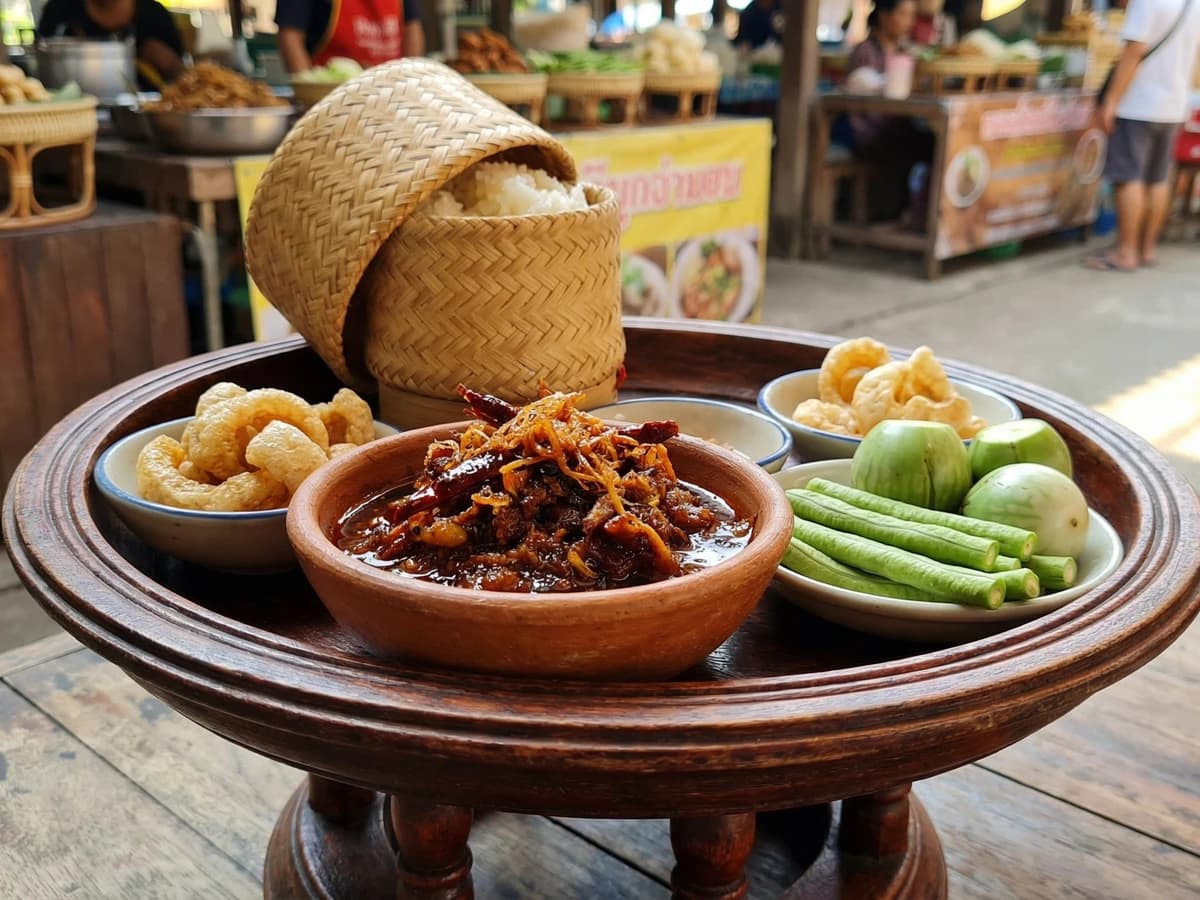
Roasted dried chilies and galangal pounded to a rough paste, folded with shredded pork skin and palm sugar until it becomes something sweet, smoky, and chewy that belongs on every khantoke tray in Chiang Mai.
Chef Fai
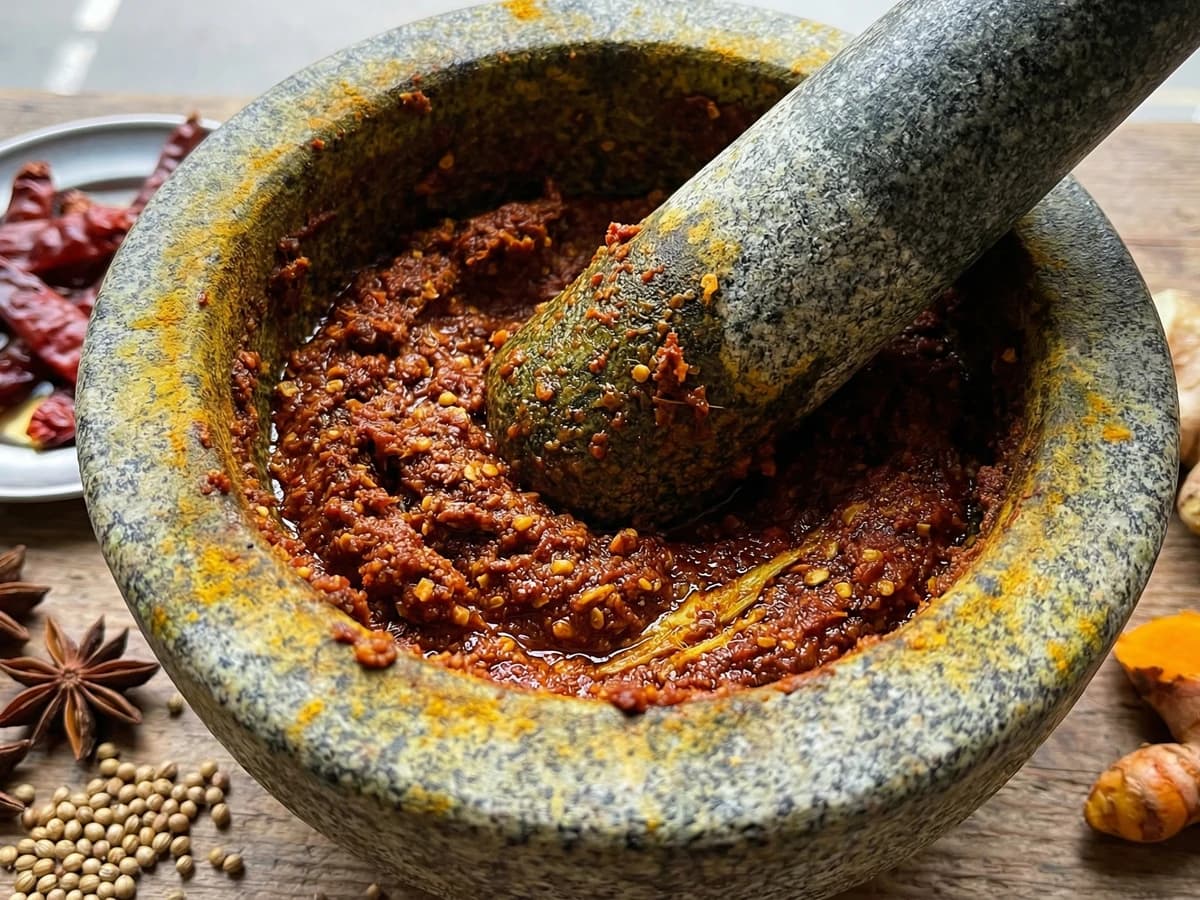
The kreung tam that proves the system adapts. Ginger instead of galangal, cumin and star anise alongside lemongrass. Lanna's mortar holds the whole Burma-to-Chiang Mai trade route in a single paste.
Chef Fai
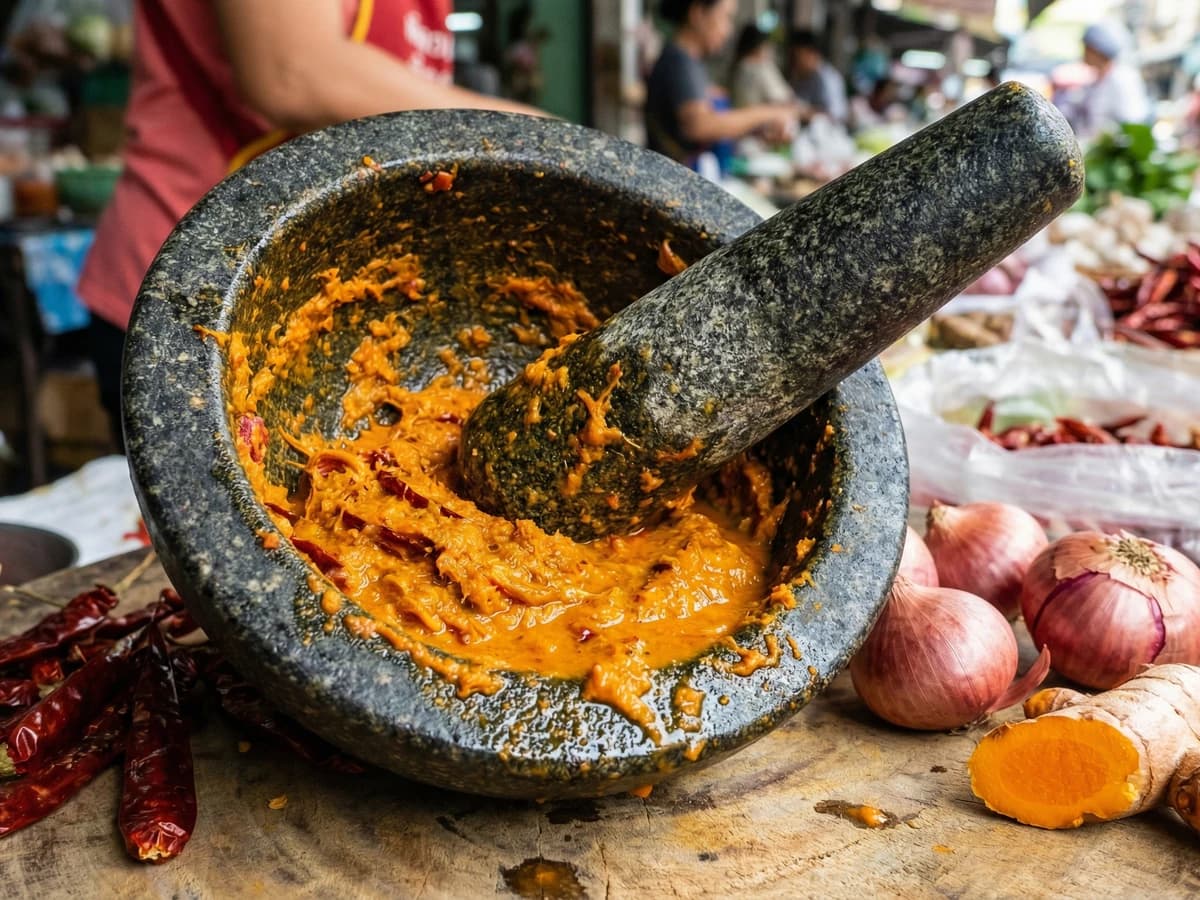
Four ingredients pounded clean in a granite mortar. This is the kreung tam stripped to its essence: dried chilies for heat, shallots for aromatics, turmeric for earth, kapi for depth. The foundation of Thailand's most underestimated curry.