
Chef Fai
Dry Egg Noodles (Ba Mee Haeng)
The four pillars live at the bottom of the bowl before the noodles ever touch it: nam pla for salt, sugar for sweet, vinegar for sour, chili for heat. Every noodle cart in Bangkok runs on this principle.
A cooking platform built around craft, culture, and the stories behind what we eat.
Created by
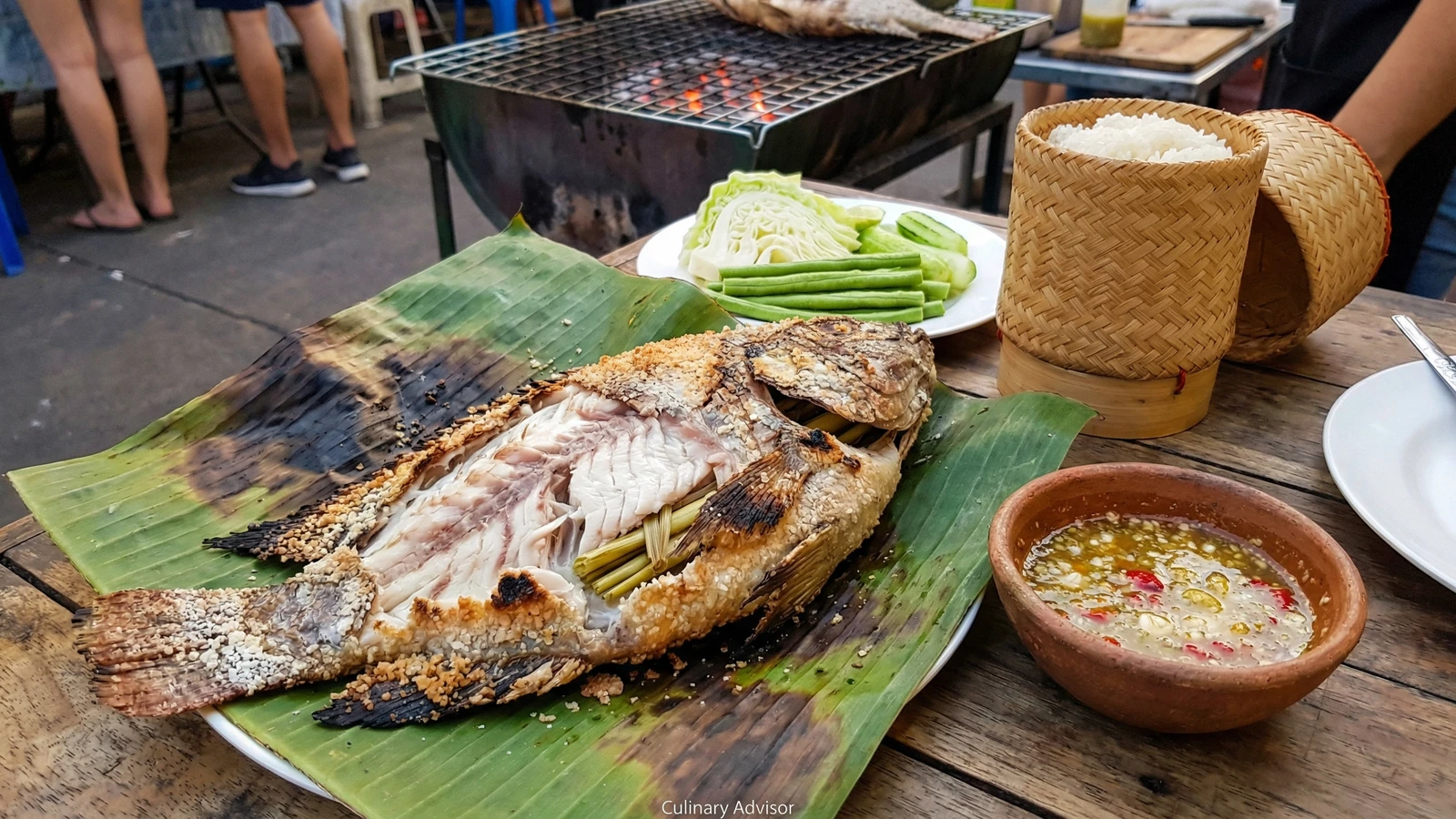
A whole fish buried in salt, grilled low and slow over charcoal until the crust cracks open to reveal flesh so moist it falls from the bone. The nam jim seafood dipping sauce carries all four pillars. The fish just needs fire and patience.
Salt does the work. That's the principle here. You take a whole fish, stuff it with lemongrass, bury it in a thick crust of coarse salt, and let charcoal do what charcoal does. The salt seals the fish completely. No moisture escapes. The flesh doesn't grill. It steams inside its own shell, slow and gentle, while the outside gets the smoke.
Ajarn always said that Thai cooking is about understanding what each element does scientifically, then letting it do its job. The salt crust on pla pao isn't seasoning. It's insulation. It creates a closed environment where the fish cooks in its own juices at a steady, even temperature. The coarse salt mixed with egg whites hardens into a shell that you crack open at the table. The flesh inside is impossibly moist, barely seasoned, clean-tasting. The fish itself is almost neutral. That's the design.
Because the fish is plain, the nam jim seafood (น้ำจิ้มซีฟู้ด) carries the entire flavor load. And this is where the four pillars show up. Garlic and cilantro root pounded in the mortar. Bird's eye chilies crushed, not chopped. Fish sauce for salt. Palm sugar for sweet. Lime juice for sour. The nam jim is a kreung tam in miniature: a pounded sauce that follows every governing rule Ajarn laid down. You pound it, you taste it, you adjust. That's the method.
I've eaten pla pao at rest stops on every highway between Bangkok and Udon Thani. The vendors sit behind rows of fish lined up on wire racks over long charcoal troughs, each fish white with salt, slowly turning golden brown over an hour. You pick your fish, they crack the crust, and you eat it with sticky rice, the nam jim, and a plate of raw vegetables. Cold beer. Open air. Smoke drifting. That's pla pao at its best, and no restaurant version has ever matched it.
Pla pao is rooted in the freshwater fishing communities along the Mekong River and its tributaries across Isan and Laos, where the technique of salt-crusting preserved fish during long days on the water. The method likely predates refrigeration as a practical solution: salt the catch, grill it slowly, eat it hours later with the flesh still moist. Tilapia (pla nin) became the standard fish for pla pao after Nile tilapia was introduced to Thailand in the 1960s by the Thai Department of Fisheries, replacing native species as the most affordable and available freshwater fish in the region.
Quantity
1, about 500-700g
gutted and cleaned, scales left on
Quantity
3 stalks
bruised and folded in half
Quantity
5
torn
Quantity
500g
Quantity
2
Quantity
5 cloves
Quantity
10, or to taste
Quantity
2
scraped and chopped
Quantity
3 tablespoons
Quantity
3 tablespoons (about 3 limes)
Quantity
1 tablespoon
Quantity
for serving
Quantity
for serving
cabbage wedges, long beans, cucumber slices, Thai eggplant
| Ingredient | Quantity |
|---|---|
| whole tilapia (pla nin)gutted and cleaned, scales left on | 1, about 500-700g |
| lemongrass (takhrai)bruised and folded in half | 3 stalks |
| kaffir lime leaves (bai makrut)torn | 5 |
| coarse sea salt | 500g |
| egg whites | 2 |
| garlic | 5 cloves |
| bird's eye chilies (prik khi nu) | 10, or to taste |
| cilantro roots (raak pak chi)scraped and chopped | 2 |
| fish sauce (nam pla) | 3 tablespoons |
| lime juice (nam manao) | 3 tablespoons (about 3 limes) |
| palm sugar (nam tan pip) | 1 tablespoon |
| sticky rice (khao niew) | for serving |
| raw vegetablescabbage wedges, long beans, cucumber slices, Thai eggplant | for serving |
Rinse the whole tilapia inside and out. Don't scale it. The scales stay on. They're part of the insulation system, another layer between the salt crust and the flesh. Stuff the cavity with the bruised lemongrass stalks and torn kaffir lime leaves. Pack them in. The lemongrass will perfume the flesh from the inside as the fish cooks, releasing its essential oils in the trapped heat.
Mix the coarse salt with the egg whites in a bowl. Work it with your hands until it holds together like wet sand. The egg whites act as a binder. Without them, the salt falls off the fish on the grill. You want the consistency of a sandcastle. Pack this mixture onto the fish in a thick, even layer, about half an inch all around. Cover every surface. No exposed skin. The crust needs to be a sealed shell with no gaps, or the moisture escapes and you've just salted a fish instead of steaming one.
Light your charcoal and let it burn down to white-gray coals. This is not a high-heat grill. You want medium, steady, indirect heat. If you hold your hand six inches above the coals and can keep it there for three to four seconds before pulling away, that's your temperature. Pla pao is slow. If the heat is too high, the salt crust cracks before the fish is cooked through and all the moisture escapes. Patience.
Place the salt-crusted fish on the grill grate. If you have a fish grilling basket, use it. Makes flipping easier. Grill over the medium coals for about 20 minutes per side, 35 to 40 minutes total for a 500-700g fish. Don't touch it. Don't poke it. Don't check it every five minutes. The salt crust will gradually harden and turn from white to golden brown with dark spots where the charcoal heat is strongest. When the crust is firm and golden all over and sounds hollow when you tap it, the fish is done.
While the fish grills, make the dipping sauce. This is where the mortar earns its place. Pound the garlic, chilies, and cilantro roots in a granite mortar (krok hin) to a rough paste. Not smooth. You want texture, visible chili seeds, chunks of garlic. Add the fish sauce, lime juice, and palm sugar. Stir with the pestle to dissolve the sugar. Taste. Sour should lead, then salty, then sweet, then heat building. Adjust. More lime if it's flat. More fish sauce if it needs backbone. More sugar if the lime is too aggressive. This sauce is the entire flavor system for the dish. Get it right.
Transfer the fish to a plate or a banana leaf. Use the back of a heavy spoon or the pestle to crack the salt crust along the spine. Peel it away in large pieces. The scales come off with the crust, leaving clean, moist flesh underneath. The lemongrass aroma should hit you the moment the crust opens. Pull the flesh from the bones with a fork or your fingers, dip into the nam jim, and eat with sticky rice and raw vegetables. That's the complete bite: clean fish, fiery sauce, sticky rice, crisp vegetable. Every component has a job.
1 serving (about 375g)
Culinary guides, cultural storytelling, and the editorial depth that makes cooking meaningful.
Discover Culinary ExplorerChef Fai
The four pillars live at the bottom of the bowl before the noodles ever touch it: nam pla for salt, sugar for sweet, vinegar for sour, chili for heat. Every noodle cart in Bangkok runs on this principle.

Chef Fai
The kreung tam fried in cracked coconut cream until the oil bleeds red. That's the technique. Concentrated, semi-dry, spooned thick over crispy fish. This is what happens when the four pillars meet restraint.

Chef Fai
Isan foraging in a bowl: wild taro stems stripped of their sting, simmered in padaek broth with a pounded chili paste and yanang leaf extract. The land feeds you if you know the rules.

Chef Fai
Lanna's kreung tam breaks from Central Thai rules: ginger over galangal, cumin and coriander from Burmese spice routes, tamarind for sour instead of lime. The North has its own system, and this curry is its crown.