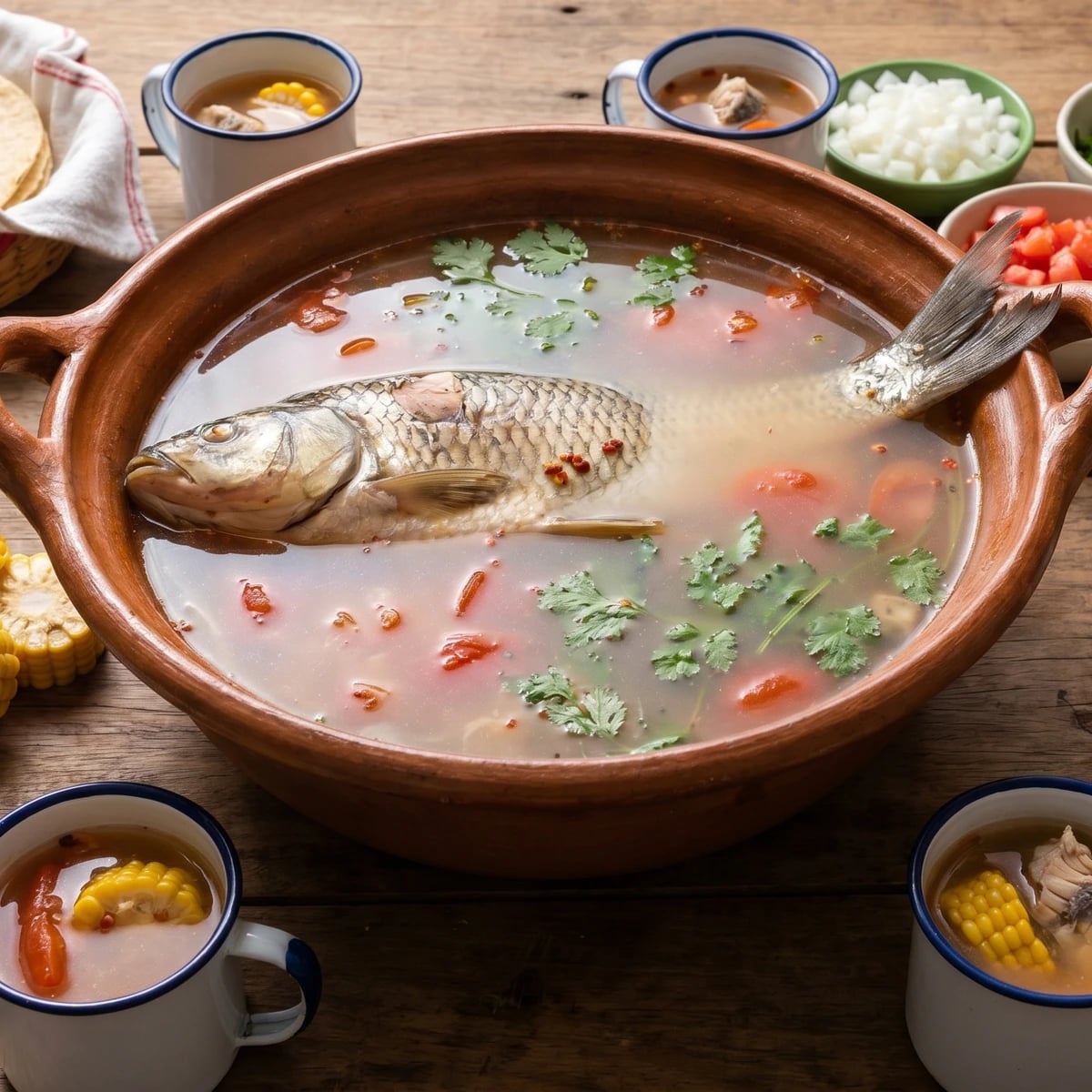
The Río Yaqui fish soup of Sonora's Yoreme nation, whole river fish simmered with tomato, onion, cilantro, and crushed chiltepín. Clean, ancestral, and built for the maíz on the table beside it.
Soups & Stews
Mexican
Comfort Food
Special Occasion
Budget Friendly
20 min
Active Time
45 min cook•1 hr 5 min total
Yield4 to 6 servings
Pitiú is from Sonora. Not the Sonora of carne asada and flour tortillas, the Sonora of the Río Yaqui, the river that runs from the Sierra Madre Occidental down through the Yoreme territories of the Yaqui and Mayo peoples before it reaches the Gulf of California. This is one of the oldest dishes still cooked in northern Mexico. It predates the Spanish, predates the cattle, predates wheat. It is fish, water, tomato, onion, cilantro, and chiltepín.
The chiltepín is non-negotiable. It is the wild chile of the sierra, tiny, round, fierce, and it is the only chile the Yoreme cooks of the eight pueblos use in this dish. You crush it in a molcajete, not a blender. You add half to the pot and leave the rest on the table for each diner to add to their own bowl. The heat is sharp and quick, gone in seconds, the way the Sonorans want it.
The fish goes in whole. Head, tail, bones. The Yaqui cooks I learned this from along the river outside Vícam laughed when I asked about filleting. The bones are the broth. The head is the broth. The whole animal is the dish. Pitiú is served alongside maíz, fresh corn rounds in the pot or hand-pressed tortillas on the side, because the Yoreme worldview holds that fish and corn are partners on the plate the way they are partners on the land. Esto no es comida de un solo Mexico. Cada estado, su propia cocina, and this one belongs to the Yoreme nation as much as it belongs to Sonora.
Pitiú is a Yoreme dish, predating Spanish contact and continuously cooked by the Yaqui (Yoeme) and Mayo (Yoreme) peoples of southern Sonora and northern Sinaloa for centuries. The Río Yaqui sustained the eight traditional Yaqui pueblos, Cócorit, Bácum, Vícam, Pótam, Tórim, Huírivis, Ráhum, and Belém, with seasonal runs of bagre and other freshwater fish, and the simmered fish-and-tomato preparation called pitiú in the Yoeme language is part of the same culinary tradition that produced wakabaki and ko'ko'ibaki. The chiltepín, classified by botanists as Capsicum annuum var. glabriusculum, is the only chile native to what is now northern Mexico and the southwestern United States, and its wild harvest in the Sonoran sierra remains a regulated economic activity for indigenous communities who consider it a sacred and ancestral ingredient.
The technique, the tradition, and the story behind every dish.
fresh corn on the cob (optional)cut into thick rounds
as desired
Equipment Needed
•Wide heavy pot or olla de barro, at least 6-quart capacity
•Volcanic stone molcajete with tejolote
•Slotted spoon or kitchen spider for lifting the fish
•Sharp scaling knife if cleaning the fish yourself
Instructions
1
Clean the fish properly
Rinse the whole fish under cold running water inside and out. Run your fingertips along the belly cavity to make sure no blood line remains. Pat dry with a clean cloth. The heads and tails stay on. The bones, the head, and the skin are what give pitiú its body. A filleted fish makes a thin broth and a thinner dish.
If your fishmonger offers to fillet, refuse. Ask only for scaling and gutting. The Yaqui cooks along the river have always cooked the whole animal because the whole animal is the flavor.
2
Build the cooking liquid
Pour the cold water into a wide, heavy pot or olla de barro. Add the whole half onion, the smashed garlic, the two whole tomatoes, the bunch of cilantro tied with twine, the bay leaves, the dried oregano, and the salt. Bring to a low simmer over medium heat. Do not let it boil hard. A boiled broth turns cloudy and the fish suffers for it.
3
Crush the chiltepín
Place the dried chiltepines in a molcajete with a pinch of salt. Crush them lightly with the tejolote until they break into rough pieces, not powder. The chiltepín is the soul of Sonoran cooking and the only chile the Yoreme have used in this dish since long before the conquest. It grows wild on the slopes of the Sierra Madre Occidental and you do not substitute it. If you cannot find it, drive to a Mexican market that supplies the Sonoran community. They will have it in glass jars, sold by the gram because it is that valuable.
4
Simmer the aromatics
Once the pot is at a steady gentle simmer, let the aromatics cook for 20 minutes. The water will turn faintly red from the tomato and the cilantro will perfume the kitchen. Taste the broth now. It should taste clean and savory, lightly herbal, salted enough to be assertive without being aggressive. If the corn rounds are going in, add them now and let them cook 10 minutes before the fish.
5
Lower in the whole fish
Lower the whole fish into the simmering broth one at a time. The liquid should cover them. Add half of the crushed chiltepín to the pot now. Bring back to a bare simmer, cover partially, and cook for 12 to 15 minutes depending on the size of the fish. The flesh is done when it pulls cleanly from the spine and the eyes have turned opaque white. Do not stir or poke. The fish will fall apart if you handle it.
Pitiú is not a stew you reduce. The broth stays light. The fish stays whole. If you cook it past 15 minutes, the flesh tightens and the broth turns muddy. Pull it off the heat the moment the spine releases.
6
Finish and rest
Remove the pot from the heat. Lift out the spent half onion, the cilantro bundle, and the whole tomatoes with a slotted spoon. Discard. Let the pot rest, covered, for five minutes. The fish settles, the broth clarifies, and the chiltepín finishes blooming into the liquid. Taste and adjust salt one last time.
7
Serve at the table
Ladle the broth into wide bowls. Place a piece of fish in each bowl, head, tail, bones and all. The bones are part of the dish and the cook eating it knows how to navigate them. Set the diced raw onion, diced fresh tomato, chopped cilantro, lime halves, extra crushed chiltepín, and warm tortillas in small dishes around the table. Each person finishes their own bowl. That ritual is the dish. Asi se hace y punto.
Chef Tips
•Find chiltepín at a Mexican market that serves the Sonoran or Sinaloan communities. It is usually sold in small glass jars by weight because it is gathered wild and never cheap. If a recipe calls for chiltepín, no other chile gives you the same flavor. Substituting pequín or arbol is a compromise, not an upgrade, and the Yoreme cooks would tell you the same.
•The fish has to be fresh. River fish like bagre or catfish are traditional, but a whole mojarra, tilapia, or even a small striped bass will work if that is what your fishmonger has. What does not work is frozen fillets. The bones and the skin are the broth and you cannot fake that.
•Pitiú is not a chowder. It is not a stew. It is a clean broth that lets the fish, the tomato, and the chiltepín speak. Do not add cream, do not add butter, do not thicken it. La cocina no es decoracion, es trabajo, and the work here is restraint.
•Serve with hand-pressed corn tortillas, not flour. Sonora is flour tortilla country for many dishes, but pitiú is a Yoreme dish and the Yoreme are corn people. Maíz nixtamalizado is the partner here.
Advance Preparation
•Pitiú does not hold. The fish overcooks within 30 minutes of being pulled from the heat and the broth loses its clarity by the next day. Cook it the same hour you serve it.
•The broth base, water with onion, tomato, cilantro, garlic, and bay, can be built one hour ahead and held warm. Add the chiltepín and the fish only at serving time.
Frequently Asked Questions
Nutrition Information
1 serving (about 380g)
Calories
285 calories
Total Fat
7 g
Saturated Fat
2 g
Trans Fat
0 g
Unsaturated Fat
4 g
Cholesterol
85 mg
Sodium
890 mg
Total Carbohydrates
27 g
Dietary Fiber
3 g
Sugars
3 g
Protein
27 g
Where cooking meets culture.
Culinary guides, cultural storytelling, and the editorial depth that makes cooking meaningful.