Chef Lupita
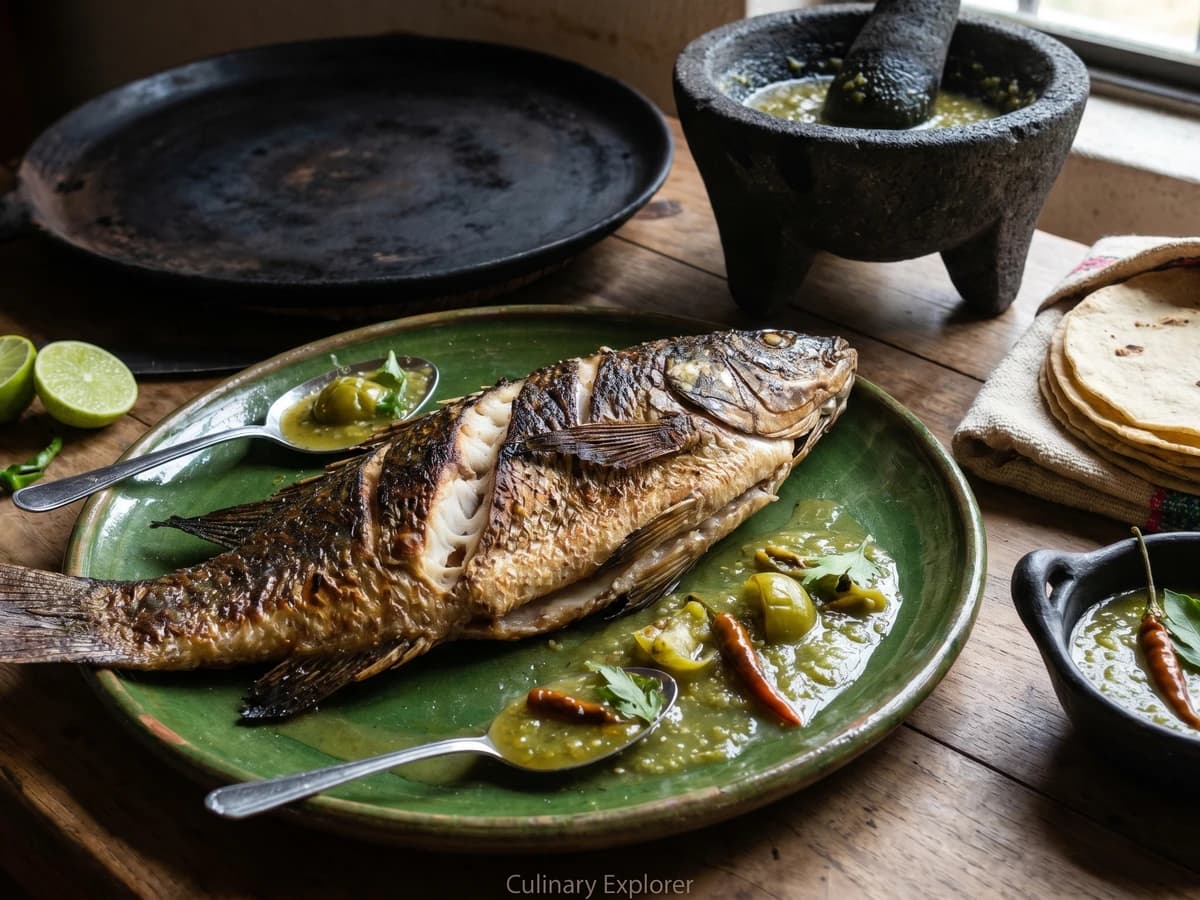
Acúmara Tatemada al Comal
Michoacán's Lake Pátzcuaro acúmara, a whole kurucha from the lago tatemada on a comal de leña and served with chile perón atápakua, corn tortillas, and P'urhépecha discipline.
A cooking platform built around craft, culture, and the stories behind what we eat.

Created by
Yucatán's Christmas pork leg, slit and stuffed with picadillo of pork, beef, olives, raisins, and almonds, then braised slowly in sour orange and recado until the bone slides free.
This is from Yucatán. Not from Mexico generally, from Yucatán specifically, the peninsula that has spent four hundred years building a cuisine separate from the rest of the country. The Maya kitchen married the Spanish kitchen, and then the Lebanese arrived in the 19th century with their own grinding stones and their own ideas about meat and spice, and the result is on this platter. You will not find pierna mechada like this in Sonora or Veracruz or Michoacán. Cada estado, su propia cocina, and this one belongs to Mérida.
The word mechada comes from mechar, to lard or to thread, the technique of cutting deep slits into a piece of meat and packing them with seasoning and stuffing. In Yucatán, the slits get picadillo, a sweet-savory mixture of ground meats with olives, raisins, capers, almonds, and warm spices that reads as much Andalusi as it does Mexican. The braise is built on naranja agria and two recados: recado rojo for the achiote color and earthy depth, recado de bistek for the black pepper sharpness that cuts the sweetness of the picadillo. Both recados. Not one. The balance is the recipe.
This is a Nochebuena dish. Christmas Eve in Mérida, the families who set out the white platters with the carved leg in the middle, the cebollas encurtidas in the glass jar, the warm tortillas wrapped in a servilleta, the salsa xnipec in a small clay bowl. I learned this recipe from a señora named Doña Esperanza in the Mercado Lucas de Galvez in 2009. She walked me through every cut of the knife and made me repeat the spices back to her three times. She told me her grandmother taught her, and her grandmother's grandmother taught her grandmother, and that the only thing that had changed in a hundred years was the oven. Saber cocinar es saber vivir.
Pierna mechada belongs to a family of Spanish colonial stuffed-meat dishes that arrived in the New World in the 16th and 17th centuries, descendants of medieval Iberian gala roasts that themselves carried Andalusi influence through their use of dried fruit, nuts, and warm sweet spices in savory meat preparations. In Yucatán, the dish absorbed two distinct local layers: the Maya tradition of seasoning meat with recados, ground spice pastes formed into bricks that could be stored and traded, and the late-19th-century Lebanese diaspora that settled in Mérida and brought further reinforcement of the almond-raisin-olive picadillo logic. Naranja agria, the bitter Seville-style orange brought from Spain, became the peninsula's defining acid by the 18th century, and its use in the marinade is what makes a Yucatecan pierna mechada immediately recognizable to anyone who grew up eating it at Nochebuena.
Quantity
1 (about 6 to 7 pounds)
Quantity
1 cup
or 2/3 cup fresh orange juice mixed with 1/3 cup fresh lime juice
Quantity
10
peeled
Quantity
2 tablespoons
Quantity
2 tablespoons
Quantity
2 teaspoons
oregano yucateco if you have it
Quantity
1 teaspoon
Quantity
1 teaspoon
Quantity
1 tablespoon, plus more for the picadillo
Quantity
1/4 cup
divided
Quantity
1 pound
Quantity
1/2 pound
Quantity
1 medium
finely diced
Quantity
4
minced
Quantity
3 medium
finely diced
Quantity
1 small
finely diced
Quantity
1/2 cup
Quantity
1/2 cup
roughly chopped
Quantity
2 tablespoons
drained
Quantity
1/4 teaspoon
Quantity
1/4 teaspoon
Quantity
1/4 cup
roughly chopped
Quantity
2
peeled and chopped
Quantity
to taste
Quantity
1 large
sliced into thick rings
Quantity
2
Quantity
1 cup
Quantity
1 whole, unpierced
for the braise
Quantity
for serving
Quantity
for serving
Quantity
for serving
Quantity
for serving
| Ingredient | Quantity |
|---|---|
| bone-in pork leg, skin on | 1 (about 6 to 7 pounds) |
| fresh sour orange juice (naranja agria)or 2/3 cup fresh orange juice mixed with 1/3 cup fresh lime juice | 1 cup |
| garlic cloves (for the marinade)peeled | 10 |
| recado de bistek (black pepper recado) | 2 tablespoons |
| recado rojo (achiote paste) | 2 tablespoons |
| dried Mexican oreganooregano yucateco if you have it | 2 teaspoons |
| ground allspice (pimienta gorda) | 1 teaspoon |
| ground cumin | 1 teaspoon |
| kosher salt | 1 tablespoon, plus more for the picadillo |
| manteca de cerdo (pork lard)divided | 1/4 cup |
| ground pork | 1 pound |
| ground beef | 1/2 pound |
| white onion (for the picadillo)finely diced | 1 medium |
| garlic cloves (for the picadillo)minced | 4 |
| Roma tomatoesfinely diced | 3 medium |
| green bell pepperfinely diced | 1 small |
| raisins | 1/2 cup |
| pitted manzanilla olivesroughly chopped | 1/2 cup |
| capersdrained | 2 tablespoons |
| ground cloves | 1/4 teaspoon |
| ground cinnamon (canela) | 1/4 teaspoon |
| blanched almondsroughly chopped | 1/4 cup |
| hard-boiled eggspeeled and chopped | 2 |
| freshly ground black pepper | to taste |
| white onion (for the braise)sliced into thick rings | 1 large |
| bay leaves | 2 |
| chicken stock | 1 cup |
| chile habanerofor the braise | 1 whole, unpierced |
| pickled red onions (cebollas encurtidas) (optional) | for serving |
| salsa xnipec (optional) | for serving |
| warm corn tortillas or hand-pressed flour tortillas (optional) | for serving |
| white rice (optional) | for serving |
In a blender, combine the sour orange juice, the 10 peeled garlic cloves, the recado de bistek, the recado rojo, the oregano, allspice, cumin, and salt. Blend until completely smooth. The marinade should be the color of dried brick, with the black pepper from the recado de bistek flecked through it. This combination of recados, achiote for color and warm depth, black pepper for sharp aromatic heat, is what makes the Yucatecan pierna mechada different from any other stuffed pork roast in Mexico. Recado de bistek is not optional. If you cannot find it ready-made at a Yucatecan market, you can grind your own from black pepper, garlic, oregano, allspice, and cumin, but do not skip it.
Lay the pork leg on a clean cutting board. With a sharp boning knife, cut deep slits all over the leg, about 2 inches deep and spaced 2 inches apart. This is the mechar in pierna mechada, the cuts that will hold the picadillo. Go around the leg, top and bottom, working into the thickest parts of the meat. Do not cut all the way through to the bone, but get close. The slits should be wide enough to accept stuffing without tearing the meat. Rub a third of the marinade deep into every slit, working it in with your fingers. Pour the remaining marinade over the entire leg and massage it into the skin. Place the leg in a deep dish or a large heavy bag, cover, and refrigerate for at least 12 hours. Twenty-four hours is better. The marinade has to reach the bone.
Heat 2 tablespoons of the lard in a wide skillet over medium-high heat. Add the diced white onion and cook until translucent, about 4 minutes. Add the minced garlic and the bell pepper and cook for 2 more minutes. Add the ground pork and ground beef. Break the meat apart with a wooden spoon and cook until no longer pink, about 8 minutes. Add the tomatoes, raisins, olives, capers, cloves, cinnamon, and a generous pinch of salt and black pepper. Cook until the tomatoes break down and the mixture is thick, almost dry, about 10 minutes more. Stir in the chopped almonds and the chopped hard-boiled eggs at the end. Taste for salt. This picadillo is sweet, salty, briny, and warmly spiced all at once. That balance is the Yucatecan signature, the kitchen of the peninsula filtered through Lebanese, Spanish, and Caribbean hands. Let the picadillo cool completely before stuffing. Warm picadillo will leak out of the slits during roasting.
Take the marinated leg out of the refrigerator. Working slit by slit, push cold picadillo deep into each opening with your fingers or the back of a spoon. Pack it firmly. Do not be polite about this. The leg should look distended, almost bursting along its lines. Reserve any leftover picadillo. It goes into the braise. If a slit cannot hold any more, move to the next one. La cocina no es decoración, es trabajo.
Heat the remaining 2 tablespoons of lard in a large heavy roasting pan or a deep cazuela set over two burners on medium-high heat. When the lard shimmers, lower the stuffed leg in. Sear on all sides until the skin is deeply colored, about 3 minutes per side. The achiote will deepen to a brick-red mahogany and the smell will turn from raw to roasted. This is the foundation of the braising flavor. Do not skip the sear and do not rush it.
Lower the heat to medium. Scatter the thick onion rings and bay leaves around the leg. Spoon any reserved picadillo around the base of the meat. Pour in the chicken stock and any marinade left in the dish. Tuck the whole habanero into the liquid, unpierced. The habanero is there for fragrance, not heat. Pierce it and you have a different dish. Bring the liquid to a gentle simmer.
Cover the roasting pan tightly with a lid or two layers of heavy foil sealed at the edges. Transfer to a 325F oven. Braise for 3 hours, basting the leg with the pan liquid every 45 minutes. The meat is ready when a knife slides into the thickest part with no resistance and the bone wiggles freely. If the leg is bigger, give it more time. You cannot overcook this. You can only undercook it.
Uncover the pan and raise the oven to 425F. Roast for 20 to 30 more minutes, until the skin is dark, glossy, and crackling at the edges. Baste once more in the last 10 minutes with the achiote-stained pan juices. The surface should look lacquered, with the recado rojo clinging to every ridge. Remove the habanero before it bursts. Let the leg rest, loosely tented, for at least 20 minutes before carving. This is non-negotiable. Cut into it too soon and the juices run out onto the board instead of staying in the meat.
Lift the leg onto a large white porcelain platter, the kind the señoras in Mérida set out for Christmas Eve. Carve thick slices across the grain, making sure each slice carries a band of the picadillo stuffing. Spoon the braising liquid over the meat, including the softened onions. Serve with pickled red onions, salsa xnipec, warm tortillas, and white rice on the side. Recetas probadas y garantizadas. Así se hace la cena de Nochebuena en Yucatán.
1 serving (about 280g)
Culinary guides, cultural storytelling, and the editorial depth that makes cooking meaningful.
Discover Culinary ExplorerChef Lupita
Michoacán's Lake Pátzcuaro acúmara, a whole kurucha from the lago tatemada on a comal de leña and served with chile perón atápakua, corn tortillas, and P'urhépecha discipline.

Chef Lupita
Puebla's weekday adobo of pork shoulder braised in a thick guajillo and ancho sauce sharpened with vinegar, cumin, and clove. The deep red of a market spice stall, the dish a poblana cooks without thinking.

Chef Lupita
Loreto's pit-roasted clams, planted hinge-up in beach sand and tatemadas under a fast fire of dried romerillo brush, the resinous Baja desert shrub that gives this dish its smoke.

Chef Lupita
Oaxaca's eighth mole, the silky, almond-and-cinnamon almendrado, served over poached chicken. Mild, sweet, restrained, and a quiet rebuttal to anyone who thinks Mexican food has to be hot to be Mexican.