
Chef Klaus
Allgäuer Krautkrapfen
The Allgäu pan dish that makes a meal from noodle dough, winter kraut, onion, and fat: brown the cut sides first, then cook gently so the rolls hold.
A cooking platform built around craft, culture, and the stories behind what we eat.
Created by
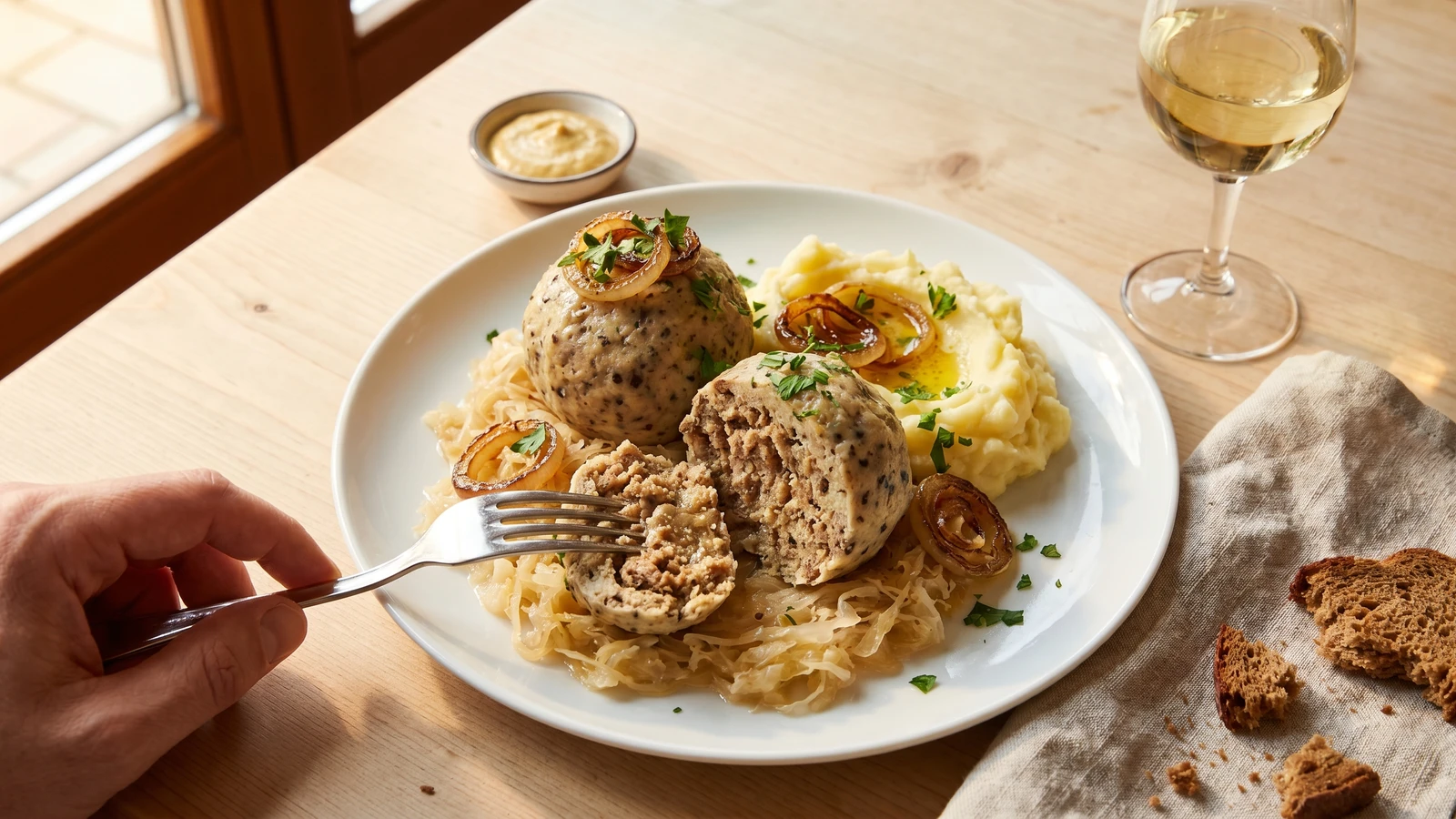
The Palatinate liver dumpling is cheap pork, stale bread, onion, and marjoram made respectable by texture: poached gently, never boiled hard, then set on kraut and mash.
Pfälzer Leberknödel, in the dialect Lewwerknepp, belong to the Palatinate table: pork country, wine country, sauerkraut country. You see them on a weekday plate with mash, and you see them on the Pfälzer Teller beside Saumagen and Bratwurst when the table is louder. This is not a beer-tent trick. It is Hausmannskost, honest home cooking, built from liver, stale rolls, onion, and fat.
The regions split right away. In the Pfalz the dumpling is usually pork liver, bread, marjoram, and onion, served with sauerkraut and potatoes. In Bavaria you meet Leberknödel smaller, often floating in clear broth. In Saarland the plate sits close to the Palatinate one, with kraut doing the sour work. Im Norden anders, im Süden anders, and here we stay in the southwest.
The technique is the dough and the water. Grind the liver fine, but don't beat the mixture into paste; let the stale bread drink up the liver and egg, then cook one test dumpling in water that trembles, not boils. A hard boil knocks the dumpling apart before the bread starch can set, and overworked liver tightens into rubber. Erst verstehen, dann kochen.
Serve them with sauerkraut sharp enough to cut the liver, mashed potatoes soft enough to catch the onions, and a spoon of brown butter or pan juices. Weggeworfen wird nichts: stale bread becomes the binder, trim becomes the fat, and the cooking liquor can enrich the kraut. Schön ist, was schmeckt.
Leberknödel are recorded across southern German and Austrian kitchens as a way to use liver, stale bread, and pork trim after slaughter days, when wasting edible offal made no sense. The Palatinate version, Lewwerknepp, became one third of the Pfälzer Teller with Saumagen and Bratwurst, a regional inn plate tied to the pork butchery and wine culture of Rhineland-Palatinate. Bavarian cooks often serve smaller liver dumplings in broth, while the Palatinate plate leans heavier on sauerkraut and mashed potatoes, a clear regional split in one dumpling family.
Quantity
400g
trimmed and very cold
Quantity
150g
very cold and diced
Quantity
3 rolls, about 180g
torn into small pieces
Quantity
180ml
warmed
Quantity
1 large
finely diced
Quantity
2 tablespoons
Quantity
2
Quantity
2 tablespoons
chopped
Quantity
1 teaspoon
Quantity
1 teaspoon, plus more for the water
Quantity
1/2 teaspoon
freshly ground
Quantity
1/4 teaspoon
freshly grated
Quantity
3 to 5 tablespoons
as needed
Quantity
600g
drained lightly
Quantity
800g
peeled and cut up
Quantity
80ml
Quantity
40g
Quantity
2
sliced
Quantity
2 tablespoons
| Ingredient | Quantity |
|---|---|
| fresh pork livertrimmed and very cold | 400g |
| fatty pork belly or pork shouldervery cold and diced | 150g |
| stale white rollstorn into small pieces | 3 rolls, about 180g |
| whole milkwarmed | 180ml |
| onionfinely diced | 1 large |
| lard or butter | 2 tablespoons |
| eggs | 2 |
| flat-leaf parsleychopped | 2 tablespoons |
| dried marjoram | 1 teaspoon |
| fine salt | 1 teaspoon, plus more for the water |
| black pepperfreshly ground | 1/2 teaspoon |
| nutmegfreshly grated | 1/4 teaspoon |
| fine dry breadcrumbsas needed | 3 to 5 tablespoons |
| sauerkrautdrained lightly | 600g |
| floury potatoespeeled and cut up | 800g |
| hot milk for the mash | 80ml |
| butter for the mash | 40g |
| onions for servingsliced | 2 |
| lard or butter for frying the onions | 2 tablespoons |
Pour the warm milk over the torn stale rolls and press them down until every dry edge is wet. Stale bread is the binder here; fresh bread turns pasty and heavy, while old bread drinks the milk and later holds the liver juices inside the dumpling. Leave it 10 minutes, then squeeze out only the loose milk, not every drop.
Cook the diced onion in 2 tablespoons lard or butter over medium heat until soft and pale gold, about 8 minutes. Don't brown it hard. Sweet onion belongs inside the dumpling, but burned onion brings bitterness that liver does not forgive. Let it cool before mixing so it doesn't warm the meat.
Chop or grind the cold liver and pork belly fine, using the small plate of a mincer or short pulses in a food processor. Keep it cold because warm liver smears before it binds, and smeared liver cooks dense. Stop when it is fine but still loose, not whipped into a paste.
Mix the liver and pork with the soaked bread, cooled onion, eggs, parsley, marjoram, salt, pepper, and nutmeg. Use your hand or a spoon and stop as soon as it holds together, because overworking tightens the protein and gives you a rubber ball. Add breadcrumbs one spoon at a time until the mixture is soft but shapeable, then rest it 15 minutes so the bread and crumbs can swell before you judge it.
Bring a wide pot of well-salted water to a bare tremble, then shape one small test dumpling with wet hands and lower it in. The water should move around it, not throw it about. If it holds for 10 minutes and feels springy, the mixture is right; if it frays, add another spoon of breadcrumbs to the bowl and rest it 5 minutes more. This little test saves the whole pot.
Shape 8 large dumplings with wet hands and lower them into the trembling water. Poach them 18 to 22 minutes, turning once, until they float and feel set when lifted with a slotted spoon. Runter mit der Temperatur: boiling hard breaks the outside before the bread starch sets, and the liver turns tight before the centre is done.
While the dumplings poach, warm the sauerkraut gently with a ladle of dumpling cooking water. The liquor carries salt and liver flavour, so it belongs in the kraut, not down the sink. Boil the floury potatoes until they fall easily from a knife, drain them well, then mash with the hot milk and butter; floury potatoes make a dry, fluffy mash that can catch the onions and juices.
Fry the sliced onions in lard or butter until brown at the edges and soft in the middle. Put sauerkraut on each plate, set two Leberknödel on top, add mashed potatoes alongside, and spoon the onions and their fat over the dumplings. Würzen, Fett, Salz zum Schluss: taste the kraut and mash at the end, because the dumplings bring their own salt.
1 serving (about 670g)
Culinary guides, cultural storytelling, and the editorial depth that makes cooking meaningful.
Discover Culinary ExplorerChef Klaus
The Allgäu pan dish that makes a meal from noodle dough, winter kraut, onion, and fat: brown the cut sides first, then cook gently so the rolls hold.

Chef Klaus
Swabian egg pasta turned toward the apple cellar: fresh Spätzle tossed with browned butter, tart apples, cinnamon, and enough restraint to stay supper, not cake.

Chef Klaus
Hesse's pork goulash belongs to Apfelwein country: shoulder, onions, and tart cider cooked low until the cheap cut turns soft and the sauce lands sweet-sour, not sour-sweet.

Chef Klaus
The old sweet supper that saves yesterday's loaf: stale bread drinks eggy milk, the pan stays moderate, and butter browns the outside only after the centre has set.