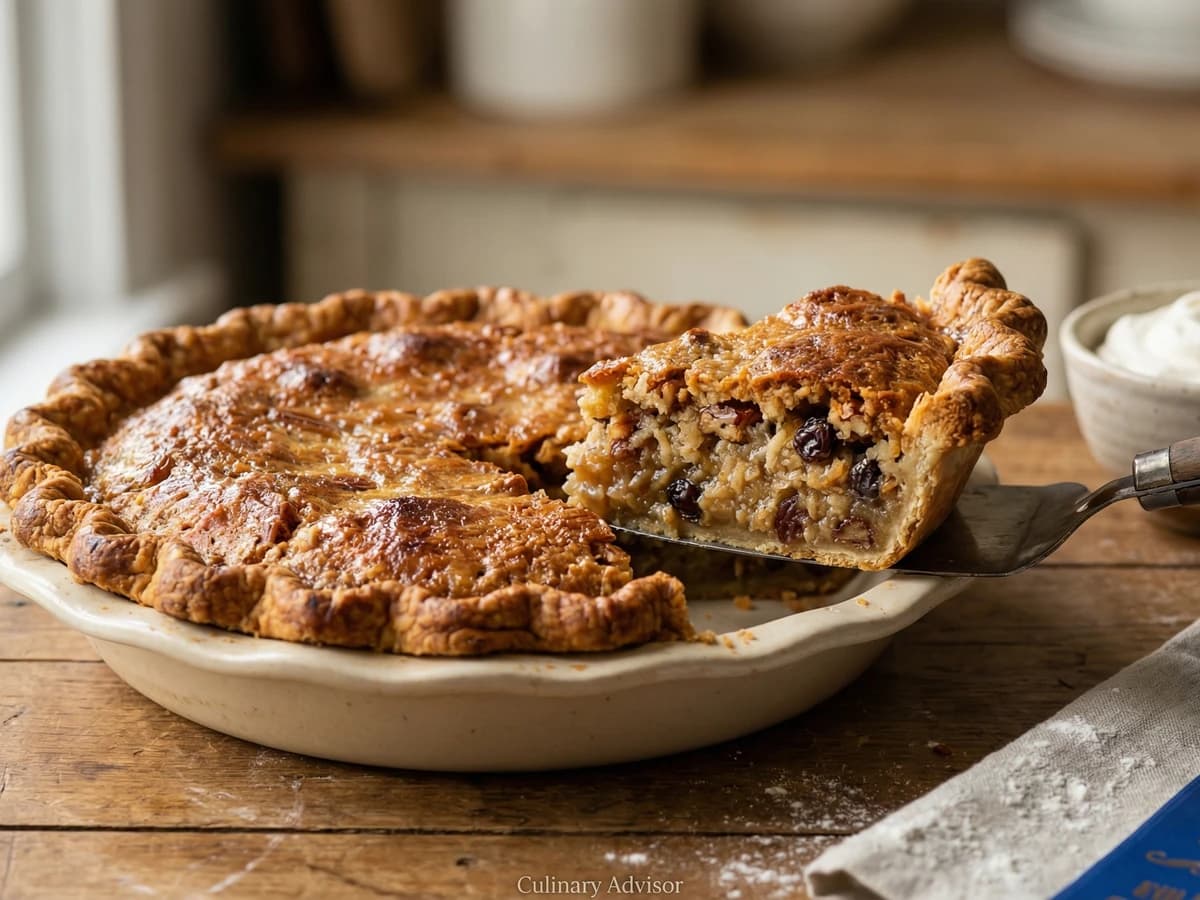
Dark and sticky molasses bubbles beneath a buttery crumb streusel in this humble masterpiece from the farmhouse kitchens of Lancaster County, where the sweetness draws flies and the aroma draws family.
Pastries & Cookies
American
Comfort Food, Make Ahead, Holiday
25 min
Active Time
45 min cook•1 hr 10 min total
Yield8 servings
This pie was born of necessity and became beloved by choice. Pennsylvania German settlers, the people we incorrectly call the Dutch, arrived in William Penn's colony with practical kitchens and pantries built for survival. When fresh fruit ran out by late winter and the root cellar held only potatoes and turnips, they turned to what kept: molasses, flour, brown sugar, and lard. From these staples emerged a pie sweet enough to serve as breakfast, sturdy enough to pack for field work, and so aromatic that flies had to be shooed away from cooling pies on windowsills. Hence the name.
There are two schools of shoofly. The wet-bottom version keeps a gooey, almost pudding-like layer of molasses beneath the crumbs. The dry-bottom bakes more thoroughly, approaching coffee cake in texture. I've given you the wet-bottom here because that's the version that makes pilgrims of people. They drive to Lancaster County seeking it. They stop at roadside stands and Amish bakeries hoping for exactly this: a pie that sticks to your fork and demands black coffee alongside.
The technique requires attention to one critical moment. When you pour the molasses mixture into the unbaked crust and sprinkle the crumbs on top, everything wants to sink. Work quickly and trust the oven. The chemical reaction between baking soda and acidic molasses creates lift, pushing the crumbs up while the filling sets below. It is kitchen alchemy at its most satisfying.
The technique, the tradition, and the story behind every dish.
Position a rack in the lower third of your oven and preheat to 375°F. Place your unbaked pie crust in a 9-inch pie plate and crimp the edges as you prefer. Set it on a rimmed baking sheet to catch any bubbling overflow. The baking sheet also helps the bottom crust brown evenly.
2
Build the crumb topping
Combine flour, brown sugar, salt, cinnamon, and nutmeg in a medium bowl. Whisk briefly to distribute the spices. Add the cold butter cubes and work them into the dry ingredients using your fingertips, pinching and rubbing until you have a mixture resembling coarse sand with some pea-sized pieces remaining. These larger bits become the most satisfying crumbs. Set aside.
Cold butter is essential. If your kitchen runs warm, freeze the cubes for ten minutes before rubbing them in. Warm butter creates paste, not crumbs.
3
Create the molasses filling
Pour the molasses into a large mixing bowl. Measure the boiling water and stir in the baking soda. The mixture will foam dramatically, nearly tripling in volume. Immediately pour this foaming liquid over the molasses and whisk together. The filling will be dark, thin, and slightly frothy. Let it cool for two minutes.
4
Temper and add the egg
Add a pinch of salt to your beaten egg. Slowly drizzle about a quarter cup of the warm molasses mixture into the egg while whisking constantly. This tempers the egg, preventing it from scrambling. Pour the tempered egg back into the bowl with the remaining molasses and whisk until fully incorporated. The filling should be smooth and pourable.
If you skip tempering and dump cold egg into hot molasses, you'll have sweet scrambled eggs. Not the goal.
5
Assemble the pie
Pour the molasses filling directly into the unbaked pie crust. It will look thin and alarmingly liquid. Take handfuls of the crumb topping and scatter it evenly across the surface, covering the filling completely. The crumbs will float momentarily, then begin to sink in spots. This is expected and correct.
6
Bake until set
Transfer the pie on its baking sheet to the lower rack. Bake for 15 minutes, then reduce the temperature to 350°F. Continue baking for another 25 to 30 minutes. The pie is done when the center no longer jiggles like liquid and the crumb top has turned deep golden brown. A knife inserted in the center should come out with sticky residue but no raw batter.
The filling will puff slightly during baking, then settle as it cools. Some cracking on the surface is traditional, not a flaw.
7
Cool completely before slicing
Remove the pie to a wire rack and let it cool for at least two hours at room temperature. The filling needs this time to set. Cut into it too soon and you'll have molasses pooling on your plate. Once cooled, the bottom layer should be gooey and sticky while the top remains crumbly and dry. That contrast is the entire point.
Chef Tips
•Seek out unsulphured molasses, sometimes labeled 'mild' or 'original.' Blackstrap molasses, the final extraction of the sugar-making process, is too bitter and mineral-tasting for this pie. Grandma's, Brer Rabbit, or any light to medium molasses works well.
•Serve shoofly pie at room temperature with strong black coffee. The Pennsylvania Dutch tradition treats it as morning food, and they're right. The sweetness awakens you; the coffee cuts through.
•For a more authentic crust, substitute half the butter with cold lard. Lancaster County bakers still use lard because it produces the flakiest texture. Leaf lard from a butcher is the gold standard.
•This pie actually improves on the second day. The crumb topping softens slightly at the edges while maintaining its center texture, and the molasses flavor deepens overnight.
Advance Preparation
•The crumb topping can be made up to three days ahead and refrigerated in an airtight container. Let it come to cool room temperature before using.
•The fully baked and cooled pie keeps well at room temperature, loosely covered, for up to four days. The texture holds better unrefrigerated.
•Freeze the unbaked, assembled pie (filling and crumbs in the crust) for up to two months. Bake directly from frozen, adding 15 to 20 minutes to the total baking time.
Frequently Asked Questions
Nutrition Information
1 serving (about 124g)
Calories
475 calories
Total Fat
19 g
Saturated Fat
11 g
Trans Fat
0 g
Unsaturated Fat
7 g
Cholesterol
45 mg
Sodium
385 mg
Total Carbohydrates
74 g
Dietary Fiber
1 g
Sugars
66 g
Protein
4 g
Where cooking meets culture.
Culinary guides, cultural storytelling, and the editorial depth that makes cooking meaningful.