Culinary Explorer

A cooking platform built around craft, culture, and the stories behind what we eat.
Discover Culinary Explorer
Paprikahendl

Paprikahendl

Created by

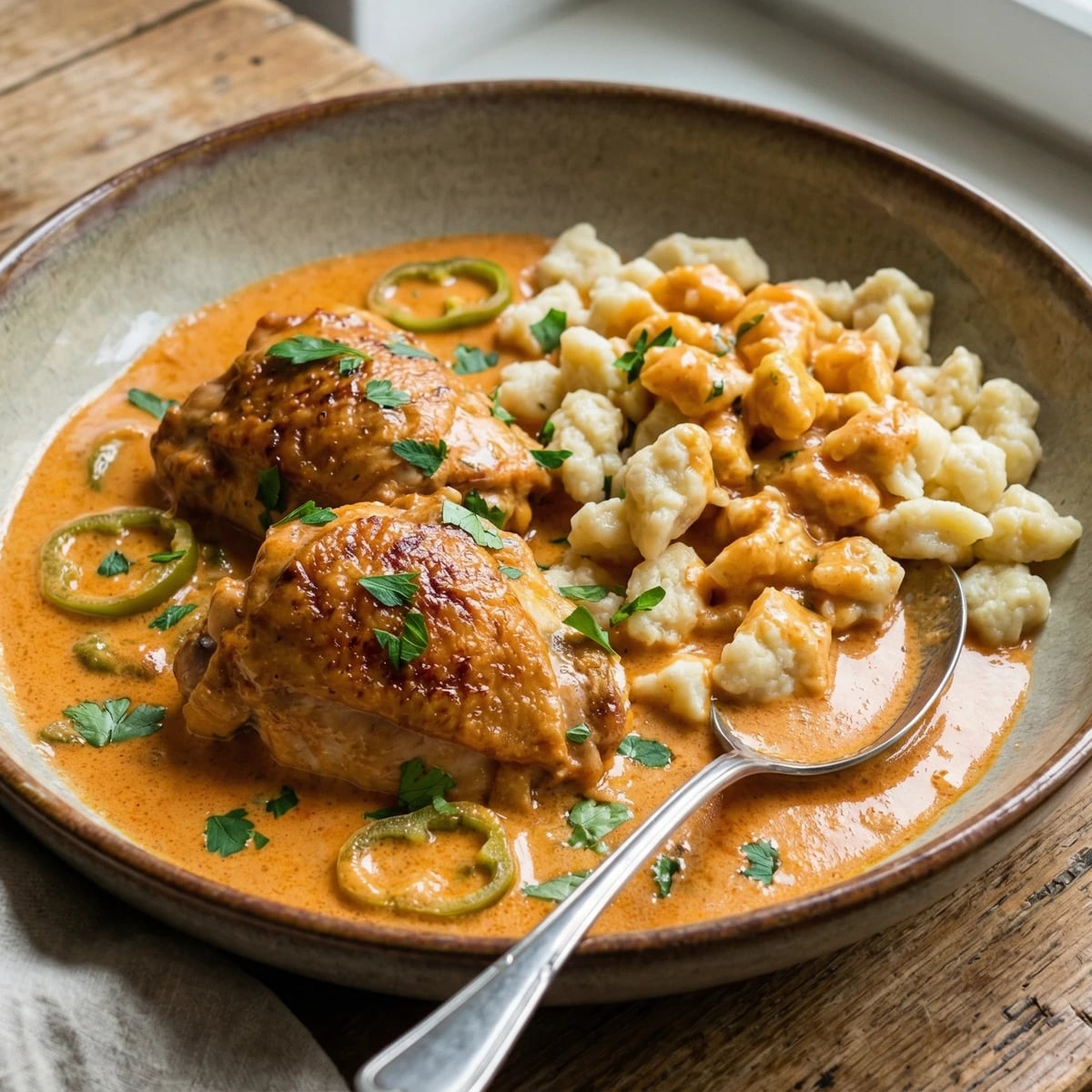
Chicken braised in a velvet sauce of sweet paprika and slow-cooked onions, finished with sour cream and served over Nockerl, the Austrian dish that proves Hungary and Vienna share a kitchen.

Soups & Stews
Austrian
Weeknight
Comfort Food
25 min
Active Time
1 hr 15 min cook1 hr 40 min total
Yield4 servings

Gretel always said you can tell how well someone cooks by what they do with an onion. Paprikahendl is the proof. You take a mountain of onions, cook them so slowly they nearly dissolve, stir in good Hungarian paprika, and let a chicken braise in that sauce until the meat is falling-apart tender and the whole kitchen smells like something your grandmother would be proud of.

This is one of those dishes that lives right at the border between Austrian and Hungarian cooking, and both countries claim it with equal conviction. In my grandmother Eva's kitchen in Kent, it showed up on cold evenings when Gretel was visiting. Eva would stand at the stove stirring onions while Gretel sat at the table with a glass of wine, telling her she wasn't using enough paprika. She was always right. The instinct is to hold back because the spice looks so vivid, but Paprikahendl needs a generous hand. Two tablespoons minimum. Three if you're brave. The sauce should be a deep, warm terracotta, not a timid pink.

The sour cream goes in at the very end, off the heat. This matters. If you let the sour cream boil, it curdles and turns grainy, and your beautiful sauce becomes something you want to hide. Stir it in gently, let the residual heat warm it through, and you'll have a sauce so smooth and rich it practically begs for Nockerl to soak it up. This is good Austrian home cooking at its most honest: simple ingredients, proper technique, no shortcuts on the things that matter.

Paprikahendl entered Austrian kitchens through centuries of shared history with Hungary under the Habsburg empire. Paprika itself arrived in Hungary via Ottoman trade routes in the 16th century, but it didn't become the defining spice of Hungarian and Austrian cooking until the 19th century, when the Szeged and Kalocsa regions began cultivating it seriously. The dish appears in Viennese cookbooks from the 1850s onward, listed alongside Gulasch and Letscho as part of the Hungarian repertoire that the Viennese adopted wholesale and never gave back.

The technique, the tradition, and the story behind every dish.

Discover Culinary Explorer

Ingredients

whole chicken

Quantity

1 (about 1.5 kg)

jointed into 8 pieces

onions

Quantity

4 large

finely diced

sweet Hungarian paprika (edelsüß)

Quantity

3 tablespoons

unsalted butter

Quantity

1 tablespoon

sunflower oil or lard

Quantity

1 tablespoon

garlic

Quantity

1 clove

crushed

ripe tomato

Quantity

1

peeled and chopped

green pepper (Hungarian or Italian)

Quantity

1 small

seeded and sliced into rings

chicken stock or water

Quantity

250ml

sour cream (Sauerrahm)

Quantity

150ml

plain flour

Quantity

1 tablespoon

salt

Quantity

to taste

fresh flat-leaf parsley

Quantity

for serving

chopped

Nockerl or Spätzle

Quantity

for serving

Equipment Needed

  • Heavy-bottomed Dutch oven or casserole pot (28cm)
  • Wooden spoon
  • Small whisk for the sour cream

Instructions

  1. 1

    Season the chicken

    Pat the chicken pieces dry with kitchen paper and season them generously with salt. Dry skin matters here. If the surface is wet, the chicken will release liquid into the pan and stew instead of getting any color. Set the pieces aside while you deal with the onions.

  2. 2

    Cook the onions slowly

    Melt the butter with the oil in a wide, heavy-bottomed pot or Dutch oven over medium-low heat. Add the diced onions and a pinch of salt. Now slow down. Cook the onions gently for fifteen to twenty minutes, stirring occasionally, until they're completely soft, translucent, and just beginning to turn golden. You're not caramelizing them. You're breaking them down so they melt into the sauce later. If you rush this step with high heat, the onions brown on the outside while staying raw in the middle, and your sauce will be grainy instead of smooth.

    Four onions looks like a ridiculous amount. It isn't. The onions ARE the sauce. They cook down to almost nothing and give the braising liquid its body and sweetness. Don't reduce the quantity.
  3. 3

    Add the paprika

    Pull the pot off the heat entirely. This is the most important moment in the recipe. Add the three tablespoons of paprika and stir it through the onions for about thirty seconds. Paprika burns in an instant if it hits dry, hot metal, and burnt paprika turns bitter and acrid. Stirring it into the warm, wet onions off the heat blooms the spice without scorching it. You'll smell it immediately: warm, sweet, faintly smoky. If it smells sharp or burnt, you've gone too far and you need to start over. Add the crushed garlic and stir it through.

    Use proper Hungarian sweet paprika, edelsüß, from Szeged or Kalocsa if you can find it. The bright red tins from Hungarian shops are what you want. Supermarket paprika that's been sitting in a jar for a year tastes like dust. Good paprika smells sweet and earthy the moment you open the tin.
  4. 4

    Build the braising liquid

    Return the pot to medium heat. Add the chopped tomato and the green pepper rings. Stir for a minute until the tomato begins to soften, then pour in the chicken stock. Stir well, scraping up anything stuck to the bottom. The liquid should be a rich, deep orange-red. If it looks pale, you didn't use enough paprika.

  5. 5

    Braise the chicken

    Nestle the chicken pieces into the sauce, skin side up. The liquid should come about halfway up the chicken. If it doesn't, add a splash more stock or water. Bring to a gentle simmer, then reduce the heat to low and cover the pot. Let it braise for forty-five minutes to an hour. The chicken is done when the thigh meat pulls away from the bone easily and the sauce has thickened and reduced around the pieces. Check it once or twice and adjust the heat if the simmer gets too aggressive. You want lazy bubbles, not a rolling boil.

    Leave the lid slightly ajar for the last fifteen minutes. This lets the sauce reduce and concentrate. A thin, watery sauce is the most common mistake with Paprikahendl.
  6. 6

    Finish with sour cream

    Remove the chicken pieces to a warm plate and tent them loosely. In a small bowl, whisk the sour cream with the tablespoon of flour until smooth. The flour stabilizes the cream and keeps it from breaking. Take the pot completely off the heat. Wait thirty seconds. Then stir the sour cream mixture into the sauce in a slow, steady stream, whisking gently as you go. The sauce will transform: it goes from a clear, paprika-red broth to a thick, creamy, coral-colored velvet. Do not let it boil after this point. If the sour cream boils, it curdles. You can warm it gently, but keep the heat low and keep stirring.

  7. 7

    Serve with Nockerl

    Return the chicken pieces to the pot and coat them gently in the finished sauce. Serve in wide, warm bowls over fresh Nockerl or Spätzle. Spoon plenty of sauce over everything. Scatter chopped parsley across the top. The Nockerl are there to catch the sauce, so be generous with both. Mahlzeit!

Chef Tips

  • Buy your paprika from a Hungarian or Central European shop, not the supermarket spice aisle. Paprika loses its flavor faster than almost any other spice. If yours doesn't smell sweet and earthy when you open the container, it's too old. Fresh paprika is the difference between a Paprikahendl that sings and one that just sits there.
  • Joint the chicken yourself or ask your butcher to do it. Bone-in, skin-on pieces braise better than boneless. The bones add body to the sauce, and the skin, while it won't stay crisp, melts richness into the liquid. If you must use boneless thighs, reduce the braising time to thirty minutes.
  • Gretel always said the sour cream should be full-fat and cold from the fridge. Low-fat sour cream breaks more easily and gives a thinner, less satisfying sauce. Don't economize here.
  • Leftover Paprikahendl is even better the next day. The flavors deepen overnight. Reheat gently over low heat, adding a splash of stock if the sauce has thickened too much, and stir in a spoonful of fresh sour cream just before serving.

Advance Preparation

  • The entire dish can be braised a day ahead and refrigerated before the sour cream is added. Reheat gently, then stir in the sour cream off the heat just before serving. This actually produces a deeper, more developed flavor.
  • Nockerl or Spätzle are best made fresh, but the batter can be prepared an hour ahead and left to rest at room temperature.

Frequently Asked Questions

Nutrition Information

1 serving (about 550g)

Calories
815 calories
Total Fat
39 g
Saturated Fat
13 g
Trans Fat
0 g
Unsaturated Fat
26 g
Cholesterol
175 mg
Sodium
920 mg
Total Carbohydrates
64 g
Dietary Fiber
8 g
Sugars
11 g
Protein
52 g

Note: Chef personas and recipes are created with AI assistance. Cook with care: follow safe food-handling practices, check doneness with a thermometer when needed, and adapt for allergies and your kitchen.

Where cooking meets culture.

Culinary guides, cultural storytelling, and the editorial depth that makes cooking meaningful.

Discover Culinary Explorer

More from Austrian Stews & Gulasch

Browse the full collection