
Chef Juliana
Ambrosia Baiana
You think curdled milk means you ruined dessert. Good. Tonight you'll do it on purpose, with lemon, yolks, cravo, and sugar, until the pot turns into golden gruminhos.
A cooking platform built around craft, culture, and the stories behind what we eat.
Created by
You don't need a convent, a grandmother, or a secret hand. Beat fresh yolks until they hold air, bake them gently, and let real calda do the rest.
You're allowed to look at a little golden doce in calda and think isso não é pra mim. I know that sentence. I said it to pans, cakes, rice, beans, almost everything, until the cheap caderno taught me the rude truth: cozinhar não é dom, é um aprendizado.
Most days, a gente is trying to resolver o jantar: rice, beans, a piece of chicken or an egg, and something green. That pê-efe is the spine of the Brazilian table. On celebration days, after that plate, a small sweet like this belongs to the same kitchen logic: comida de verdade, clear steps, no packet pretending to be flavor.
This comes from the yolk-and-sugar family, the old Portuguese grammar that Brazil kept, argued with, and served at Christmas and Sunday tables. Bahian and Pernambucano cooks carry many of these traditions with a depth I won't pretend to own; I'm teaching you the home version honestly, the one a beginner can reproduce.
The method is not a secret. Fresh room-temperature gemas beat taller because they hold air. The molds are filled lightly because air is the lift. The calda reaches ponto de fio before the baked papos go in because syrup with body coats and soaks; loose yolk in hot sugar scrambles, and thin boiling syrup knocks the little cakes around. Anota aí: we respect temperature, and the dessert behaves.
Papo de anjo belongs to the Portuguese convent-sweet family that reached Brazil with colonization: egg yolks and sugar, made abundant because whites were used for starching hábitos and for clarifying wine. In Brazil's sugar regions, especially Bahia and Pernambuco, many of these sweets were prepared in casas-grandes by enslaved and later Afro-Brazilian cooks, whose labor carried and changed the table even when written recipes kept Portuguese names. Unlike quindim or cocada, papo de anjo stays almost bare, with baked yolks drinking calda instead of coconut or flour.
Quantity
12
fresh and at room temperature
Quantity
1 teaspoon
softened, for greasing the molds
Quantity
2 cups
Quantity
1 1/2 cups
Quantity
1 strip
yellow part only
| Ingredient | Quantity |
|---|---|
| large egg yolksfresh and at room temperature | 12 |
| unsalted buttersoftened, for greasing the molds | 1 teaspoon |
| granulated sugar | 2 cups |
| water | 1 1/2 cups |
| lemon peel (optional)yellow part only | 1 strip |
Separate the eggs while they are still cool, because cold yolks break less easily. Put the yolks in a fine sieve set over a bowl and let them slip through naturally; do not scrape the thick membranes through. Let the strained yolks sit until they lose their chill, about 20 minutes. Fresh, room-temperature gemas beat higher, and leaving the membrane behind keeps that strong egg smell from taking over.
Heat the oven to 180°C (350°F). Butter 12 small papo de anjo molds, quindim molds, or the cups of a mini muffin tin with the thinnest coat you can manage. You want release, not frying; puddles of butter make greasy edges and hide the clean yolk flavor.
Beat the strained yolks with an electric mixer on medium-high until they turn pale yellow, thick, and at least double in volume, 8 to 10 minutes. Lift the beaters: the mixture should fall in a ribbon that sits on the surface for a second before sinking. That air is the lift. There is no baking powder coming to rescue you, and we don't need it.
Divide the beaten yolks among the molds, filling each about 2/3 full, then set the molds on a baking sheet. Bake until puffed, set, and barely golden at the edges, 10 to 12 minutes. Press one gently; it should spring back like a soft sponge. Pull them before they brown hard, because yolk sweets baked too hot or too long tighten, weep water, and turn rubbery.
While the papos bake, put the sugar, water, and lemon peel in a heavy 2-liter saucepan. Stir over medium heat only until the sugar dissolves, then stop stirring and let it boil until it reaches ponto de fio, about 10 to 12 minutes, or 106°C to 108°C (223°F to 226°F). If you do not have a thermometer, lift a spoon: the last drops should join into a fine thread before falling. The syrup needs that body before the papos go in; thin syrup boils like water and roughs them up, while raw gemas in hot syrup would scramble. We bake first, then bathe.
Turn the baked papos out while warm. Pierce each one 4 or 5 times with a toothpick, then lower them into the calda and reduce the heat to a lazy bubble. Simmer 2 minutes, turn gently with a spoon, and simmer 2 minutes more, spooning syrup over the tops. The little holes let the calda reach the center; without them, the outside gets sweet and the middle sits there tasting like it missed the party.
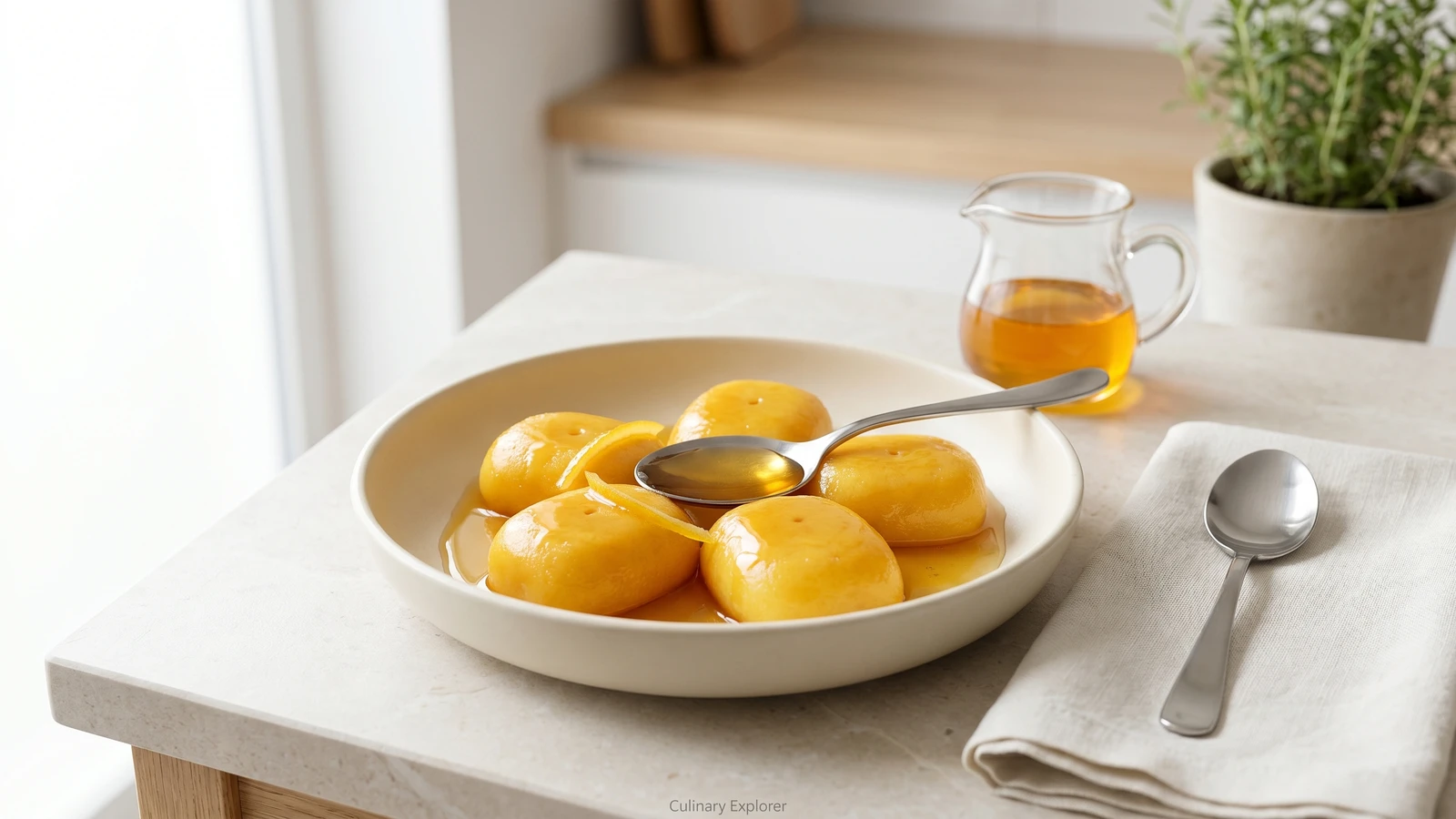
Move the papos to a shallow dish and pour the calda over them. Let them rest at least 30 minutes, turning once if the tops sit above the syrup. Serve at room temperature or chilled, with a spoonful of calda. The rest is not decoration; it gives the syrup time to settle into the sponge so each bite tastes like yolk, sugar, and patience, not just a wet outside.
1 serving (about 150g)
Culinary guides, cultural storytelling, and the editorial depth that makes cooking meaningful.
Discover Culinary ExplorerChef Juliana
You think curdled milk means you ruined dessert. Good. Tonight you'll do it on purpose, with lemon, yolks, cravo, and sugar, until the pot turns into golden gruminhos.

Chef Juliana
You are not ruining the milk. You're curdling it on purpose, slowly, until sugar, eggs, cinnamon, and patience turn cheap ingredients into dessert.

Chef Juliana
You think curdled milk means failure. Not here. Milk, yolks, sugar, and lemon cook into golden curds in amber whey, a Minas sweet where the ponto teaches the whole recipe.

Chef Juliana
You already trust rice for dinner. Trust it for dessert: cook it gently with milk, coconut, and canela until each grain turns soft, creamy, and impossible to blame on lack of talent.