Culinary Explorer

A cooking platform built around craft, culture, and the stories behind what we eat.
Discover Culinary Explorer
Baba de Moça

Baba de Moça

Created by

You don't need pastry courage for this. You need yolks at room temperature, syrup at ponto de fio, and the discipline to keep the heat gentle.

Desserts
Brazilian
Celebration
Make Ahead
Special Occasion
20 min
Active Time
20 min cook40 min total
YieldAbout 3 cups, enough to fill one 8-inch cake or serve 8 small portions

You hear twelve egg yolks and think, pronto, isso não é pra mim. I know. I used to look at sweets like this as if the pan had a university degree and I had arrived with a spoon and fear. But cozinhar não é dom, é um aprendizado. Anota aí: this is sugar, coconut milk, yolks, and slow heat. That's all the drama we're allowing.

Baba de moça belongs to the celebration table, not the everyday pê-efe, but it still comes from the same kitchen logic: comida de verdade, made from real ingredients, taught in plain steps. A country doesn't stay itself only by rice and beans and couve. It also stays itself by the doce someone makes for a birthday, a Sunday, a cake filling, a spoon stolen from the fridge when nobody is looking.

The method matters because eggs are honest and unforgiving. The sugar syrup must reach ponto de fio before the yolks go in because the syrup gives the cream body and keeps the water from making everything loose. The coconut milk needs to be at room temperature before it meets the yolks, or the cold shock tightens the eggs and invites little scrambled bits into your sweet. Low heat finishes the job slowly, so the cream thickens glossy and gold instead of turning grainy.

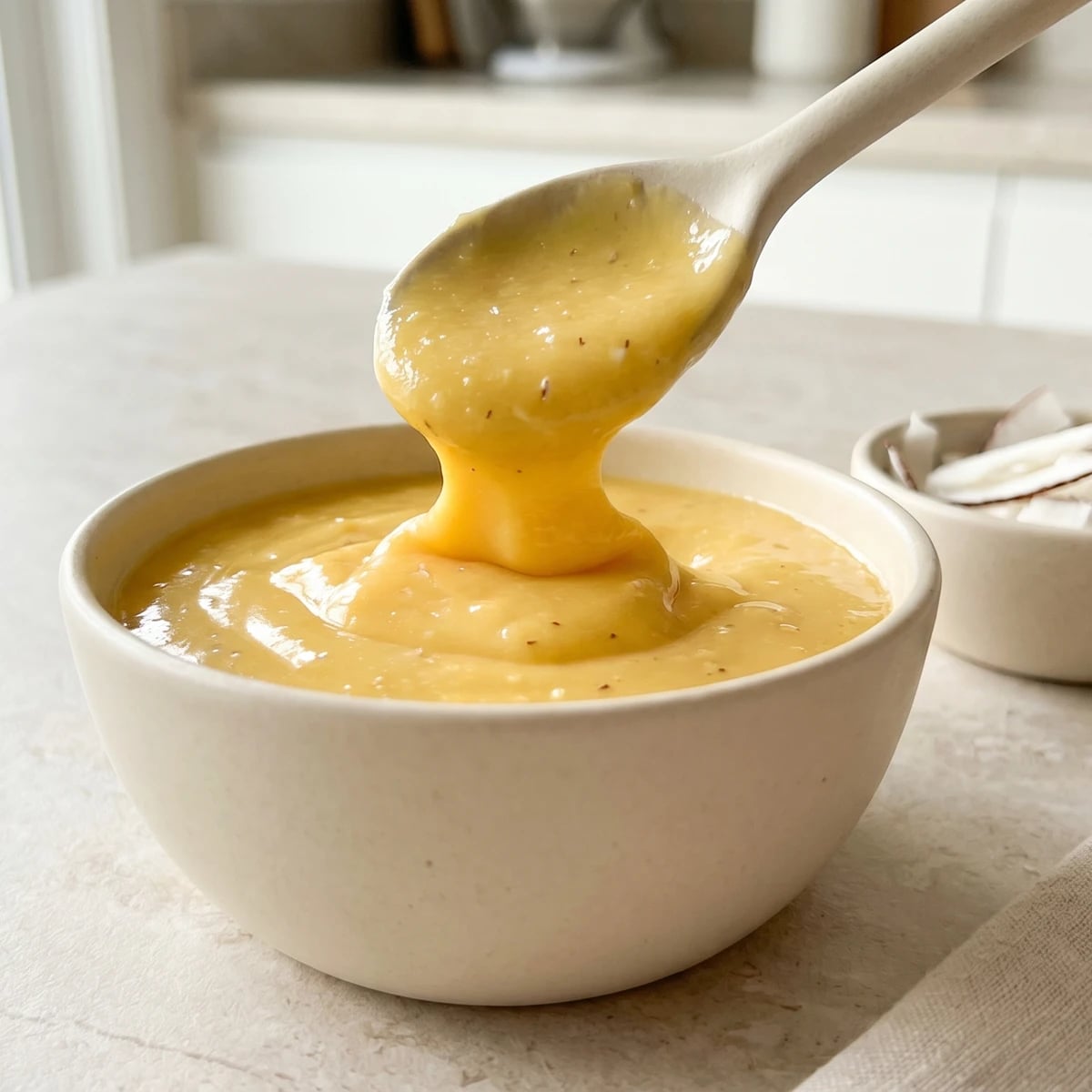
No packet, no powder pretending to be coconut. Use good coconut milk, grate fresh coconut if your Tuesday has room for it, and strain the yolks without pressing so the stronger egg smell stays behind. By the end you'll have a thick, shining spoon cream for cakes, pavês, bowls, or one small dessert glass after dinner. Worth it.

Baba de moça comes from the Portuguese convent sweet tradition, where sugar and egg yolks became a whole grammar of desserts after egg whites were used for clarifying wine and starching habits. In Brazil, especially through the colonial kitchens of Bahia and Pernambuco, African cooks worked those yolk-and-sugar techniques with New World coconut, which became one of the signatures of Brazilian sweets. The name is shared with several home versions, from spoonable cream to cake filling, but the base stays the same: syrup, gemas, and leite de coco cooked gently.

The technique, the tradition, and the story behind every dish.

Discover Culinary Explorer

Ingredients

large egg yolks

Quantity

12

fresh, at room temperature

granulated sugar

Quantity

1 1/2 cups

water

Quantity

1/2 cup

unsweetened coconut milk

Quantity

1 cup

at room temperature

unsalted butter

Quantity

2 tablespoons

fine salt

Quantity

1/8 teaspoon

vanilla extract (optional)

Quantity

1/2 teaspoon

Equipment Needed

  • Medium heavy saucepan, about 2 liters
  • Fine-mesh sieve
  • Whisk
  • Silicone spatula
  • Instant-read or candy thermometer, optional but useful

Instructions

  1. 1

    Prepare the yolks

    Separate the eggs while they're cool, then let the yolks sit until they lose the refrigerator chill, about 20 minutes. Pass the yolks through a fine sieve into a bowl without pressing hard. Let gravity do the work. The thin skin left in the sieve is where a lot of the stronger egg smell hides, and pressing it through defeats the whole point.

  2. 2

    Warm the coconut milk

    Measure the coconut milk and leave it on the counter until it is room temperature, not cold. Stir it smooth before using. Cold coconut milk hitting yolks makes the mixture tighten unevenly, and that's how you get grainy cream while blaming yourself. Don't. Blame the cold milk, then fix the habit.

  3. 3

    Cook the syrup

    Put the sugar and water in a medium heavy saucepan and stir only until the sugar is wet. Bring to a boil over medium heat, then stop stirring and let it bubble until it reaches ponto de fio, about 104°C to 106°C, or until a drop between two spoons pulls into a thin thread. This stage matters because the syrup is what gives baba de moça its body. Too thin and the cream stays loose; too far and the sweet turns heavy and sticky.

  4. 4

    Cool the syrup

    Take the pan off the heat and let the syrup rest for 5 minutes, until the violent bubbling calms and the surface looks clear and glossy. Don't pour boiling syrup straight into yolks unless you want sweet scrambled eggs. Hot is useful. Furious is not.

  5. 5

    Temper the yolks

    Whisk the coconut milk into the strained yolks until smooth. Slowly pour in about 1/2 cup of the warm syrup while whisking constantly, then whisk in another 1/2 cup. This tempering teaches the yolks the heat little by little. Dump everything together at once and the eggs panic, because apparently eggs and people have that in common.

  6. 6

    Cook gently

    Pour the tempered yolk mixture back into the saucepan with the remaining syrup. Add the butter and salt. Cook over low heat, stirring constantly with a silicone spatula and scraping the bottom and corners, until the cream thickens, coats the spatula, and a finger swiped through it leaves a clean path, about 8 to 12 minutes. Keep it below a simmer. Bubbles mean the heat is too bold for eggs, and bold eggs become curdled eggs.

  7. 7

    Finish and chill

    Take the pan off the heat and stir in the vanilla if using. For the smoothest cream, strain it once more into a clean bowl. Press a piece of parchment or plastic wrap directly on the surface and chill until thick and spoonable, at least 2 hours. Covering the surface keeps a skin from forming, and chilling lets the syrup and yolks settle into that glossy, golden texture.

Chef Tips

  • Use real coconut milk with coconut and water as the main ingredients. Powdered coconut drink is not the same food wearing a different outfit. It tastes flat, and this recipe has nowhere for flat flavor to hide.
  • Freshly grated coconut milk is beautiful if you have the time: blend 2 cups freshly grated coconut with 1 cup warm water, squeeze through a clean cloth, and use 1 cup of that milk. The honest shortcut is a good canned coconut milk. The cost is a little less perfume, not a failed dessert.
  • Room temperature yolks and coconut milk are not fuss. They're insurance. Cold ingredients make the heat hit unevenly, and egg sweets punish that nonsense fast.
  • If you see tiny cooked egg bits, don't throw it away. Strain the cream immediately into a clean bowl. It won't be perfect, but it will still be dessert, and dessert is not a courtroom.
  • Baba de moça thickens as it chills. Stop cooking when it coats the spatula, not when it looks like cake filling in the pan. If you cook it to finished thickness on the stove, it'll set too firm in the fridge.

Advance Preparation

  • Make baba de moça up to 3 days ahead and keep it covered in the refrigerator with wrap touching the surface.
  • For cake filling, chill at least 4 hours so it firms enough to spread without sliding.
  • Do not freeze it. Egg-yolk creams split after freezing, and no amount of optimism fixes that texture.

Frequently Asked Questions

Nutrition Information

1 serving (about 100g)

Calories
320 calories
Total Fat
16 g
Saturated Fat
10 g
Trans Fat
0 g
Unsaturated Fat
5 g
Cholesterol
285 mg
Sodium
55 mg
Total Carbohydrates
39 g
Dietary Fiber
0 g
Sugars
38 g
Protein
5 g

Note: Chef personas and recipes are created with AI assistance. Cook with care: follow safe food-handling practices, check doneness with a thermometer when needed, and adapt for allergies and your kitchen.

Where cooking meets culture.

Culinary guides, cultural storytelling, and the editorial depth that makes cooking meaningful.

Discover Culinary Explorer

More from Nordeste Doces: Cocada, Quindim, Bolo de Rolo & Cartola

Browse the full collection