
Chef Juliana
Ambrosia Caseira
You are not ruining the milk. You're curdling it on purpose, slowly, until sugar, eggs, cinnamon, and patience turn cheap ingredients into dessert.
A cooking platform built around craft, culture, and the stories behind what we eat.
Created by
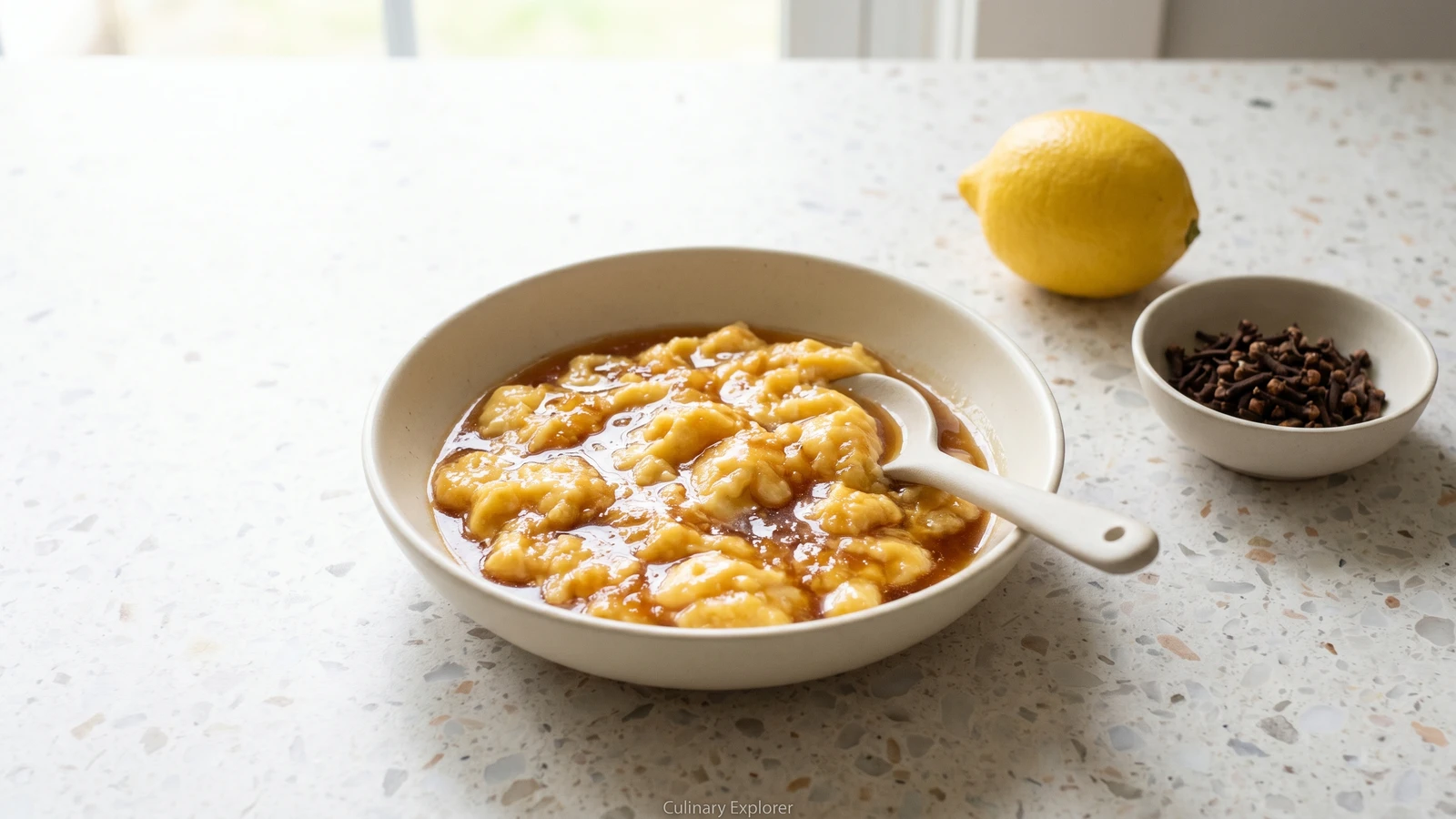
You think curdled milk means you ruined dessert. Good. Tonight you'll do it on purpose, with lemon, yolks, cravo, and sugar, until the pot turns into golden gruminhos.
You hear the milk split and your head says, isso não é pra mim. I know that voice. It showed up in my kitchen too, usually right after I did something very confident and very wrong. Here, splitting is not failure. It is the recipe.
After the pê-efe, rice, beans, a piece of meat or an egg, something green, a spoonful of sweet like this doesn't sit outside comida de verdade. It belongs to the table because the table isn't a punishment. A gente cooks dinner, eats real food, and still has room for a doce made from milk, eggs, sugar, lemon, cravo, and cinnamon. No packet pretending to be memory.
The method is plain enough to write in a school notebook. You make a syrup until it reaches ponto de fio so the sugar is hot and dissolved before the eggs arrive. You let the milk come back to room temperature before it meets the yolks, because fridge-cold milk shocks the mixture and makes the curds tight and uneven. Then lemon does the work your grandmother never explained: it talha the milk, forms the gruminhos, and carries the yolks into soft golden pieces.
Don't stir it to death. Bring it gently, watch it, and let the pot teach you. Cozinhar não é dom, é um aprendizado. By the end you'll have a chilled bowl of Bahia's sweet kitchen grammar, spoonable, perfumed, and completely possible tonight.
Ambrosia belongs to the Portuguese egg-and-sugar family of sweets that traveled into Brazil with colonial kitchens, the same grammar that made yolks, sugar, and patience into dessert. In Portugal, convent sweets are often linked to the use of egg whites for starching linens and hábitos, leaving yolks to be cooked with sugar; in Brazil, enslaved African and Afro-Brazilian cooks did much of the actual work that carried these sweets through casas-grandes and city homes. Bahian and Pernambucano versions vary by household, but the Brazilian ambrosia keeps the old milk, egg, and sugar base and makes the curd itself the point.
Quantity
1 1/2 cups
Quantity
1/2 cup
Quantity
1
Quantity
6
Quantity
2 wide strips
yellow part only
Quantity
4 cups
at room temperature
Quantity
6
at room temperature
Quantity
2
at room temperature
Quantity
2 tablespoons
Quantity
1/4 teaspoon
Quantity
1/2 cup
| Ingredient | Quantity |
|---|---|
| granulated sugar | 1 1/2 cups |
| water | 1/2 cup |
| cinnamon stick | 1 |
| whole cloves (cravos-da-índia) | 6 |
| lemon peelyellow part only | 2 wide strips |
| whole milkat room temperature | 4 cups |
| large egg yolksat room temperature | 6 |
| large whole eggsat room temperature | 2 |
| fresh lemon juice | 2 tablespoons |
| fine salt | 1/4 teaspoon |
| freshly grated unsweetened coconut (optional) | 1/2 cup |
Set the milk, yolks, and whole eggs on the counter for 30 to 45 minutes before you start. They should feel cool, not fridge-cold. Room-temperature dairy and eggs meet the hot syrup more calmly, so the gruminhos form tender and uneven, not tight little rubber beads.
Put the sugar, water, cinnamon stick, cloves, and lemon peel in a heavy wide pot over medium heat. Stir only until the sugar dissolves, then let it bubble without stirring until the syrup falls from a spoon in a thin thread, about 8 to 12 minutes, or 103°C to 105°C if you use a thermometer. Anota aí: reach ponto de fio before the eggs go in. If you add the eggs while the syrup is weak and watery, you'll have to boil hard later to reduce it, and hard boiling turns yolks into scrambled bits instead of soft curds.
While the syrup cooks, whisk the yolks and whole eggs in a bowl just until broken. Add the room-temperature milk and salt, then stir gently. Pass the mixture through a fine sieve if you want a cleaner calda. Don't beat it foamy, because foam makes ragged curds and gives you bubbles where you wanted silk.
Stir the lemon juice into the milk-and-egg mixture with two slow turns. It may look faintly split. That's wanted. The lemon talha the milk, and those first gruminhos are the dessert beginning, not a mistake.
Lower the syrup to medium-low heat and pour in the milk mixture in one steady stream. Do not stir for the first 10 minutes. Let the edges puff, the yellow curds rise, and the calda settle around them. This quiet start lets the eggs set around the curdled milk; stir too soon and you break everything into sweet sand.
Once the curds look set, use a spoon to gently loosen the sides and turn the larger pieces over. Simmer uncovered for 35 to 45 minutes, nudging every 10 minutes, until the curds are deep yellow with amber edges and the syrup looks glossy and lightly thickened. If using coconut, scatter it in during the last 10 minutes so it softens without stealing the whole pot. Too much stirring breaks the gruminhos; too much heat makes dry, eggy crumbs.
Turn off the heat and fish out the cinnamon stick, cloves, and lemon peel. Let the ambrosia cool in the pan for 20 minutes, then spoon it into a shallow dish with the syrup poured over the curds. Chill at least 4 hours. Cooling gives the calda time to soak into the curds, which is why this doce is better after it has rested instead of being rushed to the table.
Serve cold or just cool in small bowls, making sure every portion gets curds and a spoonful of calda. It should be tender, golden, and fragrant with cravo, cinnamon, and lemon. No decoration needed. The gruminhos are the whole story.
1 serving (about 170g)
Culinary guides, cultural storytelling, and the editorial depth that makes cooking meaningful.
Discover Culinary ExplorerChef Juliana
You are not ruining the milk. You're curdling it on purpose, slowly, until sugar, eggs, cinnamon, and patience turn cheap ingredients into dessert.

Chef Juliana
You think curdled milk means failure. Not here. Milk, yolks, sugar, and lemon cook into golden curds in amber whey, a Minas sweet where the ponto teaches the whole recipe.

Chef Juliana
You already trust rice for dinner. Trust it for dessert: cook it gently with milk, coconut, and canela until each grain turns soft, creamy, and impossible to blame on lack of talent.

Chef Juliana
You already know how to cook rice. Now let it go sweet, creamy, and soft, with milk, cinnamon, and the good sense to stop before it turns stiff.