Culinary Explorer

A cooking platform built around craft, culture, and the stories behind what we eat.
Discover Culinary Explorer
Panuchos Yucatecos

Panuchos Yucatecos

Created by

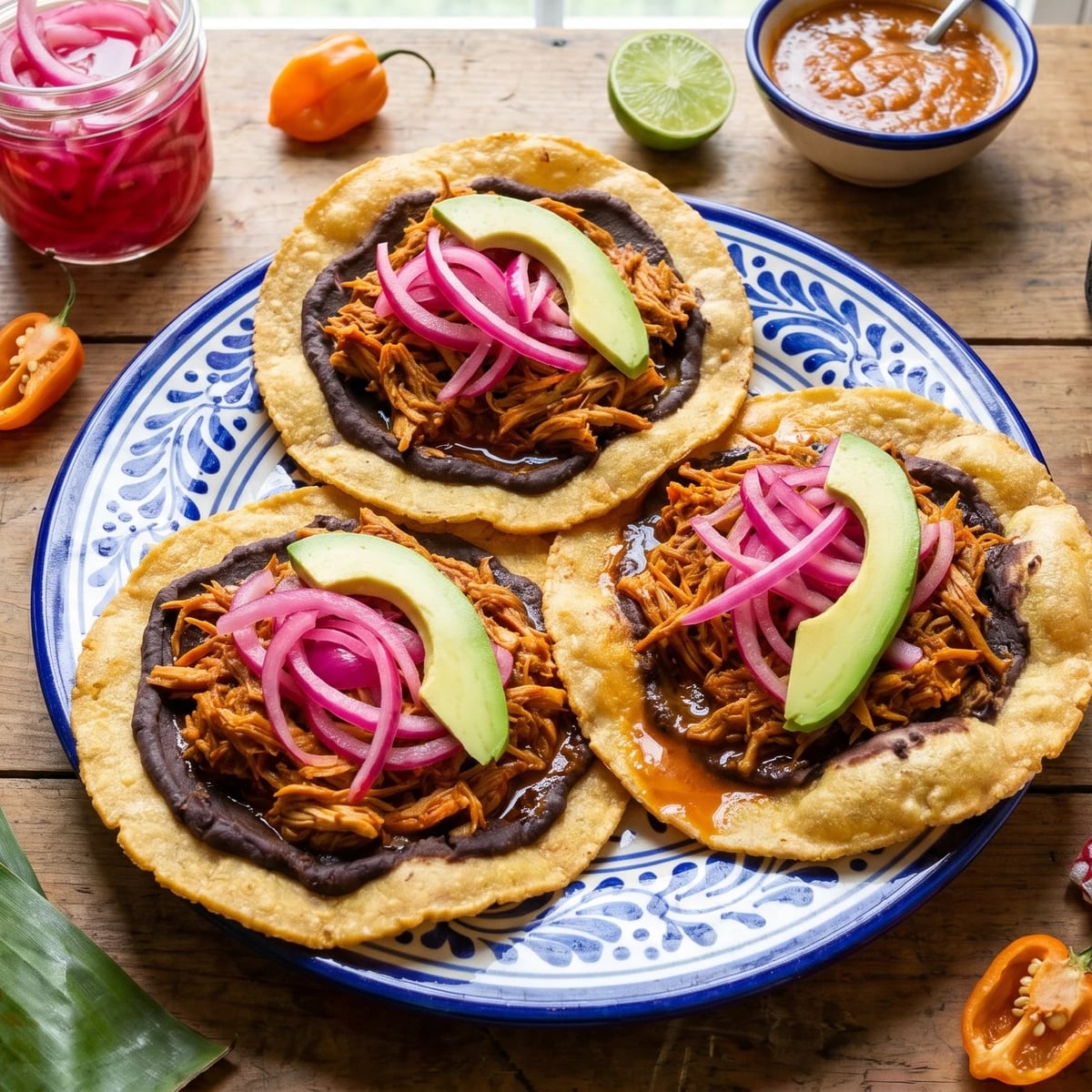
Yucatan's signature antojito: a puffed corn tortilla split and stuffed with frijol colado, fried in lard, and crowned with cochinita pibil, cebolla morada en escabeche, and avocado.

Appetizers & Snacks
Mexican
Dinner Party
Game Day
Celebration
45 min
Active Time
30 min cook1 hr 15 min total
Yield12 panuchos (4 to 6 servings)

Panuchos belong to Yucatan. Specifically to Merida, Valladolid, and the cantinas of the Peninsula where the women who run the kitchens have been making them the same way for generations. This is not a taco. This is not a tostada. This is a panucho, a puffed corn tortilla split open, stuffed with strained black beans, fried in lard, and topped with the meat of the Peninsula.

The technique sits in the puff. When the masa is right and the comal is hot, the tortilla inflates into a pocket of steam, and that pocket is what makes a panucho a panucho. You split it, fill it with frijol colado, the strained Yucatecan bean paste perfumed with epazote and habanero, and fry it in manteca until it crackles. No puff, no panucho. The senoras at the mercado in Merida will tell you the same thing. Si no conoces el mercado, no conoces la cocina.

The Peninsula has its own grammar. Black beans, not pinto. Habanero, not jalapeno. Epazote, not bay leaf. Pickled red onion cured in naranja agria. Cochinita pibil wrapped in banana leaf and cooked in the pib. None of these are interchangeable with what gets cooked in central or northern Mexico. Yucatan is its own country in terms of food, and panuchos are one of its most legible flags. Cada estado, su propia cocina.

My mother never made panuchos. She was from Jalisco and the Peninsula was a distant country to her. The first time I ate one was in a fonda outside the Mercado Lucas de Galvez in Merida in 1998, served on a talavera plate by a woman named Dona Cande, who showed me how she pressed her tortillas and split them with her thumb in one motion. I went back every morning for ten days. This recipe is hers, with adjustments only where the technique demanded clarification. Saber cocinar es saber vivir.

The panucho is a 19th-century Yucatecan invention attributed by local food historians to a fonda owner in Merida named Don Hucho, whose name, slurred over generations of customers calling for 'pan de Hucho,' is the most commonly cited etymology of the word. The dish reflects the Peninsula's unique culinary inheritance, a fusion of Maya foundations (the puffed corn tortilla, the black bean, the achiote-based recados) with Lebanese, Spanish, and Caribbean influences that arrived through the port of Progreso during the henequen boom. Yucatan's cuisine was formally recognized as distinct from central Mexican cooking in the 2010 UNESCO inscription of Traditional Mexican Cuisine, with the Peninsula's reliance on sour orange, recado rojo, banana leaf, and pit cooking (pib) cited as a regional system unto itself.

The technique, the tradition, and the story behind every dish.

Discover Culinary Explorer

Ingredients

dried black beans (frijol negro)

Quantity

2 cups

white onion

Quantity

1 small

halved

garlic cloves

Quantity

4

peeled

fresh epazote

Quantity

1 large sprig

fresh chile habanero

Quantity

1

whole and unbroken

kosher salt (for the beans)

Quantity

2 teaspoons, plus more to taste

manteca de cerdo (pork lard) for the beans

Quantity

3 tablespoons

masa harina, preferably nixtamalized

Quantity

2 cups

warm water

Quantity

1 1/4 cups, plus more as needed

kosher salt (for the masa)

Quantity

1/2 teaspoon

manteca de cerdo for frying

Quantity

1 1/2 cups

shredded cochinita pibil

Quantity

2 cups

warm

cebolla morada en escabeche (pickled red onion)

Quantity

1 cup

prepared ahead

ripe Hass avocado

Quantity

1

sliced

salsa de chile habanero (optional)

Quantity

for serving

lime wedges (optional)

Quantity

for serving

Equipment Needed

  • Cast iron comal or heavy 10-inch skillet for the tortillas
  • Tortilla press lined with two pieces of plastic (a cut zip-top bag works)
  • Wide heavy cazuela or skillet for frying
  • Fine-mesh sieve for straining the beans
  • Sharp paring knife for splitting the tortillas
  • Wire rack set over a sheet pan for draining

Instructions

  1. 1

    Cook the black beans

    Rinse the dried black beans and pick out any stones. Place them in a heavy pot with the halved onion, garlic, epazote, and the whole habanero. Cover with cold water by three inches. Bring to a gentle simmer, lower the heat, and cook uncovered for about an hour and a half, until the beans are soft enough to crush against the side of the pot with a wooden spoon. Add hot water as needed to keep them submerged. The habanero must stay whole. If it splits, the pot turns from perfumed to scorching, and the beans are ruined. Salt only at the end, once they are tender. Salt too early and the skins toughen.

    Epazote is not optional in Yucatecan beans. It is the herb that makes the pot taste like the Peninsula. If you cannot find fresh, dried epazote will work, half a teaspoon, but track down the fresh next time.
  2. 2

    Make the frijol colado

    Lift out the habanero, onion, and epazote sprig. Frijol colado means strained beans, and that is exactly what you do. Ladle the beans and a generous amount of their broth into a blender. Blend until completely smooth. Pass the puree through a fine-mesh sieve, pressing with a rubber spatula. Discard the skins left behind in the strainer. Melt 3 tablespoons of lard in a wide skillet over medium heat. Pour in the bean puree, careful, it will splatter. Cook, stirring constantly, for 10 to 15 minutes, until the beans thicken into a paste that holds a line when you draw a spoon through the bottom of the pan. This is what goes inside the tortilla. Loose beans will burst the panucho. La manteca es el sabor.

  3. 3

    Mix the masa

    Combine the masa harina and salt in a bowl. Add the warm water gradually, working it with your hands until you have a smooth, pliable dough that feels like fresh playdough. Press a small piece between your fingers. If it cracks at the edges, the masa is too dry, add water a teaspoon at a time. If it sticks to your palm, it is too wet, add a little more masa harina. Cover with a damp towel and let it rest for 15 minutes. Asi se hace y punto.

  4. 4

    Press and cook the tortillas

    Heat a comal or heavy skillet over medium-high until a drop of water dances. Divide the masa into 12 balls about the size of a golf ball. Press each one between two sheets of plastic in a tortilla press to a circle about 5 inches across and slightly thicker than a standard tortilla. You want them a little hefty because they will be split open. Cook the first side for about 30 seconds, flip, cook 45 seconds on the second side, then flip back to the first side. Press the center gently with a clean kitchen towel. The tortilla should puff into a pillow of steam. That puff is everything. It creates the pocket that holds the beans. If a tortilla does not puff, set it aside, those are for tostadas, not panuchos.

    The puff comes from a comal that is hot enough and a tortilla pressed evenly. Lukewarm comal, no puff. Uneven pressing, no puff. Practice on a few before you commit the whole batch.
  5. 5

    Split and stuff

    Work fast while the tortillas are still warm and pliable. Use a small sharp paring knife to cut a slit about two-thirds of the way around the edge of each puffed tortilla, opening it like a clamshell without separating it. Spoon about two tablespoons of the frijol colado into the pocket and press the tortilla closed. Smooth the edges with your fingers so no bean shows. The seal matters. A leaky panucho falls apart in the lard.

  6. 6

    Fry the panuchos

    Melt the 1 1/2 cups of lard in a wide heavy skillet or cazuela over medium-high heat. The lard should be about half an inch deep and hot enough that a corner of tortilla dropped in bubbles immediately. Fry the stuffed tortillas, bean side down first, for about a minute and a half, then flip and fry the other side for another minute, until both sides are deep golden and the edges crackle. The exterior should crisp without going hard. Drain briefly on a wire rack. Do not stack them. Stacking traps steam under the panuchos and the bottoms turn soggy. This is a fried antojito, treat it like one.

  7. 7

    Top and serve

    Pile each fried panucho with warm cochinita pibil. Crown with a generous tangle of pickled red onion, the more the better, the acid cuts the lard. Lay two slices of avocado across the top. Set salsa de chile habanero and lime wedges on the table. Eat immediately, with your hands, the way the senoras in the cantinas of Merida serve them. A panucho that sits gets soft. A panucho eaten the moment it is topped is what the dish is supposed to be. Recetas probadas y garantizadas.

Chef Tips

  • The cochinita pibil should be made the day before. It is its own day-long project: pork shoulder marinated in recado rojo with naranja agria, wrapped in banana leaf, and slow-cooked until the meat shreds. Do not skip the recado, do not skip the banana leaf, do not skip the naranja agria. If you cannot find naranja agria, mix two parts orange juice, one part lime, one part white grapefruit. It is a compromise, not an upgrade.
  • Pickled red onion takes ten minutes and one hour to cure. Thinly slice a red onion, cover with hot water for thirty seconds, drain, then submerge in naranja agria with salt, oregano, and a couple of allspice berries. It keeps in the refrigerator for a week and gets better every day.
  • The puff is the recipe. If you cannot get tortillas to puff, the comal is not hot enough, the masa is too dry, or you are pressing unevenly. Practice three or four before you commit to the full batch. The flat ones become tostadas, which is the same dish without the bean inside. The cantinas of Merida call those salbutes when they are fried plain, panuchos when stuffed.

Advance Preparation

  • The frijol colado can be made two days ahead and refrigerated. Reheat gently with a splash of water before stuffing.
  • The cochinita pibil should be made one day ahead. The flavor deepens overnight and the meat is easier to shred when cool.
  • The pickled red onion should be made at least one hour ahead and keeps for a week refrigerated.
  • The tortillas must be pressed, cooked, split, and stuffed the same day. Do not refrigerate stuffed tortillas before frying, the masa stiffens and the panucho will crack open in the lard.

Frequently Asked Questions

Nutrition Information

1 serving (about 350g)

Calories
860 calories
Total Fat
38 g
Saturated Fat
12 g
Trans Fat
0 g
Unsaturated Fat
24 g
Cholesterol
60 mg
Sodium
920 mg
Total Carbohydrates
95 g
Dietary Fiber
21 g
Sugars
3 g
Protein
37 g

Note: Chef personas and recipes are created with AI assistance. Cook with care: follow safe food-handling practices, check doneness with a thermometer when needed, and adapt for allergies and your kitchen.

Where cooking meets culture.

Culinary guides, cultural storytelling, and the editorial depth that makes cooking meaningful.

Discover Culinary Explorer

More from Yucatecan Appetizers & Snacks

Browse the full collection