
Chef Lupita
Acambaritas de Acámbaro
Guanajuato's daily bread from Acámbaro, a small glazed roll built on pata, enriched with manteca de cerdo, and baked until the top shines lightly for merienda.
A cooking platform built around craft, culture, and the stories behind what we eat.
Created by
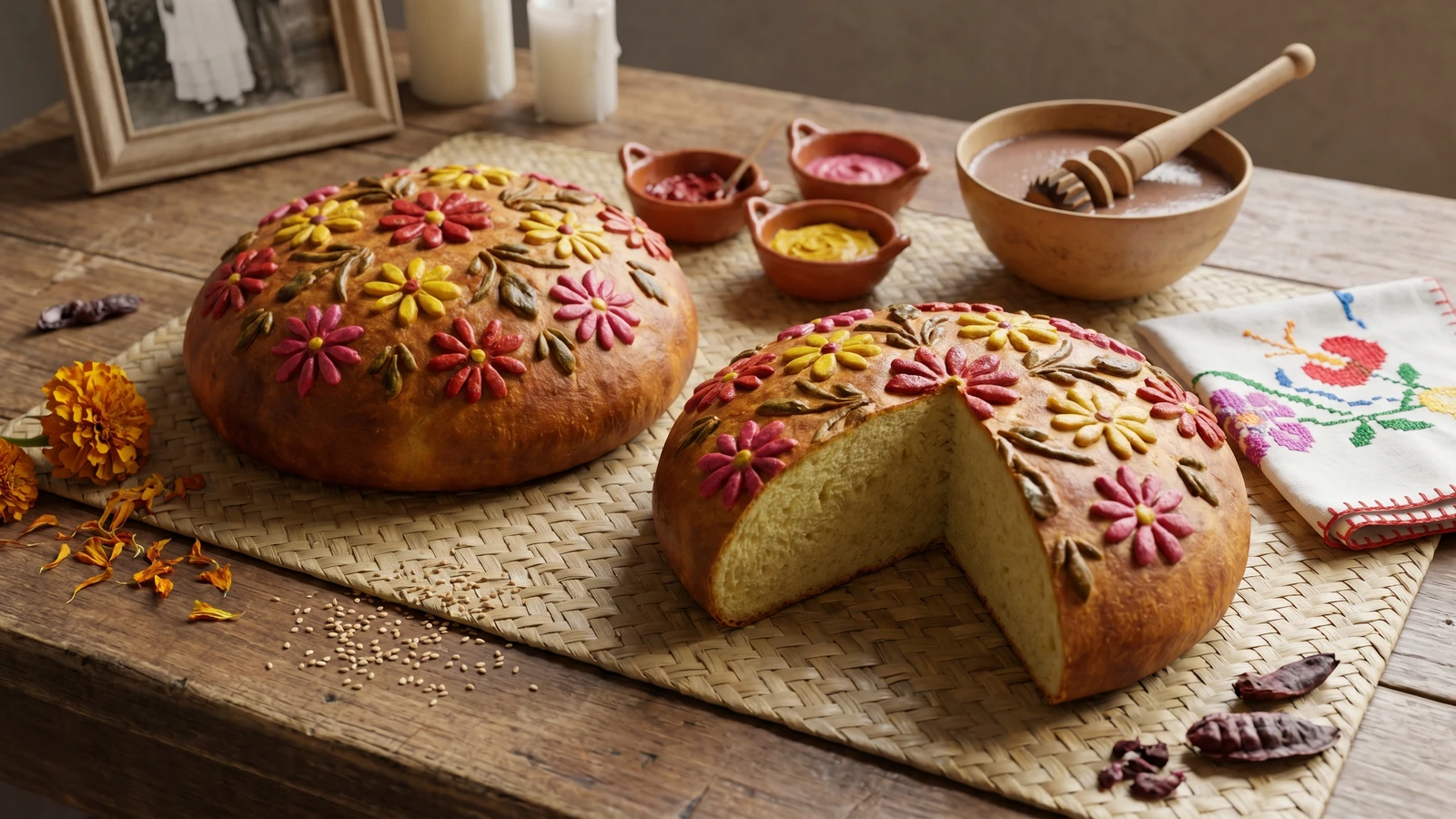
From the Mercado Alarii in Zaachila, a dense yeasted bread embroidered in red, yellow, and pink vegetable petals: a Zapotec textile rendered in dough for Dia de Muertos.
This bread is from Zaachila. Specifically from the Mercado Alarii, the Friday market in the old Zapotec town just south of Oaxaca city, where the panaderas have been pressing pan resobado for the Dia de Muertos season for as long as anyone in the valley can remember. This is not Mexico City pan de muerto. There is no cross-bone shape, no sugar dome, no orange-glaze finish. The Mexico City version is the one the rest of the world knows. The Zaachila version is the one Oaxaca knows.
What makes this bread is the embroidery. Small pieces of dough, pressed into red from grana cochinilla, yellow from cempasuchil, pink from palo de Brasil, applied by hand in the shape of flowers across the round flat surface of the loaf. The panaderas at Mercado Alarii work without stencils. They embroider from memory the same way the Zapotec weavers in Teotitlan del Valle embroider their textiles, and the visual reference is not accidental. The bread is a textile in dough form. Cada estado, su propia cocina, and Oaxaca's Dia de Muertos bread tradition is its own world.
The dough is called resobado because you knead it and knead it and knead it again. The lard, the butter, the egg yolks, all of that fat needs to be worked until the dough turns silky. There is no shortcut. A stand mixer can begin the work but the finishing twenty minutes belong to your hands. La manteca es el sabor and the long kneading is what gives this bread its dense, even crumb that holds the petal applications in place through the bake.
My mother's notebook had no Oaxacan recipes. She was a Jalisco cook to the bone. I learned this bread from Senora Margarita, a panadera at Mercado Alarii who has been baking pan resobado for thirty-eight years. She told me the first thing you have to understand is that this is bread for the dead. The cempasuchil yellow is the flower they follow home. The red is blood and life. The pink is rosa de Castilla, the saint's flower. You are not decorating a loaf. You are setting a table for the people you have lost. No me vengas con atajos.
Pan resobado de Zaachila descends from the convergence of pre-Columbian Zapotec offering breads, made from amaranth and corn for ancestor rituals, with the wheat-flour panaderia tradition introduced by Dominican friars in the 16th century. The town of Zaachila itself was the last capital of the Zapotec kingdom before the Mexica conquest, and its Mercado Alarii (the name comes from the Zapotec word for marketplace) is one of Oaxaca's oldest continuously operating markets. The flower-petal embroidery technique on the loaves draws directly from the iconography of Zapotec textile weaving in nearby Teotitlan del Valle, and the use of grana cochinilla, the cochineal insect cultivated in Oaxaca since pre-Columbian times for red dye, anchors the bread in a specifically Oaxacan pigment tradition that once supplied dye to royal European courts.
Quantity
1 kilogram (about 8 cups)
plus more for the artesa
Quantity
300 grams (about 1 1/2 cups)
Quantity
10 grams (about 1 tablespoon)
Quantity
20 grams (about 2 tablespoons)
Quantity
8
Quantity
2
Quantity
200 grams (about 7/8 cup)
softened to room temperature
Quantity
100 grams (about 7 tablespoons)
softened
Quantity
300 milliliters (about 1 1/4 cups)
warmed to body temperature
Quantity
1 tablespoon
lightly toasted on a comal
Quantity
1 teaspoon
lightly crushed in a molcajete
Quantity
from 1 orange
finely grated
Quantity
1 tablespoon
freshly ground
Quantity
1
beaten with 1 tablespoon milk
Quantity
50 grams
Quantity
50 grams
Quantity
30 grams
Quantity
20 grams
Quantity
60 milliliters (about 1/4 cup)
Quantity
about 200 grams
| Ingredient | Quantity |
|---|---|
| all-purpose flourplus more for the artesa | 1 kilogram (about 8 cups) |
| granulated sugar | 300 grams (about 1 1/2 cups) |
| fine sea salt | 10 grams (about 1 tablespoon) |
| instant yeast | 20 grams (about 2 tablespoons) |
| large egg yolks | 8 |
| whole eggs | 2 |
| manteca de cerdo (pork lard)softened to room temperature | 200 grams (about 7/8 cup) |
| unsalted buttersoftened | 100 grams (about 7 tablespoons) |
| whole milkwarmed to body temperature | 300 milliliters (about 1 1/4 cups) |
| ajonjoli (sesame seeds)lightly toasted on a comal | 1 tablespoon |
| anis seedlightly crushed in a molcajete | 1 teaspoon |
| orange zestfinely grated | from 1 orange |
| canela molida (Mexican cinnamon)freshly ground | 1 tablespoon |
| egg, for the egg washbeaten with 1 tablespoon milk | 1 |
| red vegetable colorant (grana cochinilla or rojo vegetal) | 50 grams |
| yellow vegetable colorant (cempasuchil powder or azafrancillo) | 50 grams |
| pink vegetable colorant (palo de Brasil or rosa vegetal) | 30 grams |
| white powder (almidon de maiz) | 20 grams |
| water for mixing colorants | 60 milliliters (about 1/4 cup) |
| reserved bread dough for petal applications | about 200 grams |
Pan resobado is a worked dough. Resobar means to knead and knead and knead again. Before you start, clear a long wooden table or counter, what the panaderas in Zaachila call the artesa. Have everything weighed and ready: the flour in a heap, the sugar and salt to one side, the yeast in its own bowl, the lard and butter softened to where you can press your finger through them. Cold lard will not incorporate. Cold butter will tear the dough. Asi se hace y punto.
Warm the milk to body temperature. Not hot. If you can hold your finger in it without flinching, it is right. Pour into a bowl and stir in the yeast and a tablespoon of the sugar from the recipe. Let it sit for ten minutes until it foams and smells like beer. If it does not foam, the yeast is dead and so is your bread. Start over with new yeast.
Mound the flour on the table. Make a well in the center, the way the panaderas of Mitla and Tlacolula have done it for generations. Into the well go the egg yolks, the whole eggs, the rest of the sugar, the salt, the orange zest, the canela, the toasted ajonjoli, and the crushed anis. With your fingertips, beat the eggs and sugar together inside the well. Pour in the foamed yeast mixture. Begin pulling flour from the inside walls of the well into the wet center, working in spirals. The dough will come together shaggy and sticky.
Once the dough has pulled together, work in the softened lard first and then the butter, a spoonful at a time. The dough will fight you. It will look broken. Keep working. This is where pan resobado earns its name. Lift, slap on the table, fold, push with the heels of your hands. Twenty minutes of honest kneading, minimum. The dough will go from shaggy to smooth to silky. When you press a finger into it and it springs back slowly, you are done. La cocina no es decoracion, es trabajo.
Set aside about 200 grams of the dough in a separate bowl, covered, for the petal work. Place the rest in a large bowl rubbed with a little manteca. Cover with a damp cloth servilleta. Let rise in a warm corner of the kitchen for two to three hours, until doubled. Oaxacan kitchens are warmer than most. If yours is cool, set the bowl near the comal or in a barely-warm oven.
While the dough rises, prepare the colors. Each colorant goes in its own small clay bowl, a barro rojo cazuelita is traditional. Add water a teaspoon at a time and stir with the back of a spoon to make a thick paste, like the slip a potter uses. The red from grana cochinilla will stain your fingers. The yellow from cempasuchil smells of marigold and the dead. The pink from palo de Brasil is the deepest of the three. Set them in a row alongside the reserved dough. These are the threads with which you embroider the bread.
Punch down the risen dough on a lightly floured surface. Divide in two. Shape each half into a tight round, tucking the seams underneath until the surface is taut. Place each loaf on a sheet pan lined with parchment or, if you have one, on a hand-woven petate. Press each loaf down gently to about three centimeters thick. The bread is wider than it is tall. This is not Mexico City pan de muerto. There is no bone shape, no cabecita on top, no sugar dusting. The flat round surface is your canvas.
Now the work that gives this bread its name and its meaning. Tear small pieces from the reserved dough. Roll them into thin coils, oval pads, and tiny droplets between your palms. Press one side of each shape into a colorant paste. Arrange them on top of the loaves in the patterns of the flowers your family or your town remembers: cempasuchil with yellow petals around a red center, rosa de Castilla in pink, the field flowers of the Valles Centrales. The panaderas of Mercado Alarii work without templates. They embroider from memory. Every loaf is different, the way every textile from a Zapotec weaver is different.
Cover the decorated loaves loosely with a damp cloth, careful not to disturb the petal work. Let them rise again for one to one and a half hours, until visibly puffed but not doubled. Pan resobado does not want a high domed crumb. The dense, even crumb is part of what holds the petal embroidery in place during the bake.
Heat the oven to 170 degrees Celsius (340 Fahrenheit). Lower than most bread recipes. The lower temperature lets the enriched dough cook through without scorching the surface or burning the vegetable colorants, which turn brown if the heat is too aggressive. Brush the exposed dough surface, between the petals, very gently with the egg wash. Bake for 40 to 45 minutes, until the bread is deep golden between the petals and the bottom sounds hollow when you tap it. The petals will set in their colors but darken slightly. That is correct.
Let the loaves cool completely on a wire rack before cutting. Pan resobado is a dense bread by design, and cutting into it warm will tear the crumb. Serve in thick slices alongside chocolate de agua frothed with a molinillo, or set whole on the ofrenda for the days the dead come home. In Zaachila this bread sits beside the cempasuchil and the photographs and the candles, and it is eaten by the living the morning after, when the dead have taken what they came for. Saber cocinar es saber vivir.
1 serving (about 210g)
Culinary guides, cultural storytelling, and the editorial depth that makes cooking meaningful.
Discover Culinary ExplorerChef Lupita
Guanajuato's daily bread from Acámbaro, a small glazed roll built on pata, enriched with manteca de cerdo, and baked until the top shines lightly for merienda.

Chef Lupita
Michoacan's Tinguindin aguacatas are flat, leaf-scored sweet breads made with harina de trigo, piloncillo, anise, and manteca de cerdo, shaped by hand for the wood oven.

Chef Lupita
From Ajijic on Lake Chapala, Pan Tachihual is a lightly sweet wedding loaf built with harina de trigo, harina de maiz, piloncillo, manteca, anise, and the old Guadalajara pata.

Chef Lupita
Comitán's pan de yema shaped into little pigs, birds, and rabbits, a Chiapas bakery bread rich with egg yolks, manteca de cerdo, and anís, baked golden on hoja de plátano.